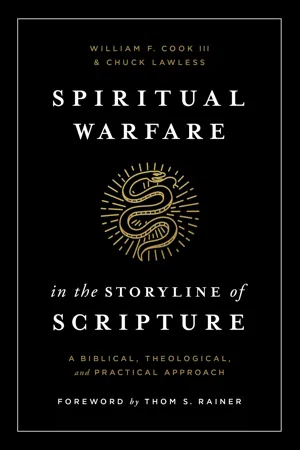
In Spiritual Warfare in the Storyline of Scripture, authors Bill Cook and Chuck Lawless provide a comprehensive study of a topic that is of key importance in the life of every believer. Surveying and analyzing incidents of spiritual warfare from Genesis through Revelation, the authors create a biblical framework for understanding the reality of Satan’s on-going assault on humankind. Building on that framework, Spiritual Warfare in the Storyline of Scripture also offers practical insights into some of Satan’s most common attacks on believers, and strategies for how we might stand against his onslaught. Readers of this book will gain a more complete understanding of what the Bible teaches about spiritual warfare in order to live in victory, confident that Satan is an enemy who has already been defeated.
eBook - ePub
Spiritual Warfare in the Storyline of Scripture
A Biblical, Theological, and Practical Approach
- 368 pages
- English
- ePUB (mobile friendly)
- Available on iOS & Android
eBook - ePub
Spiritual Warfare in the Storyline of Scripture
A Biblical, Theological, and Practical Approach
About this book
Information
Print ISBN
9781433648304

Biblical and Theological Foundations
Chapter 1
Spiritual Warfare in the Old Testament
The opening two chapters of the Bible describe in the most beautiful language imaginable God’s creation of heaven and earth. In a similar way, the Bible culminates with a magnificent description of the new heaven and new earth (Revelation 21–22).1 Between the Bible’s opening and closing chapters, it depicts a war being fought on a cosmic scale—a war fought between God and the devil. This war is played out both in the spiritual realm and on the earth. It is not a fair fight, however, because the war is not between two equals—the outcome is never in doubt. From the very beginning, the doom of God’s archenemy, the devil, is certain (Gen 3:15). God’s wisdom is demonstrated in his inscrutable plan to redeem humanity from their sin and establish a new heaven and earth.
Satan and demons are not mentioned many times in the Old Testament.2 From a canonical perspective, however, their work is evident. Satan’s initial attack against humanity takes place in the most idyllic setting humankind has ever known—the garden of Eden—and his decisive defeat will take place on a hill called Golgotha. Like a wounded animal, he continues to attack humanity until hurled into the lake of fire to accuse us no more. After Christ’s death and resurrection, there are many skirmishes and battles to be fought, but the victory has already been won (Col 2:15).
The Pentateuch
Satan is not mentioned by name in the Pentateuch. In addition, demons are specifically mentioned in only one passage. From a canonical perspective, it seems evident that the devil is to be associated with the serpent in Genesis 3. It is possible that “the sons of God” in Genesis 6 should be understood as fallen angels. These are two of the three passages in the Pentateuch that receive attention in what follows.
Genesis: The Battle Begins
The description of creation in Genesis 1 is followed in chapter 2 by an elaboration on the sixth day with the creation of Adam and Eve. At the end of these two chapters, it is clear God is the sovereign Lord over all. The created world is a place where God can have an intimate and personal relationship with humanity. Genesis 2 concludes by highlighting the innocence of Adam and Eve: “Both the man and his wife were naked, yet felt no shame” (Gen 2:25). In the opening of chapter 3, the narrator contrasts Adam and Eve’s innocence (2:25) with the serpent’s cunning nature (3:1).
Genesis 3:1–19: The Fall
It is an understatement to say that this passage is of central importance to a study on spiritual warfare. In a very real sense, it is foundational to all that follows in the Bible. The passage leaves students of the Bible with many unanswered questions: Should the serpent be equated with Satan? If the serpent is in some way Satan, why did he use a serpent? When did Satan fall? Why isn’t the woman surprised that the snake can talk? Did Eve know God’s commandment about not eating from the tree in the middle of the garden from God or only from Adam? If Adam was there during the conversation between Eve and the serpent, as it appears, why did he not keep her from eating the fruit? Although there are many unanswered questions about the passage, it gives us enough information to understand what took place and the consequences.
With stunning brevity, the author describes humankind’s fall into sin, their expulsion from the garden, and the promise of the hope of coming victory through the seed of the woman. The passage can be divided into three sections: the serpent’s questioning of God’s Word and Eve’s quick reply (3:1–3); the serpent’s blatant contradiction of God’s Word, his defamation of God’s character, and the couple’s fall into sin (3:4–7); and God’s declaration of punishment on Adam, Eve, and the serpent (3:8–19).3
The serpent’s sudden and unexplained appearance presents an unexpected challenge to the couple’s loyalty to God. While strictly speaking, the term “cunning” (ʿārûm) can be used in a positive sense,4 here it is clearly used negatively (3:1a).5 The serpent wasted no time getting to work by initiating a conversation with the woman and calling into question God’s Word (3:1b). The serpent was not only cunning, and wicked, but exceedingly diabolical.6
Eve did not hesitate to reply to the serpent’s challenge of God’s Word (3:2). While she repeated what God had said in a general way, her response reveals three important differences from what God said (cf. 2:16–17).7 First, she minimized God’s generosity. God said, “You may freely eat” (NLT), but the woman said, “We may eat” (3:2). Second, she added to God’s prohibition the thought that they must not “touch it.” Third, she weakened slightly the certainty of God’s punishment if they ate of the fruit. God had said that if they ate from the tree, they would “certainly die.” Eve said, “lest you die” (NRSV). While the changes to what God said seem insignificant, they reveal something about Eve’s failure to take seriously God’s words to them.
The serpent, perceiving an opening when it heard how Eve had weakened God’s promise of punishment, blatantly contradicted God’s Word and defamed God’s character (3:4–5). Author and Old Testament professor Allen P. Ross put it well: “Here is the lie that has allured the human race from the beginning (see John 8:44): there is no punishment for disobedience. But the Bible again and again makes it clear . . . disobedience brings death.”8 Their response to the serpent’s enticement indicated their desire to become divine, although being led by a subordinate is “a curious way to achieve divinity.”9 One recalls how Adam named the animals, indicating his superiority to them (2:19–20). Furthermore, the couple forgot they were created in God’s image (1:26–27).
The narrator describes both the sin’s appeal (3:6a), as well as their actual commission of it (3:6b): “When the woman saw that the tree was good for food, and that it was a delight to the eyes, and that the tree was desirable to make one wise, she took from its fruit and ate; and she gave also to her husband with her, and he ate” (NASB). Kidner comments insightfully that while the verbs “take” and “eat” describe very simple actions, those acts required a costly response by God—the death of Jesus.10
While Adam and Eve did not experience immediate physical death, they were cast from the garden and cut off from God’s manifest presence—no longer having the close fellowship previously experienced. Dislocated from the Author of life, their lives would now be filled with hardship, suffering, and ultimately physical death. The work of the tempter was now finished. The serpent had convinced Adam and Eve that God could not be trusted to do what was best for them.
God confronted Adam as the couple, ashamed of their nakedness, attempted to hide from him (3:8–13). It is interesting that God is described as seeking them out (3:8). God began with Adam, asking him two questions. The first question is put rhetorically: “Where are you?” His second question was intended to force Adam to acknowledge his sin: “Did you eat from the tree that I commanded you not to eat from?” Adam responded to God by immediately turning on Eve (3:12). Rather than taking responsibility for his sin, he shifted the blame to her.
God next turned his attention to Eve, asking her, “What is this you have done?” She followed in Adam’s footsteps and sought to shift the blame to the serpent (3:13). While she ultimately confessed her sin, she made the point that the serpent had “deceived” her; thus, she minimized her sin in comparison with the deceiver’s. Deception is nothing less than causing someone to believe a lie. It would become one of the most important weapons in Satan’s arsenal (cf. John 8:44).
In Gen 3:14–19, the devastating consequences for their sin are delineated. God began in reverse order, starting with the serpent and finishing with Adam. God’s curse of the serpent would result in a perpetual conflict between the woman’s seed and the serpent’s seed. God’s words seem to go beyond a mere snake and refer to Satan and his demons (“offspring”). God’s point is that there will be a perpetual war between satanic forces and humankind (3:15a). The immediate offspring of the woman would be Cain, then all humankind, but ultimately Jesus Christ (3:15b). Christ would be the one to deliver the fatal blow by crushing the serpent’s head after Satan bruised his heel.11
God turned next to Eve and then to Adam (3:16–19). The consequences of their sin were devastating. While they once experienced abundant life, they now faced a certain death. They had once experienced nothing but pleasure; now, heartache and pain. God’s abundant provision and enjoyable work were replaced by meager subsistence and labor. Worst of all, intimacy with God and one another was replaced by alienation, conflict, and loneliness.
This passage highlights several matters about spiritual warfare that are repeated throughout the Bible. First, Satan came disguised as a serpent. Paul warned the Corinthian church that Satan often comes in camouflage, even as an angel of light (2 Cor 11:14). Jesus compared false prophets to “ravaging wolves” in sheep’s clothing (Matt 7:15). Satan seldom appears “like a roaring lion” seeking someone to devour (1 Pet 5:8), or a thief, who comes only to steal, kill, and destroy (John 10:10)—though these describe him.12 He is as cunning as a serpent.
Second, although in the future the outcome of the conflict may seem at times to be in doubt, the certainty of God’s victory is established in the very beginning. God’s declaration of the serpent’s punishment reveals God’s sovereignty over the serpent. Commonly known as the protoevangelium, Gen 3:15 announces God’s ultimate victory at the fall.
Third, Adam and Eve’s sin demonstrates the absolute necessity of knowing God’s Word. A chief strategy of Satan’s will be to distort God’s Word. Heretical teachings and challenges to the truthfulness of God’s Word originate with the serpent. Fourth, just as the serpent convinced Adam and Eve that God could not be trusted, he will seek to convince humankind that they must look out for themselves because if God does exist, he certainly cannot be trusted.
Finally, while Adam and Eve ate from a forbidden tree, Jesus would one day die on a forsaken tree (Deut 21:23). Adam and Eve received a curse for their sin, but Jesus became a curse for others’ sins (Gal 3:13). When Adam and Eve died, their bodies returned to the dust; when Jesus died, he was resurrected (Luke 24:6)—truly a paradoxical strategy to win a cosmic conflict!
Genesis 6:1–4: The Sons of God
By the time readers of Genesis reach chapter 6, they find humanity falling into g...
Table of contents
- Foreword
- Acknowledgments
- Introduction
- Part One: Biblical and Theological Foundations
- Part Two: Practical Application
- Subject Index
- Scripture Index
Trusted by 375,005 students
Access to over 1.5 million titles for a fair monthly price.
Study more efficiently using our study tools.