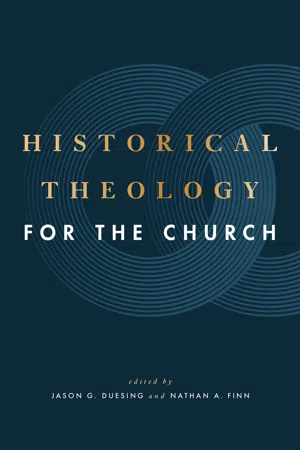
In Historical Theology for the Church, editors Jason Duesing and Nathan Finn bring together top contributors to survey key doctrinal developments in every era of church history. They not only trace the development of various doctrines within historical congregations; they also provide a resource for contemporary congregations. Steered by the conviction that historical theology serves the church both local and global, each chapter concludes with an application section that clarifies the connection between the historical doctrine being covered and the Christian church today.
eBook - ePub
Historical Theology for the Church
- 368 pages
- English
- ePUB (mobile friendly)
- Available on iOS & Android
eBook - ePub
Historical Theology for the Church
About this book
Information
Topic
Teología y religiónSubtopic
Teología cristianaUnit Four
Theology in the Modern Era, AD 1700–2000
11
Scripture and Authority
Introduction
The theological disruption of the Reformation extended into the modern era, the beginnings of which can be dated to around 1700. By this time, Western Europe had witnessed the advent of nation-states, many of which were characterized by the gradual waning of ecclesial influence over the state. Explorers had claimed lands in the Western Hemisphere for various European powers, normally staking claims for various Christian churches as well (especially the Roman Catholic Church). Protestants continued to subdivide into proto-denominational movements committed to various versions of Reformational theology and practice, sometimes including national loyalties. Meanwhile, Catholics tried to navigate a post-Reformation Europe marked by increasing pluralism among professed Christians. Eastern Orthodoxy remained mostly confined to eastern Europe and northern Asia, largely isolated from these trends until the nineteenth century.
Arguably, no single doctrine was subject to greater revision during the modern era than bibliology (the doctrine of Scripture). At the very least, revisionist views of Scripture were uniquely important; one’s view of the inspiration, authority, and interpretation of the Bible necessarily affects how one conceives every other doctrine. When it comes to Scripture (and many other topics), one could even interpret modernity as an ever-evolving crisis of authority and the various responses to that crisis. This chapter will focus on developments related to biblical inspiration, authority, and interpretation during the past three centuries.
Historical Overview
Enlightenment and Romanticism
The eighteenth century is often referred to as the Age of Reason, or the Enlightenment, because of the advent of new philosophical assumptions that dramatically influenced the transatlantic intellectual world. In reality, though the Enlightenment dates to the seventeenth century, there was no single Enlightenment—and scholars do not agree in their interpretations of various versions of the Enlightenment. Furthermore, contrary to popular understanding, not all theologians (even the more conservative) perceived the Enlightenment as a threat to the faith. Many Christian thinkers embraced certain Enlightenment emphases to help buttress their understandings of orthodoxy.
Despite these caveats, it is true that a number of Enlightenment currents did present challenges to traditional understandings of Christian thought, including the doctrine of Scripture. Many Enlightenment thinkers from René Descartes (1596–1650) forward sought rational certainty and championed the omnicompetence of autonomous human reason, setting reason in opposition to faith. This was a far cry from the Augustinian commitment to “faith seeking understanding,” which animated theological inquiry for well over a millennium. Some thinkers, such as the English deist Matthew Tindal (1657–1733), went so far as to reject the very conception of special revelation, opting for natural revelation alone. Others such as Scottish philosopher David Hume (1711–1776) went further and endorsed religious skepticism, denying the reality of the supernatural. Revisionist views of Scripture coincided with, and reinforced, revisionist understandings of doctrines such as human sinfulness, miracles, the Trinity, and the person and work of Jesus Christ. These revisionist doctrines were in turn embraced by heretical forms of Christianity such as Deism, Unitarianism, and Universalism.
Although many Enlightenment thinkers still claimed the Christian faith as their own, their assumptions about the relationship between reason and faith fed the argument that the Bible is not the inspired written words of God but rather the words of pious men. The most famous was philosopher Immanuel Kant (1724–1804), who sought to rescue Christianity from skepticism, but at the expense of the inspiration of Scripture. By making a distinction between “pure” (rational) reason and “practical” (moral) reason, and relegating matters of religion to the latter, Kant contended the value of Scripture was limited to ethics and morality.
Enlightenment views of Scripture were widely held by leaders of the American and French Revolutions. American founding fathers such as Benjamin Franklin (1706–1790), John Adams (1735–1826), and Thomas Jefferson (1743–1826) were Protestant “theistic rationalists” who imbibed of Deist and sometimes Unitarian thought, while still deeply valuing the role of the Bible in forming personal and civic virtue. (Jefferson famously published an edited version of the New Testament in 1820 that excluded all the miracles and references to Jesus’s divinity.) In France, leaders such as Voltaire (1694–1776) and Maximilien Robespierre (1758–1794) embraced a more radical skepticism, leading to an anti-Christian posture that revolted against the Ancien Régime’s commitment to Catholicism, replacing it with a state-sponsored atheism that prevailed until Napoleon Bonaparte (1769–1821) came to power and restored nominal relations with Rome.
Some thinkers reacted to the Enlightenment, most notably the proponents of Romanticism. As with the Enlightenment, Romanticism is a debated term that defies scholarly consensus. Nevertheless, by the end of the eighteenth century, a number of philosophers had grown unhappy with Enlightenment rationalism but also refused to embrace historic Christian orthodoxy. They valued human feelings and emotions over rational autonomy and emphasized the subjective elements of religion over objective truth claims. The upshot of Romanticism was a Bible that might well be inspirational but that should not be considered inspired in the sense that pre-modern theologians affirmed.
The Historical-Critical Method
During the premodern era, theologians practiced a variety of strategies of biblical interpretation, many of which you have read about in previous chapters. What these approaches had in common was a belief that the Bible is God’s inspired written Word. As such, Scripture is authoritative and trustworthy, reflecting God’s own character. This changed with the advent of modernity and its revisionist views of the Bible. Many theologians now believed the Bible to be a thoroughly human book, that it should be interpreted like any other book, and that its historical and scientific truthfulness should not be assumed.
Modern assumptions about the doctrine of Scripture gave rise to the historical-critical method of interpretation (also called higher criticism). The historical-critical method focused more on the historical circumstances that ostensibly gave rise to the biblical text rather than the content of the text itself. History (and later science), rather than the text of Scripture or church tradition, functioned as the determinative factor in biblical interpretation. This approach also meshed well with the Enlightenment emphasis on human autonomy, which championed individual conclusions over communal or churchly interpretations. For modern critical interpreters, the connection between biblical reflection and theology was severed, or at least stretched to the point of great tension.
One result was the so-called first quest for the historical Jesus, which began in the mid-eighteenth century. Scholars such as Hermann Reimarus (1694–1768), David Friedrich Strauss (1808–1874), and their successors embraced higher critical assumptions and attempted to reconstruct the life of Jesus without the supernaturalist worldview of the New Testament authors. For these scholars, the Bible contained many things about Jesus that were likely true, but biblical phenomena needed to be verified externally to validate its authenticity. The twentieth century witnessed two more quests for the historical Jesus, both of which included voices more and less sympathetic to inspired Scripture than the original questers.
A second result of the historical-critical method was the documentary hypothesis, identified especially with German scholar Julius Wellhausen (1844–1918). Proponents of this view rejected the primary Mosaic authorship and unified message of the Pentateuch, arguing instead that the canonical biblical material represented four different sources that were edited and combined over a period of about three centuries. Other Old Testament critical scholars argued that Daniel was authored in the second century BC rather than the more traditional fifth century, and contended that Isaiah was written by two or three authors, sympathetic to some of the same traditions that authored portions of the Pentateuch.
The evolutionary theory popularized by Charles Darwin (1809–1882) served to reinforce the historical-critical method in the mind of many scholars. With this theory in mind, critical scholars now had further reason to doubt supernaturalist biblical accounts of creation. Some traditionalist scholars attempted to synthesize aspects of evolution with Scripture, while others rejected evolution in principle as being incompatible with the Bible. Evolution proved to be more controversial than the historical-critical method itself, in part because the former was more widely known among everyday Christians, while the latter was mostly a debate confined to scholars and ministers.
Fundamentalist-Modernist Controversies
By the turn of the twentieth century, Protestant theologians were divided between traditionalists, progressives, and mediating theologians who tried to find a middle way. The traditionalists took on the name “fundamentalists” following the publication of a twelve-volume series of pamphlets titled The Fundamentals: A Testimony to Truth (1910–1915). Though they were divided by denominational differences and classical debates over matters such as election and baptism, fundamentalists saw themselves as a loose-knit movement that argued for traditional views on the very fundamental doctrines that had become contested in the modern era.
In their view of Scripture, most fundamentalists argued that every word of the original manuscripts was inspired by God (verbal-plenary inspiration) and that Scripture, when rightly interpreted, was fully trustworthy, even in matters of history and science (biblical inerrancy). In these views, they drew on the insights of post-Reformation theologians, as well as nineteenth-century theologians such as Charles Hodge (1797–1878) and Basil Manly Jr. (1825–1892). Although some fundamentalists such as John R. Rice (1895–1980) argued that God divinely dictated the words of Scripture to the biblical authors, most theological conservatives (and all the key theologians) argued that the Scriptures represented a concurrence of the Holy Spirit’s divine inspiration and the words freely chosen by the original authors. This followed the trajectory established by Hodge at Princeton Theological Seminary. (See the case study that follows.)
Contra the fundamentalists, modernists embraced critical views of Scripture. In many cases, this led to a rejection of biblical miracles, a redefinition of human sin and the atonement, and a downplaying of salvation through Christ alone. The father of theological modernism was Friedrich Schleiermacher (1768–1834), who put forward a critical-romantic synthesis of the Christian faith that was intended to defend the validity of Christianity against modern skepticism. In his influential book On Christian Faith, Schleiermacher argued that reflection on the human experience of dependence on God, rather than appeal to God’s revelation in Scripture, was the heart of theological inquiry. Roger Olson calls this a “Copernican revolution” in the history of doctrine. Scholars and pastors such as William Newton Clarke (1841–1912), Adolf von Harnack (1851–1930), Shailer Mathews (1863–1941), and Harry Emerson Fosdick (1878–1969) advanced the modernist cause into the twentieth century. By the postwar era, modernists were increasingly called liberals. Today the term progressive is another common label for this theological trajectory.
In the period between World War I and World War II, many of the major Protestant denominations split over debates between fundamentalists and modernists. In most cases, modernists and their mediating allies maintained control of the denominations. Fundamentalists either formed new denominations or (more often) cooperated through interdenominational networks of schools, mission boards, and publishing houses. Verbal-plenary inspiration and biblical inerrancy remained hallmarks of fundamentalism, especially among scholars and educated ministers. Postwar evangelicals (discussed below) also embraced this view of Scripture, even as they distanced themselves from fundamentalists for other reasons.
Neoorthodoxy
Modernists controlled what became known as mainline Protestantism in North America and most of the state churches in Europe. Many continued to advance liberal views of Scripture. For example, the influential biblical scholar Rudolf Bultmann (1884–1976) argued for the “demythologization” of the Bible in favor of a focus on an ethical gospel compatible...
Table of contents
- Introduction
- Unit One: Theology in the Patristic Era, AD 100–500
- Unit Two: Theology in the Medieval Era, AD 500–1500
- Unit Three: Theology in the Reformation Era, AD 1500–1700
- Unit Four: Theology in the Modern Era, AD 1700–2000
- Conclusion
- Contributors
- Name Index
- Subject Index
Trusted by 375,005 students
Access to over 1.5 million titles for a fair monthly price.
Study more efficiently using our study tools.
Frequently asked questions
Yes, you can cancel anytime from the Subscription tab in your account settings on the Perlego website. Your subscription will stay active until the end of your current billing period. Learn how to cancel your subscription
No, books cannot be downloaded as external files, such as PDFs, for use outside of Perlego. However, you can download books within the Perlego app for offline reading on mobile or tablet. Learn how to download books offline
Perlego offers two plans: Essential and Complete
- Essential is ideal for learners and professionals who enjoy exploring a wide range of subjects. Access the Essential Library with 800,000+ trusted titles and best-sellers across business, personal growth, and the humanities. Includes unlimited reading time and Standard Read Aloud voice.
- Complete: Perfect for advanced learners and researchers needing full, unrestricted access. Unlock 1.5M+ books across hundreds of subjects, including academic and specialized titles. The Complete Plan also includes advanced features like Premium Read Aloud and Research Assistant.
We are an online textbook subscription service, where you can get access to an entire online library for less than the price of a single book per month. With over 1.5 million books across 990+ topics, we’ve got you covered! Learn about our mission
Look out for the read-aloud symbol on your next book to see if you can listen to it. The read-aloud tool reads text aloud for you, highlighting the text as it is being read. You can pause it, speed it up and slow it down. Learn more about Read Aloud
Yes! You can use the Perlego app on both iOS and Android devices to read anytime, anywhere — even offline. Perfect for commutes or when you’re on the go.
Please note we cannot support devices running on iOS 13 and Android 7 or earlier. Learn more about using the app
Please note we cannot support devices running on iOS 13 and Android 7 or earlier. Learn more about using the app
Yes, you can access Historical Theology for the Church by Jason G. Duesing, Nathan A. Finn, Jason G. Duesing,Nathan A. Finn in PDF and/or ePUB format, as well as other popular books in Teología y religión & Teología cristiana. We have over 1.5 million books available in our catalogue for you to explore.