Perspectives on Church Government presents in counterpoint form the basic models of church government which have developed over the course of church history with a view toward determining which is most faithful to Scripture. Each chapter will be written by a prominent person from within each tradition—with specific guidelines dealing with the biblical, historical, and theological issues within each governance tradition. In addition, each writer will have the opportunity to give a brief response to the other traditions.
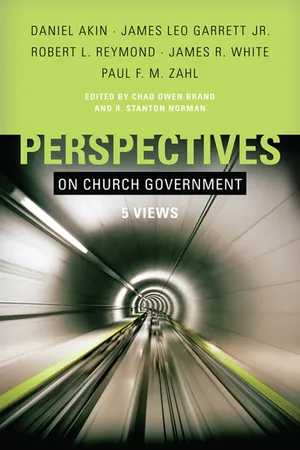
- 368 pages
- English
- ePUB (mobile friendly)
- Available on iOS & Android
eBook - ePub
About this book
Information
Topic
Theology & ReligionSubtopic
Christian ChurchCHAPTER 1
__________________________________________________
The Single-Elder-Led
Church
The Bible's Witness to a
Congregational/Single-Elder-Led Polity
__________________________________________________
DANIEL L. AKIN
Single-pastor Congregationalism is often a sight to behold. It is not necessarily a pretty one. A somewhat paranoid autocrat as pastor, monthly business meetings dedicated to senseless issues that only eat up time, a committee structure that looks like the Department of Education and is about as efficient, and a deacon board that functions like a carnal corporate board. My fellow contributors, I am sure, will be quick on the draw and point out how unbiblical such a model is. They are 100 percent right! It is unbiblical, but this is not what the Bible teaches about Congregational church government. What we discover in God's Word is altogether different.
A study of Scripture provides a number of snapshots of the early church doing church. A number of ecclesial patterns emerge, and specific commands appear periodically as well. Still, the New Testament does not provide a precise manual on how the structure of church government should be organized. Some would even agree with the skeptical judgment of Eduard Schweizer, who said, “There is no such thing as the New Testament church order.”1 I understand why some persons draw this conclusion, but I believe it to be unwarranted and unnecessary. While there is no precise manual on church government and polity, a survey and analysis of the biblical material reveals definite patterns and discernable guidelines on how the churches in the New Testament functioned.
In broad terms there are five forms of church government or polity: Episcopal (Roman Catholics, Anglicans/Episcopalians, Methodists), Presbyterian, Congregational (Baptists, Congregationalists, some Lutherans), Erastian (national state churches), and minimalist or nongovernmental (Quakers, Plymouth Brethren).2 Each of these systems would seem to have positive and even commendable features. Each seeks to highlight particular features found in Scripture. It is likely that in the early stages of the church's history, church government and polity were not highly developed. Local congregations were loosely knit groups. It is extremely probable that there were a variety of church governmental arrangements.3 Each church would have organized itself, taking into consideration its own unique context and situation.
For instance, the apostles had the church in Jerusalem assist them in selecting candidates to serve the widows (Acts 6:3), whereas different circumstances required Paul to have Titus appoint elders on Crete (Titus 1:5). However, as we examine the Scriptures, the evidence leads us to the following position: New Testament churches were basically Congregational in their government and polity. The exact nature of this Congregationalism may have varied, but at its most basic and fundamental level churches were local bodies of baptized believers who operated within the parameters of Congregationalism. Further, there were two and only two offices within each congregation: pastors (elders or bishops) and deacons (Phil. 1:1; 1 Tim. 3:1–13). The Scriptures never specify the required or precise number of either. I am convinced, based on the evidence, that the number of elders or deacons is not the issue but that persons meeting scriptural qualifications is what is crucial. In the context of elders, who is giving leadership and direction to the church is far more important than how many are involved in this assignment.
It is my contention that the New Testament allows flexibility on this point. Both a single elder and a plurality of elders within a Congregational structure fit the pattern of church government and polity that emerges from a study of the New Testament. My assignment is to defend the single-elder view. I do believe, as I have stated, that it is an acceptable and biblically defensible position. I will make that defense in the latter part of this chapter. First, the evidence for Congregationalism will be examined. From there I will analyze the concept of elder. Following that, I will quickly survey relevant historical issues germane to Baptists and in particular the Southern Baptist Convention (the denomination in which I serve). I will then move to make a case for single elder, or better, senior pastor. I will conclude with insights from practical theology and several summary observations.
The Evidence for Congregationalism
Congregationalism locates the authority of the church in each local body of believers. No person or organization is above or over it except the Lord Jesus Christ alone as its head. Saucy summarizes well how this works itself out as each local church conducts its affairs:
Emphasis is upon the democratic structure of the church whereby the ultimate authority is vested in the members themselves. This does not preclude ministers elected in recognition of their divine gifts to serve as leaders, but their authority rests in their relation to the congregation and is generally less extensive in practice than either the Episcopal or Presbyterian ministers. In the ultimate sense, officers have no more ecclesiastical authority than any other member. Each has but one vote on any issue.4
Each and every member has equal rights and responsibilities. However, aspects of representative democracy are not ruled out. Certain persons may indeed be chosen by the body of believers to lead and serve in particular and specific ways. Those who are called to pastor the church immediately come to mind. Striking a delicate but discernable balance, leaders in a local congregation are answerable ultimately to God (Heb. 13:17; James 3:1; 1 Pet. 5:2–4), but they are also responsible to those who have chosen them. Because all believers comprise the priesthood of the New Testament church, no particular group or individual may be interposed between any child of God and the heavenly Father. There is only one mediator between God and mankind, and that mediator is Jesus Christ (1 Tim. 2:5). The humblest believer has direct access to God (Heb. 10:19–22). This equal standing before God would point toward a Congregational form of government. However, this can be abused where the practice of church discipline is absent. The result can be ecclesiastical anarchy and great harm can come to the health, fellowship, and witness of the church.
The Biblical Data
It is my intention to simply walk through the canon of New Testament Scripture as it has been passed down to us and see what picture naturally emerges concerning the operations of first-century churches. We will not tarry at any particular location any longer than is necessary to see what is said about the way the church worked and handled its business.
Matthew 18:15–17
This is the only text in all of the Gospels to use the word “church” (ekklesia). MacArthur is no doubt correct when he states, “Used in a nontechnical sense in Matthew, ekklesia does not specifically refer to the church born at Pentecost, but it certainly anticipates the New Testament church that comes about by the baptism of the Spirit of God in Acts 2. Its immediate application was to the assembly of the disciples who were gathered in the house at Capernaum, but it gives a principle that goes beyond that small assembly and embraces the whole church.”5
The issue is how the believing community is to deal with a sinning brother or sister. The text is straightforward, with the pattern followed being rooted in Deuteronomy 17:6 and 19:15. It is also consistent with other practices of the day.6 Matthew records Jesus as saying, “Moreover if your brother sins against you, go and tell him his fault between you and him alone. If he hears you, you have gained your brother. But if he will not hear, take with you one or two more, that ‘by the mouth of two or three witnesses every word may be established.’ And if he refuses to hear them, tell it to the church. But if he refuses even to hear the church, let him be to you like a heathen and a tax collector” (Matt. 18:15–17 NKJV, emphasis added).
The clear meaning of the text is that the final court of appeal in the exercise of church discipline is the church and “that each member of the church is to abide by the corporate judgment” (emphasis added).7 Mark Dever gets to the heart of the issue when he writes, “Notice to whom one finally appeals in such situations. What court has the final word? It is not a bishop, a pope, or a presbytery; it is not an assembly, a synod, a convention, or a conference. It is not even a pastor or a board of elders, a board of deacons or a church committee. It is, quite simply, the church—that is, the assembly of those individual believers who are the church.”8
Acts 6:1–7
Early in its history the church was confronted with a problem related to the work of the ministry. The issue was how daily distributions for widows should take place and who would be responsible to see that the task was properly accomplished. The fact that the apostles themselves were involved in the way the decision was reached makes what we find all the more remarkable. Verses 2–3 say that the Twelve summoned the multitude of disciples and urged them to “seek out from among you seven men of good reputation...whom we may appoint over this business” (NKJV). Verse 5 reveals that “the saying pleased the whole multitude. And they chose Stephen.” They (the whole multitude) then brought these men before the apostles who “when they had prayed, they laid hands on them” (Acts 6:6 NKJV).
It is not necessary for our discussion to make a decision on whether this is when the office of deacon was instituted. What is important to see is the congregational involvement, initiated by the apostles, in seeking out these men from among themselves to serve. The whole congregation had the responsibility of identifying men who were spiritually qualified for the task of daily distributions to Hebrew and Hellenistic widows. It is instructive to note that they brought these men before the apostles for their commissioning and, apparently, approval. This is a wise strategy that balances congregational participation with pastoral leadership. F. F. Bruce, no Congregationalist, accurately notes, “It was the community as a whole that selected these seven men and presented them to the apostles for their approbation; it was the apostles who appointed them to their office.”9 John Stott adds, “The Twelve did not impose a solution on the church, however, but gathered all the disciples together in order to share the problem with them.”10 In this incident we discover the wisdom of strong pastoral leadership and appropriate congregational involvement. Even the apostles recognized that it was proper to involve the congregation in vital decision-making that would affect the life and ministry of the church.
Acts 11:22
The church at Antioch was predominantly a Gentile congregation. It was also the first and most prominent missionary-sending fellowship in the early days of the church. When the gospel came to Antioch, Jerusalem wanted to help and encourage the work there. Verse 22 informs us that the church in Jerusalem “sent out Barnabas to go as far as Antioch” (NKJV). He was not sent by the apostles or the elders only. The clear indication is that the congregation as a whole sent him.
Acts 14:27
Paul and Barnabas returned to Antioch following the first missionary journey (Acts 13:1–14:28). Upon their return the text says, “Now when they had come and gathered the church together, they reported all that God had done” (NKJV, emphasis added). Their report was evidently not to the leadership only but to the entire congregation.11
Acts 15
This passage records the crucial meeting of the Jerusalem conference that convened to determine the status of Gentiles in the church and issues related to salvation and the keeping of the Law. This text is crucial at a number of points in terms of ecclesiology. Issues of local church autonomy, voluntary cooperation between churches, and church polity all come to light. First, it was the local church at Antioch that sent Paul and Barnabas to Jerusalem (Acts 15:2–3), and it was the local church at Jerusalem that received them along with the apostles and elders (Acts 15:4). Second, the decision by the church at Antioch that sent Paul and Barnabas to Jerusalem to confer with the apostles and elders about the “Gentile question” arose from that church's voluntary initiative. This important problem started from the bottom and moved up. It was not a top-down decision.
Third, though the apostles and elders appropriately convened and led the discussion, “all the multitude...listened” (Acts 15:12, NKJV) to the debate. Fourth, verse 22 points out that “it pleased the apostles, and elders, with the whole church, to send chosen men of their own company” (NKJV, emphasis added) to deliver Paul and Barnabas with the decision reached by the conference at Jerusalem. Fifth, the letter that was sent came from “the apostles, the elders, and the brethren,”12 and it was directed to “the brethren” (the church as a whole) at Antioch (Acts 15:23). Sixth, it was the church as a whole that received the letter (Acts 15:30) and rejoiced over its content (Acts 15:31). In all that took place congregational involvement and action are present at every turn.
Saucy summarizes the entire event quite well: “In all of these important actions there is no hierarchy which rules by its own authority.”13 The Scriptures are quite consistent on this. Further, there is no command to form interchurch unions of any type. There is no instance of control over a local body of believers by any outside organization or individuals. The apostles and their representatives (e.g., Titus) appointed elders for new church starts, gave their judgment, made recommendations and provided advice, but they did not exercise rulership or control.
1 Corinthians 5
The issue is again church discipline (cf. Matt. 18:15–17). A case of sexual immorality had gone unchecked, and Paul was scandalized by the lax behavior and indifferent attitude of the church at Corinth. Paul addressed not the elders, but the congregation as a whole. In p...
Table of contents
- Front cover
- Halftitle
- Frontmatter
- Fulltitle
- Copyright
- Dedication
- Table of contents
- Preface
- Introduction
- Chapter 1
- Chapter 2
- Chapter 3
- Chapter 4
- Chapter 5
- Notes
- Name Index
- Subject Index
- Scripture Index
Trusted by 375,005 students
Access to over 1.5 million titles for a fair monthly price.
Study more efficiently using our study tools.
Frequently asked questions
Yes, you can cancel anytime from the Subscription tab in your account settings on the Perlego website. Your subscription will stay active until the end of your current billing period. Learn how to cancel your subscription
No, books cannot be downloaded as external files, such as PDFs, for use outside of Perlego. However, you can download books within the Perlego app for offline reading on mobile or tablet. Learn how to download books offline
Perlego offers two plans: Essential and Complete
- Essential is ideal for learners and professionals who enjoy exploring a wide range of subjects. Access the Essential Library with 800,000+ trusted titles and best-sellers across business, personal growth, and the humanities. Includes unlimited reading time and Standard Read Aloud voice.
- Complete: Perfect for advanced learners and researchers needing full, unrestricted access. Unlock 1.5M+ books across hundreds of subjects, including academic and specialized titles. The Complete Plan also includes advanced features like Premium Read Aloud and Research Assistant.
We are an online textbook subscription service, where you can get access to an entire online library for less than the price of a single book per month. With over 1.5 million books across 990+ topics, we’ve got you covered! Learn about our mission
Look out for the read-aloud symbol on your next book to see if you can listen to it. The read-aloud tool reads text aloud for you, highlighting the text as it is being read. You can pause it, speed it up and slow it down. Learn more about Read Aloud
Yes! You can use the Perlego app on both iOS and Android devices to read anytime, anywhere — even offline. Perfect for commutes or when you’re on the go.
Please note we cannot support devices running on iOS 13 and Android 7 or earlier. Learn more about using the app
Please note we cannot support devices running on iOS 13 and Android 7 or earlier. Learn more about using the app
Yes, you can access Perspectives on Church Government by Chad Brand,Stan Norman in PDF and/or ePUB format, as well as other popular books in Theology & Religion & Christian Church. We have over 1.5 million books available in our catalogue for you to explore.