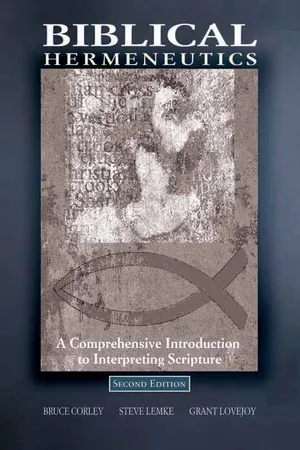
Biblical Hermeneutics is a textbook for introductory courses in hermeneutics. It takes an interdisciplinary approach that is both balanced and practical with six major areas of focus: the history of biblical interpretation, philosophical presuppositions, biblical genre, the uniqueness of Scripture, the practice of exegesis, and use of exegetical insights that will be lived and communicated in preaching and teaching. Biblical Hermeneutics is designed for students who have little or no knowledge of biblical interpretation. It provides, in one volume, resources for gaining a working knowledge of the multi-faceted nature of biblical interpretation and for supporting the practice of exegesis on the part of the student. The first chapter "A Student's Primer for Exegesis" by Bruce Corley gives the student a bird's eye view of the entire process. It becomes for the student a kind of template to which they will return again and again as they engage in the process of exegesis.This revised edition of Biblical Hermeneutics contains seven new chapter that deal with the major literary genre of Scripture: law, narrative, poetry, wisdom, prophecy, Gospels and Acts, epistles, and apocalyptic. The unique nature of Scripture is presented in part three that addresses the authority, inspiration, and language of Scripture. The book contains two extensive appendices, "A Student's Glossary for Biblical Studies" and an updated and expanded version of "A Student's Guide to Reference Books and Biblical Commentaries.
IN THE FIRST CLASS OF MY FIRST SEMESTER IN SEMINARY, the professor wrote the word exegesis on the chalkboard and told us that one of these research assignments was due in two weeks. I had no idea what he meant. As it turns out, not many others have claimed to know what he meant, and those who have seem to disagree. Exegesis, like its well-traveled partner hermeneutics, “is a word that is forever chasing a meaning” (Frei, 16). The scholarly debate has featured a baffling array of linguistic insights, philosophical critiques, and competing theories of interpretation—all about the “meaning of meaning.”
Meanwhile, theological students everywhere, still working to produce acceptable papers, continue to enter the strange world of exegesis and hermeneutics. The puzzled looks and bewildering talk that usually follow are reminiscent of an oft-repeated story, the dispute between Alice and the contemptuous Humpty Dumpty, who with delight turned “meaning” on its head (Lewis Carroll, Through the Looking Glass, 1872, chap. 6):
“When I use a word,” Humpty Dumpty said, in rather a scornful tone, “it means just what I choose it to mean—neither more nor less.”
“The question is,” said Alice, “whether you can make words mean so many different things.”
“The question is,” said Humpty Dumpty, “which is to be master—that's all.”
Alice was too much puzzled to say anything.
Like Alice who did not know the language games of a nonsense world, the alert student could wish for a bit of help in grasping what words really mean, especially when their masters stretch them beyond recognition.
Here, then, is a short primer for beginning students—a field guide for those who are “too much puzzled”—along the fundamental lines of “How to Write an Exegetical Paper.” From the viewpoint of the ever-growing literature on this subject, it is a pretentious venture, written at the risk of slighting important issues and technical jargon (that will appear in later chapters) but in search of a clear reward, namely: an approach to exegesis and how to do it in plain and simple terms.
The Aims of Biblical Exegesis
What is exegesis, and how is it related to hermeneutics? Although both words appear in other fields of academic study, they mainly belong to the classical disciplines of theology, where both exegesis and hermeneutics refer to the interpretation of the Bible. Hermeneutics probably first emerged as a name for this biblical discipline in J. C. Dannhauer's Hermeneutica Sacra (Strasburg, 1654); whereas exegesis had already appeared in the title of Papias's five-volume work in the early second century, Exegesis of the Lord's Sayings, an exposition of Gospel teachings known to us only by fragments quoted in later authors. For Papias, like other ancient writers, exegesis and hermeneutics were overlapping concepts; the preface to the Exegesis describes Jesus’ sayings themselves, collected and handed down, as “interpretations” (Greek herm
neiai; see Eusebius, Ecclesiastical History 39.1, 3). The skills of interpretation taught in Greco-Roman education had long before shaped the popular coinage of both terms, and we must first look there to define their meanings.
Classical Definitions
The Greek word groups related to the nouns ex
g
sis and herm
neia, which gave us the English counterparts, denote an understanding or meaning derived from an object of reflection and study such as an event, a speech, or a law. In the area of our interest—literary usage— both nouns refer to an “explanation, interpretation, or meaning” of a written text, and the corresponding verbs (ex
geomai and herm
neu
) describe the act by which meaning is found, “to expound, to explain, to interpret” the text. When applied to texts in foreign languages, herm
neu
means “to translate.”
Usage that reaches back to classical Athens (fourth century B.C.) shows the closeness of the two word groups. According to Plato, a herm
neut
s could be an “interpreter” of the sacred law (Laws 907d) or a poet expounding divine utterances as a “spokesman” for the gods (Ion 534e; Statesman 290c), one practicing the “art of interpretation” (cf. Symposium 202e; Theaetetus 209a; Statesman 260d). Plato's exeg
t
s had similar skills (cf. Cratylus 407a), whether an “expounder” of ancestral law (Laws 631a; 759c; 775a) or the famous Delphic oracle entrusted as the “interpreter [exeg
t
s] of religion to all mankind” (Republic 4.427c). This functional linkage between exegesis and hermeneutics persisted in Greek literature, specifically in the Jewish writings of the Second Temple period (LXX, Philo, and Josephus), down to the New Testament itself.
A wordplay found in the Acts account of Paul and Barnabas at Lystra (Acts 14:8–18) provides an instructive example. After the crowd saw a lame man healed, they acclaimed Paul and Barnabas as miracle workers, shouting “the gods have come down to us in human form” (14:11). Likely echoing local knowledge of a legendary visit of Zeus and Hermes to the Phrygian hill country, Paul was “called Hermes because he was the chief speaker” (14:12). Hermes was the spokesman for the gods who invented language and its uses, and according to Plato's etymology of his name, Hermes meant “interpreter” [herm
neus] whose gift was the hermeneutical art (Cratylus 408a). On the other hand, the description of Paul as the “chief speaker” (literally, “the one who leads in speaking”) hints at the exegetical skill. The Greek word used of Paul,
geomai (“to lead”), is the verbal root behind exegesis, which in its compound form (ex +
geomai) means “to lead, bring out [the meaning].”
Biblical Images
More than two dozen terms in the Hebrew and Greek Scriptures make up the vocabulary domain related to interpretation (see the references in Thiselton, 574–82). However the noun ex
g
sis, used sparingly in the Old Testament, does not occur in the New Testament, and its cognate verb is used only six times (John 1:18; Luke 24:35; Acts 10:8; 15:12, 14; 21:19). The “hermeneutics” word group dominates the biblical usage (cf. Ezra 4:7; Gen. 42:23; Sir. 47:17; Matt. 1:23; Mark 4:41; 15:22, 34; John 1:38, 41–42; Acts 4:36; Heb. 7:2). Notable instances of herm
neia are Joseph's gift for the interpretation of dreams (Gen. 40–41) and Paul's instruction concerning the interpretation of tongues (1 Cor. 12–14). As for interpretation of the Scriptures, the Old Testament has little to say, but we get memorable images of the biblical perspective in four New Testament passages.
1. Opening Up the Scriptures. Along the Emmaus road, Jesus spoke with Cleophas and a despondent companion, helping them to understand the Scriptures: “And beginning with Moses and all the Prophets, he explained [dia + herm
neu
] to them what was said in all the Scriptures concerning himself” (Luke 24:27). Later in the evening, after they had recognized Jesus, the two recounted their experience with a parallel term; they said to one another that their hearts had been set on fire as Jesus had “opened up” (dianoig
, 24:32) the Scriptures to them. Interpretation opened up the closed text, inspiring the mind and heart to a new understanding.
2. Guiding Through the Scriptures. When Philip came upon a chariot on the desert road south of Jerusalem, he heard an Ethiopian eunuch reading aloud from the prophet Isaiah. Philip asked him whether he understood what he was reading. “How can I,” he said, “unless some-one explains [hod
ge
] it to me?” (Acts 8:31). The eunuch wanted a pathfinder to lead or guide, to strike a trail to a chosen place; interpretation was a guide along the right path of meaning.
3. Cutting Straight with the Scriptures. Paul enjoined Timothy to be an unashamed workman “handling accurately the word of truth” (2 Tim. 2:15 NASB). The verb orthotome
conveys the picture of cutting a straight line, for example, cutting a straight road through a dense forest or plowing a straight furrow in a field. Timothy was to expound the word of truth along a straight line without being turned aside by wordy debates or impious talk. Such interpretation cut straight through the issues with the unswerving truth.
4. Unlocking the Scriptures. In warning against “cleverly devised tales” used by false teachers, 2 Peter cautions against an arbitrary reading of prophecy: “But know this first of all, that no prophecy of Scripture is a matter of one's own interpretation [epilysis]” (2 Pet. 1:20 NASB). The noun epilysis (“solution, explanation”) touches the area of inquiry and problem solving, particularly the unlocking of a mystery or secret. The confirmation (1:19) of the Scriptures was not located in personal whim; rather its meaning was secured and unlocked by the Spirit's activity (1:21).
Contemporary Models
The cases of exegesis and hermeneutics we have surveyed indicate that interpretation aims at the appropriate meaning of a text, that is, a meaning judged to be accurate, responsible, or faithful to a specified goal. How can an accurate meaning be found? This question gave rise to the development of “rules” for interp...
Table of contents
Cover Page
Halftitlepage
Titlepage
Copyright
Table of Contents
Contributors
Preface Revised Edition
Preface
Part I
Chapter 1
Chapter 2
Chapter 3
Part II
Chapter 4
Chapter 5
Chapter 6
Chapter 7
Chapter 8
Chapter 9
Chapter 10
Chapter 11
Part III
Chapter 12
Chapter 13
Chapter 14
Chapter 15
Chapter 16
Part IV
Chapter 17
Chapter 18
Chapter 19
Chapter 20
Chapter 21
Chapter 22
Chapter 23
Part V
Chapter 24
Chapter 25
Chapter 26
Chapter 27
Chapter 28
Glossary
Reference Books
Index
Trusted by 375,005 students
Access to over 1.5 million titles for a fair monthly price.
Study more efficiently using our study tools.
Frequently asked questions
Yes, you can cancel anytime from the Subscription tab in your account settings on the Perlego website. Your subscription will stay active until the end of your current billing period. Learn how to cancel your subscription
No, books cannot be downloaded as external files, such as PDFs, for use outside of Perlego. However, you can download books within the Perlego app for offline reading on mobile or tablet. Learn how to download books offline
Perlego offers two plans: Essential and Complete
Essential is ideal for learners and professionals who enjoy exploring a wide range of subjects. Access the Essential Library with 800,000+ trusted titles and best-sellers across business, personal growth, and the humanities. Includes unlimited reading time and Standard Read Aloud voice.
Complete: Perfect for advanced learners and researchers needing full, unrestricted access. Unlock 1.5M+ books across hundreds of subjects, including academic and specialized titles. The Complete Plan also includes advanced features like Premium Read Aloud and Research Assistant.
Both plans are available with monthly, semester, or annual billing cycles.
We are an online textbook subscription service, where you can get access to an entire online library for less than the price of a single book per month. With over 1.5 million books across 990+ topics, we’ve got you covered! Learn about our mission
Look out for the read-aloud symbol on your next book to see if you can listen to it. The read-aloud tool reads text aloud for you, highlighting the text as it is being read. You can pause it, speed it up and slow it down. Learn more about Read Aloud
Yes! You can use the Perlego app on both iOS and Android devices to read anytime, anywhere — even offline. Perfect for commutes or when you’re on the go. Please note we cannot support devices running on iOS 13 and Android 7 or earlier. Learn more about using the app
Yes, you can access Biblical Hermeneutics by Bruce Corley,Grant Lovejoy,Steve W Lemke in PDF and/or ePUB format, as well as other popular books in Theology & Religion & Biblical Studies. We have over 1.5 million books available in our catalogue for you to explore.