In classroom and scholarly study, the Gospels, Acts, and the Pauline letters receive far more attention than does the so-called “end” of the New Testament: Hebrews; James; 1 and 2 Peter; 1, 2, and 3 John; Jude; and Revelation.
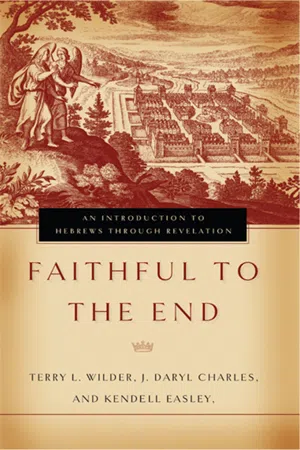
Faithful to the End: An Introduction to Hebrews Through Revelation offers a careful study of these latter biblical letters, closely examining each one's authorship and origin, destination and audience, purpose, and major themes. Appropriate as a reference work or textbook in college and seminary classrooms,
this volume uniquely combines head knowledge with a challenge to the heart, for it is purposefully titled after each book’s recurring theme of persevering in the faith.
Coauthor Terry L. Wilder writes, “Our hope is that God might use this text to help readers not only learn about these New Testament books, but also to appropriate the message contained in each. May we be faithful to the end!”
eBook - ePub
Faithful to the End
An Introduction to Hebrews Through Revelation
- 496 pages
- English
- ePUB (mobile friendly)
- Available on iOS & Android
eBook - ePub
Faithful to the End
An Introduction to Hebrews Through Revelation
About this book
Information
Topic
Theology & ReligionSubtopic
Biblical StudiesOne
HEBREWS
Persevere in Faithfulness
In exploring the letter to the Hebrews, we are engaging simultaneously one of the most fascinating books in the entire Bible and one of the reputedly most difficult NT documents to understand. At the outset, then, we are both intrigued and intimidated. The reasons for this intimidation are multiple, arising from several obstacles:
- The letter requires a preliminary knowledge of OT writings, people, events, and institutions, not least of these being Israel's cultic sacrificial system, which is challenging even to students of the Bible. The combination of multiple citations from the Psalms, such as one finds in the first chapter, and a cursory knowledge of the OT sacrificial order, assumed in chapters 7–10, seems daunting, preventing the average reader from even attempting to wade through the whole epistle.
- Correspondingly, some contemporary readers would be relatively illiterate in terms of their knowledge of the Bible and the OT in particular. The average layperson more than likely has not read through the entire Bible and almost assuredly has not read through those books of the Bible from which the writer to the Hebrews draws most of his material (the Psalms excluded).
- The letter begins without any lead-up, in sharp contrast to the “letters” of the NT.1
- Moreover, Hebrews does not mirror the standard form of a letter. There is no identification of the writer, no introduction, no Christian greeting,2 no salutation, and there are relatively few specific or personal references that might earmark the document as to author, recipients, destination, and surrounding circumstances.3 We are correct to note that Hebrews takes on the character of a sermon, based on the writer's urging the readers to “bear with” his “word of exhortation” (13:22), even when the sermonic style was adopted in its final “letter” form.
- Nothing concrete is known of the recipients or the circumstances that produced the letter. Clues are present throughout, but one must dig in order to string these markers together in a coherent fashion. That there is some sort of crisis among the recipients is clear. The nature of this crisis and its extent, however, are not.
- Hebrews is very different in character from other documents of the NT. To illustrate, the Synoptic Gospels are a rendering of God's in-breaking into the world, through which the kingdom of God is made visible. The Gospel of John attempts a witness to God's definitive statement about divine revelation through Christ. In the Pauline epistles we find a strong emphasis on God's grace in Christ, which justifies us, freely and forensically, apart from any taint of works-righteousness. A counterpart to Paul is the emphasis in James on good works. Authentic Christian faith will demonstrate, i.e., give evidence of, its presence in our lives through our deeds. And the Revelation represents an attempt to depict hostility between the world and Christian faith. But the epistle to the Hebrews is quite different, engaging in a multifaceted presentation of Jesus' covenantal mediation of our access to God.
- The writer's method of argumentation strikes us as strange. In addition to the fact that no other NT letter commences without any personal greeting, Hebrews begins with a declaration of salvation history—not what one might expect in a personal letter to friends.
- A cast of strange, and at times cryptic, characters parades across the stage of the letter. While the wilderness generation (chaps. 3 and 4) is by no means unfamiliar to most Bible readers, the choice of Melchizedek, to whom a total of eight verses in the OT are devoted, as an illustration strikes us as bizarre. Furthermore, what book of the Bible—NT or OT—develops an argument around angels? To encounter such, and that barely five verses into the letter, is to enter abruptly a world with which the average reader is wholly unfamiliar.
- And what do we make of passages such as those found in Hebrews 6? Do these verses teach that Christians indeed can fall away from the faith? Remove themselves from divine grace? Lose their salvation?
- Finally, the contemporary reader is left perplexed when encountering very solemn and disconcerting admonitions such as those recorded in 6:4–8 and 10:26–31. What are we to make of these statements? Are these warnings or threats merely theoretical? Are they present merely for rhetorical effect? Or do they suggest that Christians indeed can actually fall away from grace?
Intrigue should not be eclipsed by intimidation, however, regardless of how daunting the challenges of Hebrews might seem. The richness of the letter, despite those features that perplex the contemporary reader, beckons us yet today. There awaits the hungry inquirer a treasure of insight and understanding into both the divine purpose, mediated by “the Son,” and the human response to the divine purpose. For those who are willing to move beyond the letter's traditional neglect, or beyond “Christianity Lite,” Hebrews offers life-changing perspectives on the nature of faith, perseverance, and witness, as well as on the exalted and unchanging object of that faith. The Christian community of any era cannot afford to neglect the message of Hebrews. Indeed, there may be no generation that has ever needed the message of Hebrews more than our own.
Setting, Audience Situation, Destination, and Date of Writing
To whom was this letter written and why? Answers do not come easily. Hebrews begins as if it were a sermon. We find no customary opening, designation, or greeting that characterize the epistles of the NT. Who were these people, and where were they located? Were they Christians or Jews or Jewish Christians or Gentile Christians familiar with the OT? And what was the nature of the “suffering” and “hardship” they were enduring that necessitated a letter like Hebrews? This anonymous epistle has engendered no little speculation as to the identity and location of its recipients.
The earliest appearance of the heading “To Hebrews” (Pros Hebraious)4 dates to the late second century.5 Clement of Alexandria, according to Eusebius,6 was said to know of this title, as did Tertullian (early third century).7 What is meant by “Hebrews” remains a mystery, although in its few occurrences it denotes language or descent. Are they Jews? Jewish Christians? The frequency of OT allusions in the letter is striking, whatever the role that it plays. Is the reference perhaps a metaphor, not unlike reference to the “twelve tribes” in Jas 1:1 and the diaspora in 1 Pet 1:1, directed at readers of a mixed—i.e., Jewish and Gentile—background?
Whoever these people were, they were known reasonably well by the writer. Whether or not these were “second-generation Christians,” as many commentators assume from the inference in 2:1 and 2:3, the writer was well acquainted with their past and their present condition (2:1; 6:11–12; 10:32–34; 12:4–5), commended them for their generosity (6:10) and their sympathy toward those in prison (10:34), chided them for their immaturity (5:11–6:3),8 questioned their relationship to leadership in the church (13:7, 17), and hoped to visit them soon. Both author and recipients had a relationship with Timothy (13:23).
Wildly divergent commentary has been offered over the last century as to whom the letter was addressed. Explanations include, though by no means are confined to, the following:
- The letter was written to a group of Jews originally belonging to the Qumran community who were converted to Christianity but who maintained their former messianic beliefs (Y. Yadin, A. S. Woude, H. Kosmala).
- The letter mirrors a “Hellenized” or “progressive” Judaism, based on correspondences between Hebrews and Acts 7 and the model of Stephen (W. Manson).
- The letter was written by a Philonic convert to Christianity who came from the Alexandrian school of Judaism in which typological exegesis flourished (C. Spicq, S. Stowers).
- The letter represents Platonic-style dualist philosophy that emphasized the heavenly and spiritual while downplaying the earthly and the material (C. K. Barrett, J. W. Thompson).
- The author of the letter wrote from the standpoint of pre-Christian Gnosticism, which focused on the spiritual or heavenly rather than the material world (E. Käsemann).
- The letter is a Jewish-Hellenistic homily (H. Thyen).
- The letter was written to reconcile differences between Jewish and Samaritan forms of Christianity (E. A. Knox).
- The letter sets on display first-century Jewish Merkabah mysticism (H. M. Schenke, O. Hofius).9
In light of the heading “to Hebrews” and reliance on the OT and Jewish tradition material, much traditional interpretation has assumed that the letter represents a Judaizing tendency or dispute with Judaism or that it is written to dissuade Jewish converts to Christian faith from returning to Jewish religion. The “Jewish” interpretation of Hebrews, in varied forms, has been remarkably persistent and for good reason. Significant disagreement exists among commentators as to who the recipients of the epistle were. Were they practicing members of the Jewish faith? Perhaps Jews who converted to Christian faith and were considering a return to Jewish religion? Or were they Gentiles who were adequately rooted in both Jewish and Gentile thought worlds? How one views the background of the audience is intricately related to how one interprets the letter.
Upon closer inspection, we find that the letter does not allude to the temple, which one might initially expect, were its recipients living in or near Palestine. Nor does it reflect anti-Jewish tendencies or polemical features, which would be anticipated were the recipients considering a return to Jewish religion. Significantly, nothing in Hebrews parallels Paul's argument to the Galatians—no argument against law or legalism or works-righteousness, no mention of circumcision, no sustained emphasis on the cross.
Indeed, as the bulk of the writer's argument suggests, and as the material in the closing section of the letter (i.e., chaps. 11, 12, and 13) indicates, there are deep sympathies toward and a strong appreciation of the shadows, patterns, and types furnished in the old covenant. A shared base of theological knowledge and orientation exists between the writer and his readership. Whether this requires his readers to be former Jews is the subject of much debate;10 the correspondence may also be explainable on the basis of extensive interpenetration of Jewish and Gentile cultures, especially in the Diaspora.11
Establishing any sort of social or historical context for Hebrews depends first and foremost on the profile that emerges from the letter. The epistle indeed mirrors a struggle, but this struggle is not with Judaizing elements in the church. What precisely is the character of the struggle, and what is the nature of the writer's burden? It is the struggle to endure, to be faithful, to persevere with joy (10:32, 36, 38; 12:1, 2, 3, 7, 27; 13:1). And it is a struggle that unites, rather than separates, the people of God in the old and the new. Hence, the comparison to the OT covenant community is meaningful. Wandering in the wilderness, priesthood, and sacrifice have their full explanation and fulfillment in the life and ministry of God's exalted Son; the...
Table of contents
- Preface
- Chapter One—Hebrews
- Chapter Two—James
- Chapter Three—1 Peter
- Chapter Four—2 Peter
- Chapter Five—The Letters of John
- Chapter Six—Jude
- Chapter Seven—Revelation
- Abbreviations
- Contributors
- Name Index
- Subject Index
- Scripture Index
Trusted by 375,005 students
Access to over 1.5 million titles for a fair monthly price.
Study more efficiently using our study tools.
Frequently asked questions
Yes, you can cancel anytime from the Subscription tab in your account settings on the Perlego website. Your subscription will stay active until the end of your current billing period. Learn how to cancel your subscription
No, books cannot be downloaded as external files, such as PDFs, for use outside of Perlego. However, you can download books within the Perlego app for offline reading on mobile or tablet. Learn how to download books offline
Perlego offers two plans: Essential and Complete
- Essential is ideal for learners and professionals who enjoy exploring a wide range of subjects. Access the Essential Library with 800,000+ trusted titles and best-sellers across business, personal growth, and the humanities. Includes unlimited reading time and Standard Read Aloud voice.
- Complete: Perfect for advanced learners and researchers needing full, unrestricted access. Unlock 1.5M+ books across hundreds of subjects, including academic and specialized titles. The Complete Plan also includes advanced features like Premium Read Aloud and Research Assistant.
We are an online textbook subscription service, where you can get access to an entire online library for less than the price of a single book per month. With over 1.5 million books across 990+ topics, we’ve got you covered! Learn about our mission
Look out for the read-aloud symbol on your next book to see if you can listen to it. The read-aloud tool reads text aloud for you, highlighting the text as it is being read. You can pause it, speed it up and slow it down. Learn more about Read Aloud
Yes! You can use the Perlego app on both iOS and Android devices to read anytime, anywhere — even offline. Perfect for commutes or when you’re on the go.
Please note we cannot support devices running on iOS 13 and Android 7 or earlier. Learn more about using the app
Please note we cannot support devices running on iOS 13 and Android 7 or earlier. Learn more about using the app
Yes, you can access Faithful to the End by Terry L. Wilder,J. Daryl Charles,Kendell H. Easley in PDF and/or ePUB format, as well as other popular books in Theology & Religion & Biblical Studies. We have over 1.5 million books available in our catalogue for you to explore.