![]()
![]()
Chapter 1
Originations
If you wish to understand Jesus, you must start by looking into his inheritance. I don't mean the monies, heirlooms, and odd pieces of furniture that may have been lined up for his enjoyment after the passing of his earthly parents, had he outlived both of them. What I have in mind is the religious, cultural, and political heritage that came down to him at birth. These are factors whose roots reached far back into history, helping to shape his beliefs about God, his ethnic and national identity, and even his views on such things as taxes and politics.
If you wish to understand Jesus, you must start by looking into his inheritance.
We all have such inheritances; they are ours whether we like them or not. At the outset it's not a matter of choice, for we are all set in place at birth; and, assuming you came into the world in the standard way, no one consulted your preferences prior to your debut on the world stage. Your beginning and your inheritance were handed to you no-questions-asked on day one. Though returns are not possible, you can choose whether you will live in accordance with your inheritance. Many of us live within its walls, never realizing how they hem Many factors that make you who you are were handed to you no-questions-asked on the day of your birth.
Others relish the rebel image; they drive against the flow of cultural traffic and wave dismissively at all the lemmings that go diving off high places en masse. But even rebels are shaped by their inheritance, for it has helped define their choices by serving as the foil against which they strive to forge a unique identity.
Many factors that make you who you are were handed to you no-questions-asked on the day of your birth.
For the above reasons all biography starts out as an exercise in history. If I wish to learn about you, I will need to roll up my sleeves and dive into details about things that came and went long before you arrived to jam a foot in life's door. Naturally the same is true if we wish to reach an accurate understanding of Jesus. We cannot just look at his time trekking around Israel. When Jesus dropped onto the scene at the turn of history (the hairpin curve of history, actually), he picked up a backstory or inheritance that we must comprehend before we begin to examine the memoirs of his life, which are collected in the volume known as the New Testament. This means we must go back in time to the era before Jesus was born. Fortunately, we are not forced to scramble around the hills and vales of the Middle East in search of whatever dusty traces may remain of Jesus' ancestral world. Instead, we enjoy the opportunity of cracking open an ancient set of books we call the Old Testament. But there is something unique in this maneuver. In researching Jesus' inheritance documented in the Old Testament, we are looking into a book that millions of people have taken to be from God. We will further examine this belief—its source, rationality, and feasibility—as we go along in the following chapters. For now the important point to note is that by the Old Testament's own testimony we are reading the words of God given through his chosen prophets, priests, and kings.
When Jesus dropped onto the scene at the turn of history, he picked up a backstory or inheritance that we must comprehend before we begin to examine the memoirs of his life.
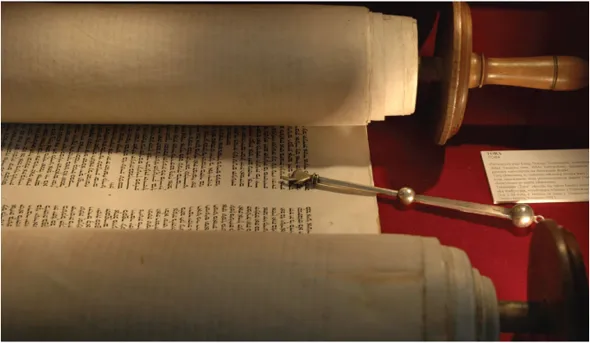
The Old Testament records the words God gave through his chosen prophets, priests, and kings. Photo: Merlin (CC Lisence 2.5).
God's Autobiography
The Old Testament is the beginning of what is essentially God's autobiography.
The Old Testament is the beginning of what is essentially God's autobiography; for in this collection of books, God repeatedly reveals himself by words of disclosure and works of power. He tells us who he is, who we are, how we came to be, and what this buzzing, careening world is all about. In other words, God tells us about ultimate meaning and purpose, and it all centers on him. Certainly the Jews of Jesus' day believed these things of the Old Testament (known then simply as the Scriptures), and Jesus held fast to this belief. So here is our first insight to Jesus' inheritance: he believed that the Old Testament was written by men who had a commission from God to reveal truths about God and the world he made. Comprehending the message of these Scriptures is therefore our first chore in the quest to understand the cultural, religious, and historical foundations that grounded Jesus' identity.
Here is our first insight to Jesus' inheritance: he believed that the Old Testament was written by men who had a commission from God to reveal truths about God and the world he made.
Moses Speaks and Writes from God
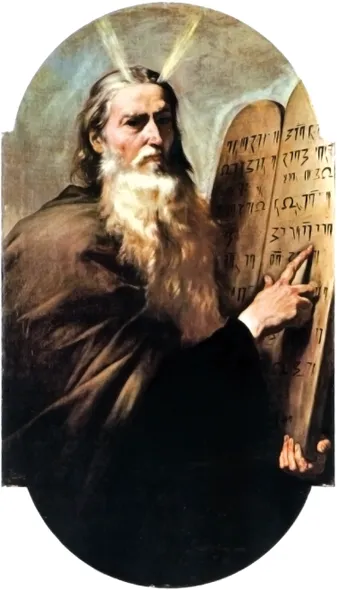
Moses by Jose de Ribera.
According to long-standing tradition the first five books of the Bible were written by Moses as he and his fellow Hebrews (descendants of a renowned man named Abraham) sojourned in the wilderness between Egypt and modern Israel from roughly 1440 to 1400 BC. Having spent several hundred years in Egypt, first as guests and then eventually as slaves, the majority of the Hebrews had forgotten many important truths that had been handed down to them from ancestors who had had life-changing encounters with God. This heritage of relations with God marked the Hebrew family line as unique among the peoples of Earth. Naturally stories of the old encounters with God were treasured and passed down with care generation after generation. But Egypt had beaten these treasures back into the deepest recesses of the Hebrew consciousness, and so Moses was led by God to cast light in these dark corners by teaching about beginnings—their beginning as a distinct people but also the beginning of the universe and human history.
How could Moses write accurately about things that preceded his lifetime by many centuries?
How could Moses write accurately about things that preceded his lifetime by many centuries? Some people suggest that God miraculously gave Moses details about far-gone people, places, and conversations. God is capable of working such miracles, but the Bible nowhere hints that the histories were written in this manner. Instead, the Genesis narratives read like straight-forward accounts that have been handed down in the usual way: through oral and written records that originated soon after the events occurred. Thus it is best to concentrate on two sources for Moses' writings. First, Moses drew significantly from a collection of oral and written histories that had come down to him through his ancestors. Accomplished scholars such as Duane Garrett and K. A. Kitchen have reasonably suggested that thoughtful persons well in advance of Moses learned early forms of writing and thus took steps to preserve seminal stories that previously had been transmitted only as oral history.1 These stories would have covered topics such as early human history and God's dealings with humankind, especially concerning Abraham and his descendants since God kept up regular dealings with them. In both their oral and early written versions, the stories would have been carefully guarded against error due to the important nature of the topics they conveyed. After all, it's not every day that God Almighty shows up and has a talk with humans or directs them to undertake heroic ventures. The guardians of these stories, being the descendants of Abraham and in many cases sharing similarly fantastic experiences with God themselves, would not dare handle the reports loosely. They were passed down faithfully with reverence and gratitude to the God who had involved himself in the human story.
Long before Moses, stories about God's dealings with humanity were passed down faithfully with reverence and gratitude to the God who had involved himself in the human story.
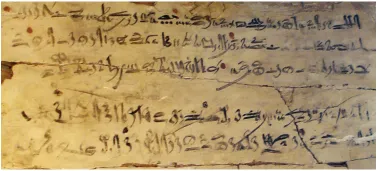
An Egyptian scribe's tablet from around the time of Moses. Photo: David Liam Moran (CC License 3.0).
Later in Hebrew history a descendant of Abraham named Joseph moved to Egypt and rose to a position of great power. He married an Egyptian woman of high standing, and his family naturally had access to education in the advanced Egyptian writing arts. When the rest of the Hebrews migrated to Egypt to shelter under Joseph's wings, they came to venerate him as head of their tribe. In such a situation he would become chief guardian of the sacred Hebrew histories; and as a man of education and privilege, he almost certainly would have ensured that everything was written down in permanent fashion and placed in a repository for safeguarding. Four hundred years later, God's hand piloted a water-borne baby named Moses into Pharaoh's care. This Moses grew up in Pharaoh's beneficent shadow as an adopted family member. This allowed him to receive the best Egyptian education on offer. Known to be the son of a Hebrew woman, Moses was in a fine position to access the written Hebrew histories. Hence it is reasonable to suppose that he would have made off with these documents when he left Egypt permanently after his confrontations with Pharaoh. These documents would then be on hand when Moses set out to write the ancient histories. Lest you think it seems far-fetched to suppose that Moses would have used older, nonsacred documents as source material for writing Genesis, please note that the Old Testament frankly admits the use of nonbiblical sources. For instance, Numbers 21:14, authored by Moses, openly quotes from the “Book of the LORD'S Wars,” a nonbiblical book which has been lost to history. The principle seems obvious: if the source (be it written or oral) is telling truth about the histories it records, it is fit for contributing information to the Holy Bible.
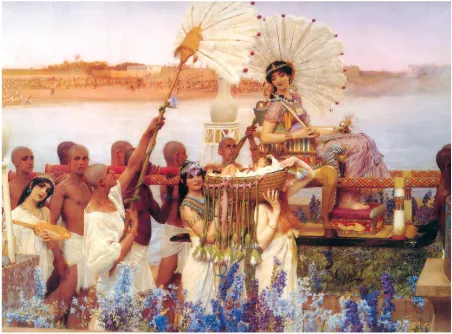
Finding of Moses by Lawrence Alma-Tadema.
But is this all Genesis is—a patchwork of documents and oral histories brought together by Moses? Certainly not. The second and most significant factor in Moses' authorship of Genesis is the fact that he wrote with the guidance of God. Several years before Moses set out to write Genesis, God selected him to be spokesperson to Pharaoh and the Hebrew slave-force that suffered under Egyptian suppression. Trouble is Moses was not an eloquent man. Words were not his craft, and so he worried that God had made a poor selection. In response to these misgivings, God promised to help Moses speak and teach him what words he should say (Exod 4:12). God kept this promise. The inspired books Moses wrote are the chief lasting result.
God promised to help Moses speak and teach him what words he should say (Exod 4:12). God kept this prom...