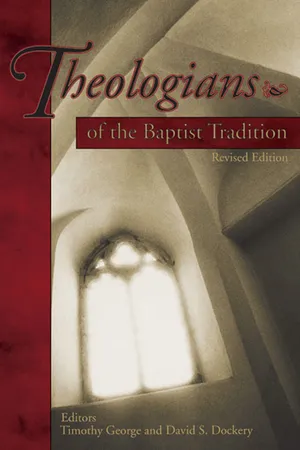
Baptists' Timothy George and David S. Dockery update and substantially reshape their classic book in an effort to preserve and discover the Baptists' "underappreciated contribution to Christianity's theological heritage." George and Dockery have re-arranged this volume—considerably abbreviated from the seven-hundred page first edition—in light of the Southern Baptist identity controversy.
- 414 pages
- English
- ePUB (mobile friendly)
- Available on iOS & Android
eBook - ePub
Theologians of the Baptist Tradition
About this book
Information
Topic
Theology & ReligionSubtopic
Christianity1
The Future of Baptist Theology
By Timothy George
SEVERAL YEARS AGO WILL D. CAMPBELL PUBLISHED A FASCINATING NOVEL entitled The Glad River. The chief character is a man named Doops Momber. Actually his real name was Claudy Momber, but everybody called him Doops because Claudy sounded too much like a girl's name. He grew up among the Baptists of Mississippi, attended the revivals, the hayrides, and the Sunday school wiener roasts, but somehow he never got baptized. Later, when he was inducted into the army, his sergeant asked, “You a Protestant or a Catholic?” Doops did not answer for a moment. Then he said, “I guess I'm neither. I'm neither Catholic nor Protestant. I never joined. But all my people are Baptist.” “But there's a P on your dog tag. Why not a C?” “They asked me what I was and I told them the same thing I told you. And the guy stamped a P on it.” “Why do you suppose they did that?” the sergeant asked. “Well,” said Doops, “I guess in America you have to be something.”1
The confusion Doops encountered about his own religious identity is symptomatic of many other Baptist Christians who, unlike Doops, have indeed taken the plunge but who, no more than he, have any solid understanding about what that means in a postdenominational age of generic religion and dog-tags Christianity. In the first edition of Baptist Theologians, I wrote an opening essay entitled “The Renewal of Baptist Theology,” which began with the following lamentation.
There is a crisis in Baptist life today that cannot be resolved by bigger budgets, better programs, or more sophisticated systems of data processing and mass communication. It is a crisis of identity rooted in a fundamental theological failure of nerve. The two major diseases of the contemporary church are spiritual amnesia (we have forgotten who we are) and ecclesiastical myopia (whoever we are, we are glad we are not like “them”). While these maladies are not unique to the people of God called Baptists, they are perhaps most glaringly present among us.2
This article is a sequel to that earlier essay. First of all, I want to point out some of the difficulties in speaking about the theological identity of Baptists. Then, in the heart of the paper, I will present a mosaic for the renewal of Baptist theology by identifying five major components for such an agenda.
Diversity and Adversity
The first problem in sorting out the theological identity of Baptists is the sheer diversity of the movement. From the beginning of the Baptist experiment in seventeenth-century England, General (Arminian) and Particular (Calvinistic) Baptists developed diverse, even mutually incompatible, paradigms for what it meant to be a Baptist. The Particulars, who were better educated, better organized, and more successful than the Generals, forged alliances with other mainstream Dissenting bodies, denying that they were in any way guilty of “those heterodoxies and fundamental errors” that had been unfairly attributed to them.3 The Generals, on the other hand, were drawn into the orbit of that “swarm of sectaries and schismatics,” as John Taylor put it, which included Levellers, Ranters, Seekers, Quakers, and, at the very far end of the Puritan movement, the mysterious Family of Love. It was, as Christopher Hill has called it, a world turned upside down. An anonymous rhymester may well have had the General Baptists in mind when he penned these lines in 1641: “When women preach and cobblers pray, the fiends in hell make holiday.”4
The diversification of the Baptist tradition that began in England was accelerated in America where the great fact of national life was the frontier—a seemingly endless expanse of space that offered limitless opportunities for escaping the past. “If you and yours don't agree with me and mine, you can pack your Scofield Bibles in your hip pocket and start your own church!” And so they did. And the line stretches from Roger Williams, who left Massachusetts to practice soul-liberty in Rhode Island, to Brigham Young, who carried the Mormons to Utah, to Jim Jones in California and David Koresh in Waco. The frontier was always there.
As for the Baptists, one only has to skim through Mead's Handbook of Denominations to appreciate the bewildering variety. Among many others, there are American Baptists, Southern Baptists, National Baptists, United Baptists, Conservative Baptists, General Association of Regular Baptists (GARB), Free Will Baptists, Landmark Baptists, Duck River and Kindred Associations of Baptists, Six-Principle Baptists, Primitive Baptists, Seventh-Day Baptists, Two-Seed-in-the-Spirit Predestinarian Baptists, and the National Baptist Evangelical Life and Soul-Saving Assembly of the USA, Inc.! That's a lot of Baptists! How do you talk about theological identity amidst that kind of variety?
There's a second factor we also need to consider—not only diversity within the tradition but adversity from the environing culture. While Baptists in America, especially in the South, have long been accustomed to the accoutrements of an established religion, they began as a small, persecuted sect. Long after the 1689 Act of Toleration granted statutory freedom of worship, Baptists, along with other Nonconformists in England, suffered harassment, discrimination, and ridicule. One critic labelled them as “miscreants begat in rebellion, born in sedition, and nursed in faction.”5 The struggles for religious liberty continued for Baptists in America where Obadiah Holmes was publicly beaten on the streets of Danvers, Massachusetts, and John Leland was clapped up in a Virginia jail.
An example of the low esteem in which Baptist folk were held in the early nineteenth century was recorded by David Benedict, who traveled by horseback through all seventeen states of the new nation collecting historical information and impressions about the Baptists. One person, “a very honest and candid old lady,” gave Benedict the following impression she had formed of the Baptists:
There was a company of them in the back part of our town, and an outlandish set of people they certainly were.… You could hardly find one among them but what was deformed in some way or other. Some of them were hair-lipped, others were bleary-eyed, or hump-backed, or bow-legged, or clump-footed; hardly any of them looked like other people. But they were all strong for plunging, and let their poor ignorant children run wild, and never had the seal of the covenant put on them.6
Despite diversity within and adversity without, by the mid-nineteenth century Baptists in America had developed a remarkable unity of purpose and vision, a theological consensus that even cut across the seismic fault line produced by slavery and the Civil War. Thus in 1861, Francis Wayland, a Northern Baptist, could write:
I do not believe that any denomination of Christians exists, which, for so long a period as the Baptist, have maintained so invariably the truth of their early confessions.… The theological tenets of the Baptists, both in England and America, may be briefly stated as follows: they are emphatically the doctrines of the Reformation, and they have been held with singular unanimity and consistency.7
Thus despite countless splits and some doctrinal defections (e.g., the lapse of certain Baptists into universalism), there emerged among Baptists in the late-nineteenth, early-twentieth century America what might be called an orthodox Baptist consensus, represented in the North by Augustus H. Strong, in the South by E. Y. Mullins.
One knew instinctively when the bounds of this consensus had been transgressed. Thus in the controversy surrounding the forced departure of Crawford Howell Toy from Southern Seminary in 1879, both Toy himself and the colleagues who bid him a tearful adieu were all aware, as Toy himself put it, that he “no longer stood where most of his brethren did.”8
Erosion of Theological Consensus
The history of the Baptist movement in the twentieth century could be largely written as the story of the erosion of that theological consensus that obtained in most places until the Fundamentalist-Modernist disputes. In the face of the pressures of this era, the Baptist apologetic made a twofold response, neither of which was really adequate to deal with the challenge at hand. The first response was an appeal to “Baptist distinctives.” In part this effort was fueled by old-fashioned denominational braggadocio, as seen in the book Baptist Why and Why Not published by the SBC's Baptist Sunday School Board in 1900. Chapter titles include: “Why Baptist and Not Methodist,” “Why Baptist and Not Episcopalian,” “Why Immersion and Not Sprinkling,” “Why Close Communion and Not Open Communion,” etc.9
Further emphasis on Baptist distinctives such as the separation of church and state, the nonsacramental character of the ordinances, and the noncreedal character of our confessions appeared as a litany of negative constraints, rather than the positive exposition of an essential doctrinal core. Indeed, for some Baptists these so-called distinctives, often interpreted in an attenuated, reductionistic form, became the essence of the Baptist tradition itself.
This consensus was further eroded by what may be called the privatization of Baptist theology. Historically Baptist life was shaped by strong communitarian features. The congregation was not merely an aggregate of like-minded individuals, but rather a body of baptized believers gathered in solemn covenant with one another and the Lord. Nor were Baptists doctrinal anarchists who boasted of their “right” to believe in anything they wanted to. Instead of flaunting their Christian freedom in this way, Baptists used it to produce and publish confessions of faith both as a means of declaring their own faith to the world and of guarding the theological integrity of their own fellowship.10 Nor did Baptists want their young children “to think for themselves,” as the liberal cliché has it, but instead to be thoroughly grounded in the faith once for all delivered to the saints. Thus they developed Baptist catechisms and used them in both home and church to instruct their children in the rudiments of Christian theology.
The communitarian character of Baptist life, exemplified by covenants, confessions, and catechisms, was undermined by the privatization of Baptist theology and the rising tide of modern rugged individualism that swept through American culture in the early twentieth century. It should be noted that this movement influenced Baptists at both ends of the religious spectrum. Liberal Baptists followed the theological trajectory of Schleiermacher and Ritschl into revisionist models of theology that denied, in some cases, the most fundamental truths of the gospel.11 At the other extreme, anti-intellectual pietism and emotion-laden revivalism pitted theology against piety, soul religion against a reflective faith, thus producing a split between sound doctrine and holy living. Although Billy Sunday belonged to another denomination, many Baptists could resonate with his assertion that he did not know any more about theology than a jackrabbit knew about Ping-Pong!
What are the benchmarks for shaping Baptist theological identity in the new world of the third millennium? Rather than put forth subtle speculations or a new methodology, I propose that we look again at five classic principles drawn from the wider Baptist heritage. These five affirmations form a cluster of convictions that have seen us through turbulent storms in the past. They are worthy anchors for us to cast into the sea of postmodernity as we seek not merely to weather the storm but to sail with confidence into the future God has prepared for us.
Identity Markers
1. Orthodox Convictions. In 1994 the Southern Baptist Convention unanimously adopted a resolution acknowledging that “Southern Baptists have historically confessed with all true Christians everywhere belief in the Triune God, Father, Son, and Holy Spirit, the full deity and perfect humanity of Jesus Christ, His virgin birth, His sinless life, His substitutionary atonement for sins, His resurrection from the dead, His exaltation to the right hand of God, and His triumphal return; and we recognize that born again believers in the Lord Jesus Christ may be found in all Christain denominations.” The recognition of common Christian convictions shared by Baptists and other believers has led the Baptist World Alliance to sponsor interconfessional discussions and dialogues with both Roman Catholics and Protestants of several denominational traditions.
Baptists are orthodox Christians who stand in continuity with the dogmatic consensus of the early church on matters such as the scope of Holy Scripture (canon), the doctrine of God (Trinity), and the person and work of Jesus Christ (Christology). Leon McBeth is correct when he observes that Baptists have “often used confessions not to proclaim ‘Baptist distinctives’ but instead to show how similar Baptists were to other orthodox Christians.”12 Thus the “Orthodox Confession” of 1678 incorporated (article 38) the Apostles', Nicene, and Athanasian creeds, declaring that all three “ought thoroughly to be received, and believed. For we believe, that they may be proved, by most undoubted authority of Holy Scripture and are necessary to be understood of all Christians.”13 Reflecting this same impulse, the Baptists who gathered in London for the inaugural meeting of the Baptist World Alliance in 1905 stood in that assembly and recited in unison the Apostles' Creed.
Fundamentalism arose in the early part of this century as a protest against the concessions and denials of liberal theologians on cardinal tenets such as the virgin birth of Christ, the inerrancy of the Bible, and penal substitutionary atonement. This was a valid and necessary protest, and we should be grateful for those worthy forebearers who stood with courage and conviction on these matters. However, the problem with fundamentalism as a theological movement was its tendency toward reductionism—not what it affirmed, but what it left out. In recent years the inspiration and authority of the Bible have again assumed a major role in Baptist polemics, especially within the Southern Baptist Convention. From the drafting of the Baptist Faith and Message in 1963 through the adoption of the Presidential Theological Study Committee Report in 1994, Southern Baptists have repeatedly affirmed their confidence in the inerrancy or total truthfulness of Holy Scripture. As the latter report declares, “What the Bible says, God says; what the Bible says happened, really happened; every miracle, every event, in every book of the Old and New Testaments is altogether true and trustworthy.”
In more recent years, however, the SBC has found it necessary to address other pressing doctrinal issues such as the being of God and the importance of using biblical language to address him (over against certain models of contemporary feminism), and the belief in Jesus Christ as sole and sufficient Savior (over against universalism and soteriological pluralism). Within the Baptist General Conference, divine omniscience has been debated as certain theologians have denied God's absolute knowledge of the future. All Baptists need to cultivate a holistic orthodoxy, based on a high view of the Scriptures and congruent with the trinitarian and Christological consensus of the early church. Only in this way will we avoid the da...
Table of contents
- Front Cover
- Half Title
- Full Title
- Copyright
- Dedication
- Table of Contents
- Contributors
- Preface
- 1. The Future of Baptist Theology
- 2. John Gill
- 3. Andrew Fuller
- 4. John L. Dagg
- 5. James Petigru Boyce
- 6. The Broadus-Robertson Tradition
- 7. Charles Haddon Spurgeon
- 8. Augustus Hopkins Strong
- 9. Benajah Harvey Carroll
- 10. Edgar Young Mullins
- 11. Walter Thomas Conner
- 12. Herschel H. Hobbs
- 13. W. A. Criswell
- 14. Frank Stagg
- 15. Carl F. H. Henry
- 16. James Leo Garrett Jr.
- 17. Millard J. Erickson
- 18. Looking Back, Looking Ahead
- Notes
- Name Index
- Contributors
Trusted by 375,005 students
Access to over 1.5 million titles for a fair monthly price.
Study more efficiently using our study tools.
Frequently asked questions
Yes, you can cancel anytime from the Subscription tab in your account settings on the Perlego website. Your subscription will stay active until the end of your current billing period. Learn how to cancel your subscription
No, books cannot be downloaded as external files, such as PDFs, for use outside of Perlego. However, you can download books within the Perlego app for offline reading on mobile or tablet. Learn how to download books offline
Perlego offers two plans: Essential and Complete
- Essential is ideal for learners and professionals who enjoy exploring a wide range of subjects. Access the Essential Library with 800,000+ trusted titles and best-sellers across business, personal growth, and the humanities. Includes unlimited reading time and Standard Read Aloud voice.
- Complete: Perfect for advanced learners and researchers needing full, unrestricted access. Unlock 1.5M+ books across hundreds of subjects, including academic and specialized titles. The Complete Plan also includes advanced features like Premium Read Aloud and Research Assistant.
We are an online textbook subscription service, where you can get access to an entire online library for less than the price of a single book per month. With over 1.5 million books across 990+ topics, we’ve got you covered! Learn about our mission
Look out for the read-aloud symbol on your next book to see if you can listen to it. The read-aloud tool reads text aloud for you, highlighting the text as it is being read. You can pause it, speed it up and slow it down. Learn more about Read Aloud
Yes! You can use the Perlego app on both iOS and Android devices to read anytime, anywhere — even offline. Perfect for commutes or when you’re on the go.
Please note we cannot support devices running on iOS 13 and Android 7 or earlier. Learn more about using the app
Please note we cannot support devices running on iOS 13 and Android 7 or earlier. Learn more about using the app
Yes, you can access Theologians of the Baptist Tradition by Timothy George,David S. Dockery in PDF and/or ePUB format, as well as other popular books in Theology & Religion & Christianity. We have over 1.5 million books available in our catalogue for you to explore.