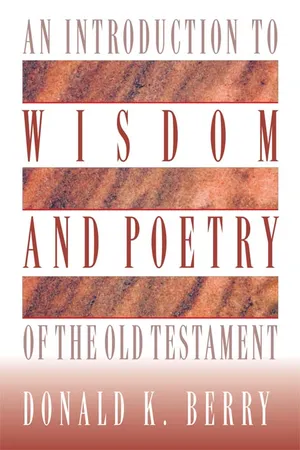
Written for pastors with a relatively elementary knowledge of the Old Testament. Includes accounts of how this portion of the Bible has been interpreted throughout history. Easily incorporated into individual sermons.
How much better it is to get wisdom than gold! And to get understanding is to be chosen above silver. (Prov. 16:16, NASB)
Passages in Proverbs and Psalms place top priority on securing wisdom; this book continues the age-old quest for wisdom. The seeker of wisdom immediately faces a question that shapes all further exploration: What is wisdom?
Innumerable scholarly definitions invite consideration, but this study follows what appears to be a sounder approach to understanding biblical wisdom: seek such understanding from the contents of the Bible's wisdom books. Understanding wisdom in terms of the literature of wisdom involves many levels of study:
Which books do we include in the scope of wisdom?
What interests do the books of wisdom share with wisdom materials from other ancient civilizations?
How did the wisdom sayings fit within the community of worship in ancient Israel?
How were the books understood and interpreted in subsequent history?
What are the unique and common features of each of the wisdom books?
How does the combination of the books' unique features expand the general concept of wisdom?
The Beginning Point
All these issues rely on an answer to a more basic question: What is wisdom? Answers come from various quarters, reflecting the special perspectives assumed by various communities and individuals. For our purposes we will assume a beginning definition: Wisdom is the exercise of mind as a religious pursuit.
This definition provides a broad base from which to consider many specific definitions. More specific definitions arise from four sources. First, the biblical books of wisdom contain several depictions of wisdom. One special approach characterizes wisdom as the ability to live well. Accordingly, Proverbs contains advice intended to lead the novice to a successful and happy life. Artisans, kings, and other professionals display wisdom through vocational or practical skill. Ecclesiastes' attention to the philosophy of living presents a concept of wisdom based in the understanding of ultimate concepts. The Deuterocanonical works from the Septuagint (Sirach and The Wisdom of Solomon) include the basic perspective of Proverbs. These two works add more immediate historical concerns to their special concepts of wisdom. This chapter and following chapters fill in the details involved in the biblical portrait of wisdom.
Second, beyond the confines of biblical literature, wisdom carried special connotations in related Near Eastern literature. The common history Israel shared with these cultures led to overlap in their conceptions of wisdom.
Third, many current notions related to the word wisdom come from Jewish and Christian interpretations. These are classical, but secondary, descriptions based on the primary biblical materials.
Fourth, consistency demands special awareness that contemporary descriptions of biblical wisdom reflect the presuppositions of the present life and times. One objective of this study involves careful distinction between ancient views and contemporary interpretations.
All these ideas influence the study of biblical wisdom. This necessitates an approach marked by humility and the confession of this writer's biases. The basic presupposition that a canonical approach provides the best angle of vision on biblical materials accounts for most of the unique interests in this review of wisdom. The word canon stands as a near synonym for Scripture. A canonical approach to biblical literature reflects keen interest in the history of the books' acceptance and use as inspired works. The interpreter remains consistently aware of the ties between the content of the books and the various communities of faith which valued them.
For example, the interest of certain groups in the Song of Songs as love poetry shows one level of concern, and the interest of others in the Song of Songs as an allegory of God's love shows another. Both views fall within a long, varied tradition affirming the ultimate worth of the book as an inspired document. Both views provide insight into the nature of the interpreting communities as well as insight into the nature of the biblical book.
A Canonical Approach
Wisdom vocabulary and themes appear in a broad range of biblical literature. A canonical view involves a commitment to investigate specific wisdom units in light of the entire scope of biblical wisdom. The slightest indication of wisdom concern qualifies a brief biblical passage for inclusion. At times these smaller passages indicate a need to expand the general definition of wisdom. In this way, the content of the briefer passages influences the description of the general collection. Admittedly, the checks and balances resulting from this method lead to inconclusiveness. It is difficult to say what wisdom is when the definition continually contracts and expands.
For example, we can take the often-repeated maxim, “The fear of the LORD is the begnning of wisdom” and understand it as a reference to wisdom as religious devotion. This conception proves too small to allow for the anger of Job or the skepticism of Ecclesiastes. If we are to affirm their wisdom nature, we must admit that these books express ideas and emotions inconsistent with Proverbs' ideal of religious devotion. A canonical approach offers full description of the contents of wisdom books rather than absolute characterizations of wisdom. Such absolute characterizations cannot account for opposing trends. This suits biblical wisdom on its own terms. According to its perspective on human action, “Every matter has its time and way” (Eccles. 8:6).
So, what is appropriate in one context is out of place in another. The secret of wisdom is to know when and how. It involves the ability to match activities with the proper circumstances. Similarly, canonical criticism seeks to match ideas with their proponents rather than assuming a single audience or context for biblical wisdom. The Bible is a complex document spanning many centuries and types of social structure. Consequently, it is more inclusive than uniform in its entirety.
One of the by-products of the broad canonical approach relates to the content of the canon itself. Throughout this study, I refer to the books commonly known as Apocrypha as Deuterocanon. This includes all the biblical books included in the Roman Catholic and Eastern Orthodox canons. All other early Jewish and Christian works which claim special authority for themselves are referred to with the conventional term, Pseudepigrapha, with the exception of Talmud and other Jewish writings, which bear their own designations.
The early Christian communities accepted many, if not all, the works of Deuterocanon as scriptural in authority. A few early thinkers, such as Jerome, questioned their value. However, only in the sixteenth century, shortly before Luther's Reformation, did Christian thinkers first distinguish the Deuterocanon as less valid than other works of Scripture. The original King James Version included the works. Many of their teachings (such as those on hell, angels, and wisdom) play important roles in Protestant biblical interpretation, though these ideas are not often recognized as deuterocanonical. (The reader may refer to the discussion of Sirach in chapter 3 for a few examples.) The term Apocrypha has been used to designate these books as invalid resources, but the less extreme view of Martin Luther is assumed here. Namely, these books contain valuable information, though not fully scriptural in terms of inspiration. For some communities of faith, the Deuterocanon assumes full scriptural status. In this work, we adopt sensitive terminology, but presume a narrower definition of Scripture.
General Characteristics of Wisdom
Interpreters agree on the general characteristics of biblical wisdom. This consensus includes such themes as (1) the doctrine of divine reward for good or evil conduct, (2) the choice of living responsibly or recklessly, (3) creation, and (4) citizenship. The consensus also involves the use of the form known as “proverb” in all wisdom books. The feature of biblical wisdom that receives the most attention in practically all studies of wisdom is the practical side of wisdom, which addresses issues relating to everyday decisions and conduct. In style as well as content, wisdom focuses on the ins and outs of daily living—business, love and marriage, morals, child rearing, and so forth. Wide agreement exists on such basic concerns.
As the definition grows narrower, however, each specialist limits the field of wisdom because each scholar assigns priority to different materials in the canon. A preference for Ecclesiastes leads to a more speculative, quasi-philosophical description. An opposing perspective based on Proverbs highlights a practical focus, including a utilitarianism consistent with the theology of the Deuteronomist. This more practical perspective, also present in a few psalms, stands at odds with the calculated denial of meaning that marks Ecclesiastes.
The wisdom books themselves provide the basis for the depiction of wisdom in this study. This approach raises the basic question, “Where does the canon of Israel's wisdom begin and end?” Job, Proverbs, and Ecclesiastes appear in all studies of biblical wisdom. Including the Song of Songs in Israel's wisdom canon greatly increases the scope of wisdom literature. This book contains no sages, few if any proverbs, and no discussion of wisdom as a theme. It consists entirely of love poetry. Two features commend its inclusion: its ascription to Solomon, and the practical nature of its discourse. In other respects, the Song of Songs bears less resemblance to Job, Proverbs, and Ecclesiastes than do Sirach and the Wisdom of Solomon. Yet these two later works lie outside the Protestant canon.
Segments of Hosea, Amos, Isaiah, and Jeremiah exhibit numerous wisdom themes and forms. The narratives relating to Joseph and the court history of David also show traits common to Israel's wisdom. All these texts support the definition and discussion of wisdom, but are not “wisdom literature” in the full sense. Some scholars claim wisdom personnel shaped specific portions of the Bible not typically regarded as wisdom. They find wisdom's traits in the Decalogue,1 the succession narrative (2 Sam. 9–20, 1 Kings 1–2)2 and Deuteronomy.3 Assuredly, “the interests of scholarly investigation are not served by the application of the word ‘wisdom’ to every manifestation of brains in ancient Israel.”4 One could counter with the claim that since wisdom's origins are so ambiguous, study must begin with the elements of wisdom as they appear in the broad spectrum of Israel's literature.
All material containing wisdom themes, vocabulary, and literary forms must be included in the early course of this study. Since they indicate the huge proportion of wisdom influence on Israel's sacred literature, the materials outside the wisdom canon supply valuable information concerning the scope and diversity of the wisdom corpus, leading to a more refined sense of context. This prevents excessive dependence on conceptions of wisdom too narrow to account for its diversity. It also shows the necessity for a complex definition.
A Working Definition of Wisdom
Our study begins with a broad definition of wisdom drawn from and applied to Proverbs, Job, Ecclesiastes, Song of Songs, Wisdom of Solomon, and Sirach. For Proverbs, Job, and Ecclesiastes the chief end is
km
(
).5 The simplistic translation, “wisdom”, can lead to confusion. The confusion arises as contemporary notions of wisdom replace the natural breadth in meaning of the Hebrew term. The Hebrew concept embodies all the ethical and social abilities that distinguish the wise person from the fool or the unrighteous—skill, discretion, education, morality, and faith. In the Hebrew Bible wisdom refers to predominantly practical activities. Action and thinking are inseparable. To possess wisdom is to excel at pragmatic activity rather than to participate in sustained reflection. Wisdom indicates skill or ability: to perform manual labor like spinni...
Table of contents
Cover
Half Title
Full Title
Copyright
Dedication
Table of Contents
List of Abbreviations
List of Tables
PART ONE: WISDOM
Chapter 1
Chapter 2
Chapter 3
Chapter 4
Chapter 5
Chapter 6
Chapter 7
Chapter 8
PART TWO: POETRY
Chapter 9
Chapter 10
Chapter 11
Chapter 12
Chapter 13
Chapter 14
Chapter 15
Chapter 16
Glossary of Terms
Bibliography—Wisdom
Bibliography—Poetry
Bibliography—History of Interpretation
Bibliography—Ancient Near Eastern Literature
Trusted by 375,005 students
Access to over 1.5 million titles for a fair monthly price.
Study more efficiently using our study tools.
Frequently asked questions
Yes, you can cancel anytime from the Subscription tab in your account settings on the Perlego website. Your subscription will stay active until the end of your current billing period. Learn how to cancel your subscription
No, books cannot be downloaded as external files, such as PDFs, for use outside of Perlego. However, you can download books within the Perlego app for offline reading on mobile or tablet. Learn how to download books offline
Perlego offers two plans: Essential and Complete
Essential is ideal for learners and professionals who enjoy exploring a wide range of subjects. Access the Essential Library with 800,000+ trusted titles and best-sellers across business, personal growth, and the humanities. Includes unlimited reading time and Standard Read Aloud voice.
Complete: Perfect for advanced learners and researchers needing full, unrestricted access. Unlock 1.5M+ books across hundreds of subjects, including academic and specialized titles. The Complete Plan also includes advanced features like Premium Read Aloud and Research Assistant.
Both plans are available with monthly, semester, or annual billing cycles.
We are an online textbook subscription service, where you can get access to an entire online library for less than the price of a single book per month. With over 1.5 million books across 990+ topics, we’ve got you covered! Learn about our mission
Look out for the read-aloud symbol on your next book to see if you can listen to it. The read-aloud tool reads text aloud for you, highlighting the text as it is being read. You can pause it, speed it up and slow it down. Learn more about Read Aloud
Yes! You can use the Perlego app on both iOS and Android devices to read anytime, anywhere — even offline. Perfect for commutes or when you’re on the go. Please note we cannot support devices running on iOS 13 and Android 7 or earlier. Learn more about using the app
Yes, you can access An Introduction to Wisdom and Poetry of the Old Testament by Donald K. Berry in PDF and/or ePUB format, as well as other popular books in Theology & Religion & Biblical Studies. We have over 1.5 million books available in our catalogue for you to explore.