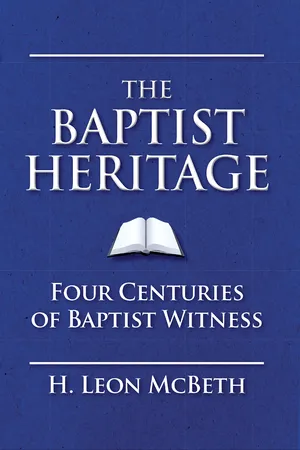
The Baptist Heritage: Four Century of Baptist Witness H. Leon McBeth's 'The Baptist heritage' is a definitive, fresh interpretation of Baptist history. Based on primary source research, the book combines the best features of chronological and topical history to bring alive the story of Baptists around the world.
- 850 pages
- English
- ePUB (mobile friendly)
- Available on iOS & Android
eBook - ePub
The Baptist Heritage
About this book
Information
Topic
Theology & ReligionSubtopic
ReligionUnit IV:
The Twentieth Century
In Future Shock, published first in 1970, Alvin Toffler said that more history has unfolded within living memory than during the rest of recorded history combined. Some people pinpointed 1945, the beginning of the atomic age, as the midway point of history. Since then we have been “future shocked” with successive “ages,” such as the nuclear age, the television age, and the computer age. One might now argue that more has happened since Toffler wrote than before; history continues to “telescope” and the midway point keeps gaining on us.
If history means “happenings,” and not merely the passing of time, then more Baptist history stems from the twentieth century than all previous times combined. However, space allotments in this book cannot reflect that assessment for several reasons. First, recent Baptist history becomes meaningless if severed from its earlier roots. What is grows out of what was, and today takes its significance, at least in part, from yesterday. Second, for all its bulk, recent history bristles with problems. As in photography, we lack the depth of field to bring events into sharp focus. The historian can list endless facts but may lack the insights to put them into perspective, dividing the mountains from the molehills. Third, with the recent past, the historian describes his own times and becomes vulnerable to subconscious biases and imbalances. The reader shares this vulnerability, for one also reads of one's own times.
“A great people have come to a great time.” That description of one Baptist group entering the twentieth century could be applied to the entire Baptist family. This century has been unprecedented both in problems and progress. Some parts of the Baptist family grew rapidly, while others fell into steep decline, and historians have not been able to give satisfactory explanations for either trend. While Baptists in the English-speaking world took religious liberty for granted, and some even began to undermine the historic Baptist position on that subject, Baptists in parts of Europe faced the most severe and sustained persecution which Christians have seen since the caesars.
The world has seemed less secure in the twentieth century. Two world wars, countless other conflicts, the development of atomic and nuclear weapons, advances in transportation and communication, and opening of the space age have radically transformed the global village. Hunger, war, and pollution have seemed to compete as the most likely agents of destruction. These world changes have been matched by changes in the realm of religion. The resurgence of Eastern religions, the rise of curious new cults, the violent revivals within Islam, renewal of Catholicism, and the rise of fundamentalist tensions in most of the Protestant bodies have shown that the twentieth century will not be an irenic time. The rise of new theologies, increased social awareness, and the ecumenical movement have been among the major trends affecting Christianity. Permeating this entire atmosphere, and providing perhaps the one greatest challenge to twentieth-century Christianity, has been the rise of secularism. Baptists, of course, have shared in all these developments.
Among the British Baptists perhaps the primary internal development in the present century has been numerical decline. Social conditions that favored the Free Church tradition in the Victorian era changed, and Baptists found themselves facing an uphill pull. English Baptists have participated in the world ecumenical movement, experimented with closer relationships with other English Free Churchmen and have made various theological restatements. English Baptists took the lead in forming the Baptist World Alliance in 1905, a body which gave for the first time a world structure to the Baptist family.
In Canada, Baptists have achieved a national union but have lost much of their inner unity in a series of doctrinal and regional tensions. The Fundamentalist movement, often identified with the United States, ravaged the Canadian Baptists as well. After mid-century, the growing Southern Baptist presence in Canada raised important questions for future directions of Baptists both in America and Canada.
In the United States, Baptists in the twentieth century have formed a confusing but dynamic picture. Baptists in the North tinkered with the denominational machinery, forming a “convention” in 1908, and changed their name to “American” in 1950. They abandoned the convention structure in the 1970s, adopting a more ecclesiastical structure. During this century, American Baptists were fragmented by Fundamentalism, challenged by ecumenism, and concerned by the massive movement of Southern Baptists into the North. The American Baptists have been actively involved in the Social Gospel and other social ministries since 1900.
Early in the twentieth century, Southern Baptists achieved a high degree of internal unity, symbolized by formation of the Cooperative Program in 1925, but a half century later appeared to lose much of that unity in the rise of Fundamentalism within the denomination. Once confined to the states of the deep South, Southern Baptists in the twentieth century have expanded to the entire nation and appear ready to annex Canada as Southern Baptist territory. Beginning in the 1920s with the development of large programs of ministry, and large sums of money to fund them, Southern Baptists entered an era of centralization in which money and decision making moved inward to the denominational center. By the 1970s, however, a process of decentralization had appeared, with renewed vitality at associational and state levels of Baptist work.
Black Baptists in the United States entered the twentieth century organized into one major body, the National Baptist Convention. That convention split in 1915 over ownership and control of convention property and again in 1961 over the Civil Rights movement. Toward the end of the century, however, they seemed to achieve a high degree of spiritual unity despite organizational disunity. Black Baptists entered the century in segregation and suppression; toward the end of the century, a National Baptist pastor attracted widespread attention and support in his bid to run for the presidency of the United States.
For Baptists in Europe, the twentieth century has brought mixed blessings. For the most part, Baptists in the Western countries on the Continent have achieved religious freedom, but their sectarian status has prevented their making a major impact upon the population. Nothing comparable to the Wesleyan Revival of England or the Great Awakenings of America occurred in Europe. Those evangelical movements had paved the way for Baptist advance in their respective countries. The nearest European equivalent was the Pietist movement and when that faded, the European Baptists were left with no spiritual vehicle of sufficient force to carry them forward.
More than Baptists in other countries, Baptists in Europe felt directly the devastation of the world wars. Those conflicts and the subsequent realignment of political borders, economic systems, and language groupings affected Baptists. Amid these challenges, the Baptists not only survived but also have flourished in many areas. In this century, they have perfected their national Baptist unions, supported several strong theological seminaries, participated in the world Baptist community through the Baptist World Alliance, and about the middle of the century formed the European Baptist Federation which brought a measure of commonality among the twentyfive or so different Baptist groups of Europe.
The one overwhelming reality faced by Baptists in Eastern Europe during the twentieth century has been the rise of Communism. Though officially committed to atheism, the Communism which first arose in the Soviet Union allowed Baptists more freedom than the tsars had done. Later the Communist government cracked down and Baptists suffered severe and sustained periods of persecution. With the enlargement of the Soviet empire, late in the century about two-thirds of all European Baptists lived behind what the West calls “the iron curtain.” Some of the major challenges these Baptists have faced include: how to survive the systematic Communist persecution; how to be good citizens and yet true to their faith; how to teach their faith with a shortage of Bibles and printed materials and with restrictions upon preaching; how to provide ministers in the absence of seminaries and restrictions upon study abroad; and how to maintain their own unity in the face of internal strife and schisms.
Toward the end of the century the Soviet Baptists have become more visible to the outside world. Because they represent the major Protestant group in Eastern Europe, Baptists have attracted widespread and sympathetic attention in the West. This high visibility and sympathetic awareness probably provides their greatest bulwark against future government efforts to eradicate the church.
13
British Baptists
“Larger Horizons and New Problems” is the title A.C. Underwood gives to his discussion of English Baptists in the twentieth century.1 Certainly the horizons for Baptists, indeed for the whole world, have been vastly enlarged in the present century. However, it appears that rapidly as the horizons have expanded, the problems have grown even more rapidly.
A recent general secretary of the Baptist Union, E. A. Payne, reduced to one word the story of English Baptists at mid-century: hesitancy. This hesitancy expressed itself in theology, ecumenical relations, and perhaps most of all in the life of the local churches.
In this century English Baptists have confronted a declining membership, efforts to restructure the denomination, ecumenical dialogue, serious questions about theology and belief patterns, and a growing sense of discouragement. Yet, amid these challenges, English Baptists continue to bear witness to the faith. This chapter will sketch briefly the highlights of their recent heritage.
The Baptist Union
J. H. Shakespeare
The Baptist Union entered the twentieth century two years early with the election of John Howard Shakespeare as general secretary in 1898. A man of remarkable vision and statesmanship, Shakespeare (1857-1928) served until 1924 and gave the denomination its present structure and shape. As a youth he had come under the preaching of James Thew of Leicester, a man less traditional than most Baptist preachers of the time. A student at Regent's Park College and later a graduate of the University of London, Shakespeare's only pastorate was at St. Mary's Chapel in Norwich. His outstanding gifts as a preacher and organizer led to his election in 1898 to succeed Samuel H. Booth as head of the Baptist Union.
Shakespeare occupies a secure place in English Baptist history. At least five major achievements are credited to him: (1) He led the Baptist Union in major fund drives, including the Twentieth Century Fund in 1899 and the Sustentation Fund in 1914; (2) he led in construction of the Baptist Church House, the handsome denominational headquarters in London; (3) he restructured the denomination under the leadership of general superintendents; (4) he led Baptists into serious ecumenical dialogue with other denominations; and (5) he helped form the Baptist World Alliance in 1905.
Shakespeare's first task as general secretary was to lead the Twentieth Century Fund, the largest financial drive English Baptists had mounted to that date. As early as 1896, people had suggested a major fund; in 1899 those suggestions became official when the union voted “that a ...
Table of contents
- Unit I: The Seventeenth Century
- Unit II: The Eighteenth Century
- Unit III: The Nineteenth Century
- Unit IV: The Twentieth Century
- Bibliography
- Index
Trusted by 375,005 students
Access to over 1.5 million titles for a fair monthly price.
Study more efficiently using our study tools.
Frequently asked questions
Yes, you can cancel anytime from the Subscription tab in your account settings on the Perlego website. Your subscription will stay active until the end of your current billing period. Learn how to cancel your subscription
No, books cannot be downloaded as external files, such as PDFs, for use outside of Perlego. However, you can download books within the Perlego app for offline reading on mobile or tablet. Learn how to download books offline
We are an online textbook subscription service, where you can get access to an entire online library for less than the price of a single book per month. With over 1.5 million books across 990+ topics, we’ve got you covered! Learn about our mission
Look out for the read-aloud symbol on your next book to see if you can listen to it. The read-aloud tool reads text aloud for you, highlighting the text as it is being read. You can pause it, speed it up and slow it down. Learn more about Read Aloud
Yes! You can use the Perlego app on both iOS and Android devices to read anytime, anywhere — even offline. Perfect for commutes or when you’re on the go.
Please note we cannot support devices running on iOS 13 and Android 7 or earlier. Learn more about using the app
Please note we cannot support devices running on iOS 13 and Android 7 or earlier. Learn more about using the app
Yes, you can access The Baptist Heritage by H. Leon McBeth in PDF and/or ePUB format, as well as other popular books in Theology & Religion & Religion. We have over 1.5 million books available in our catalogue for you to explore.