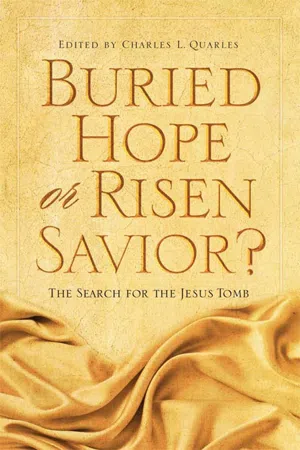
Buried Hope or Risen Savior? argues for the credibility of Jesus Christ's resurrection, engaging the issue in relation to the recent "Jesus Family Tomb" claims that continue making headlines around the world.Among the contributors, Steve Ortiz (professor of Biblical Archaeology at Southwestern Baptist Theological Seminary) discusses the general background of this type of tomb and the archaeology of the Talpiot tomb site. Craig Evans (New Testament professor at Acadia Divinity College) writes about ossuaries and tomb inscriptions. Richard Bauckham (New Testament professor at Scotland's University of St. Andrews) gives the history of Jewish names, extrabiblical writings, and Mary Magdalene. William Dembski (SWBTS research professor in Philosophy) discusses the statistical evidence for the names found on the Talpiot tomb to have been "Jesus." Mike Licona (North American Mission Board director of Apologetics and Interfaith Evangelism) responds to claims that finding the bones of Jesus would not disprove Christ's resurrection. Gary Habermas (Apologetics & Philosophy chair at Liberty University) summarizes the evidence for the bodily resurrection of Jesus. And Darrell Bock (New Testament professor at Dallas Theological Seminary) addresses the importance of the resurrection and how Christians should respond to challenges upon their faith.
eBook - ePub
Buried Hope or Risen Savior?
The Search for the Jesus Tomb
- 256 pages
- English
- ePUB (mobile friendly)
- Available on iOS & Android
eBook - ePub
About this book
Information
Topic
Theology & ReligionSubtopic
Ancient ReligionTHE USE AND ABUSE OF
ARCHAEOLOGICAL INTERPRETATION
AND THE LOST TOMB OF JESUS
Steven M. Ortiz
INTRODUCTION
When the public debate surrounding the media attention to The Lost Tomb of Jesus arose, the most common question asked of me as an archaeologist was, “Is this the tomb of Jesus?” I responded “Yes!” because it is probable that a man named Jesus was buried in the tomb at Talpiot. Naturally the inquirer was taken aback because I am a professing evangelical Christian and this tomb does not support the accounts in the canonical Gospels regarding the death, burial, and resurrection of Jesus of Nazareth.
The next inquiry is, “Does the archaeology prove that this is the tomb of Jesus of Nazareth?” I reply, “Archaeological data alone cannot prove or disprove a proposition but can only support or critique propositions.”
The person is usually frustrated at this time and will ask me if I believe that our Lord married, had children, died, and was buried with his family in this Talpiot tomb as the so-called documentary proposed. I then answer that the proposal is preposterous and certain to be rejected by the overwhelming majority of archaeologists and historians; without all the commotion in the media, it would hardly be worthy of a serious scholarly response.
This dialogue illustrates common misconceptions about the use of archaeology to “prove” or “disprove” the Bible. Unfortunately, I must respond to the outlandish claims espoused in The Lost Tomb of Jesus because of the potential impact and influence this documentary will have on the general public. In particular, it is necessary to address the issues raised by this documentary because it distorts proper interpretation of the archaeological data.
Most public perceptions of an archaeologist follow the Hollywood model of Indiana Jones. He is an archaeologist with a dual personality of scholar in the classroom wearing a tweed coat during the academic semester, and then he becomes transformed into a whip-carrying swash-buckling hero who fights evil forces as he heads off on an adventure to find some lost object. It is humorous to those in the field of archaeology that whenever amateurs want to portray themselves as serious archaeologists, who are responsible for some significant find, they portray themselves as a modern-day Indiana Jones. This is true whether they are looking for the lost ark of the covenant, Mount Sinai, Noah's ark, Paul's wrecked ship, the route of the exodus, or—now for the first time—the “real” location of the tomb of Jesus. The scripts for all of these amateur portrayals are similar and follow the same basic 10 points:
- The prevailing hypothesis affirmed by the consensus of the scholarly community is wrong.
- The “discoverer” is not a trained archaeologist but is self-taught and knows the “true story” that all others have overlooked.
- An expedition is planned for one season, and (lo and behold) at the first attempt they find exactly what they are looking for.
- This is all documented while a camera crew happens to be filming the discovery.
- The process is “detective work” that has been missed by the academic community, and they (amateur archaeologists) are the ones who are able to unravel the mystery or solve the problem that has perplexed the experts.
- No new data is presented, only a reworking of previously published data. A corollary is that not all of the data is consulted.
- Upon the presentation of the discovery, the scholarly community scoffs at the find, and it is claimed that there is a secret conspiracy by those in power to suppress the information.
- The amateurs sensationalize the “discovery” by claiming that it is so revolutionary that it will change our way of thinking and our lifestyle.
- The old “discovery” is presented to the media as a “brand-new” discovery.
- Usually a book or movie comes out within a week of the “new” discovery.
The presentation of The Lost Tomb of Jesus follows the above script. You could take the discovery of the tomb and replace it with the holy grail, the ark of the covenant, Mount Sinai, or any type of religious icon; and the script would be the same. The only thing separating this documentary from the typical Hollywood script is the absence of snake pits, rolling stones, a damsel in distress, and Nazis chasing the main character. While the above 10 points make an excellent movie script or docudrama, they are not reflective of the actual archaeological enterprise.
ARCHAEOLOGICAL METHODOLOGY: HOW DO ARCHAEOLOGISTS WORK?
If the above 10 points of the presentation of the Talpiot tomb are not representative of what archaeologists do, then the question needs to be asked, “How should they have researched the Talpiot tomb?” I will avoid a dense discussion of archaeological method and theory and instead illustrate the nature of archaeological inquiry by addressing each of the above 10 points related to the popularization of archaeology in the media and pop culture.
THE DISCIPLINE OF ARCHAEOLOGY
1. The prevailing hypothesis affirmed by the consensus of the scholarly community is wrong.
2. The “discoverer” is not a trained archaeologist but is self-taught, and he knows the “true story” that all others have overlooked.
Archaeology is an academic discipline with its own methods and theoretical base for the interpretation of the archaeological record. Most archaeologists go to school for several years in order to earn a PhD in archaeology or a related field and receive years of field training. Archaeology is not treasure hunting—digging holes and robbing tombs of special finds.1 Granted, the basic unit of study of an archaeologist is the artifact, but it is not studied in isolation. An artifact is part of a larger cultural system. Archaeologists study artifacts in their cultural contexts, while treasure hunters focus on the artifact itself. The removal of an artifact from its archaeological context removes it from its historical and cultural context. This is why the antiquities market is so detrimental to archaeological research. Its presence encourages the looting of objects from archaeological sites without proper scientific investigation. While these objects are valuable and provide a wealth of information for reconstructing ancient society and addressing questions of social transformation, they lose a majority of their value when they are removed from the archaeological context without proper excavation.
Archaeology requires a systematic research design, knowledge of the historical context of the region and area of study, a theoretical basis for the reconstruction of ancient society based on the material correlates, and years of study of various artifacts and material culture. The archaeological enterprise consists of many specialists from auxiliary disciplines who aid the archaeologist in the interpretation and excavation of artifacts. While some artifacts have significant value in terms of information that is provided to the scholar (such as inscriptions), it is not the single artifact but the patterning of many artifacts within the archaeological record that is used to interpret the past. The Talpiot tomb is an example of an isolated discovery taken out of context to interpret a larger historical picture. No discussion or presentation by the producers occurred placing this tomb within the context of other tombs and the larger southern cemetery of the early Roman period; moreover, no serious attempt was made to interpret the artifacts of the tomb within their historical context.
Archaeological scholarship does not take place in a vacuum. The findings are published, and results are presented at academic meetings. Initial finds or interpretations should be presented before other archaeologists and historians and subject to peer review. While any academic discipline is political and there are power struggles and a tendency to preserve the status quo,2 new ideas and interpretations are constantly being presented and debated. The original excavators of the Talpiot tomb have published and presented their findings in major archaeological publications (the Qadmoniyot and ‘Atiqot journals of the Israel Antiquities Authority, formerly the Department of Antiquities), and several major works based on the archaeological excavations have been produced. Two notable examples are a major work on the Jewish ossuaries in the holdings of the IAA and a monograph on Jewish personal names.3
ARCHAEOLOGICAL EXCAVATIONS
3. An expedition is planned for one season, and (lo and behold) at the first attempt they find exactly what they are looking for.
4. This is all documented while a camera crew happens to be filming the discovery.
Archaeological excavations are labor-intensive enterprises. In the old days of “biblical archaeology,” a scholar could almost begin an excavation merely with the permission of the landowner. In the early days of exploration, private donors and museums would fund excavations. Most of these were only focused on the collection of museum pieces for the public and were nothing more than treasure hunting. This contributed to the public's perception of archaeological research as archaeologists digging holes for goodies.
Archaeological excavations must be done within the context of broader research goals and strategies.4 The granting of a license by the IAA is done only by an application that demonstrates professional competency by the director and his staff, support from an academic institute that has an archaeology department, and evidence for a budget that would support not only the field research but also publication and postseason analysis. Most archaeological excavations are multiyear projects involving a team of scholars who not only work during the excavation but also invest enormous amounts of time during the off-season in the lab.
At face value archaeological discoveries are usually chance finds. Rarely do archaeologists go to a site, mark an X on a spot, and determine that they are going to find a specific artifact. Usually major finds are discovered as archaeologists are examining something else. This is not to say that archaeologists are blindly setting up a grid and haphazardly uncovering whatever is beneath the surface. They have a research design and methodology to explore a site. If they are investigating city planning, they will naturally set up a research design that looks at fortifications and various sections of an ancient city. Archaeological data are accumulated and analyzed over many field seasons. When this information is finally presented to the public, it is usually years after the initial investigation.
The Discovery Channel report of the Talpiot tomb was disingenuous because they recreated an “archaeological discovery” by attempting to “find” the tomb in the backyard of homeowners in the Talpiot neighborhood. In addition, the program implied that the producer and his crew were discovering the evidence for the first time—whether they were walking down the rows of shelves of the IAA storeroom facility or opening up the cement cap that was put over the tomb as a safety precaution to keep children from falling down the shaft. This is not to say that previously excavated finds should not be reevaluated. Archaeologists should always keep an open mind and constantly reevaluate old hypotheses and historical reconstructions as new evidence and finds continue to be discovered and studied.
There is value in recreating the event associated with the discovery for teaching, illustration, and even entertainment. The production of the film on the Talpiot tomb did not recreate the actual discovery or excavation but gave the impression that the crew was making a new discovery. In truth they were staging what amounted to a “rediscovery” of the archaeological data. The hoopla associated with the release of the documentary on the Talpiot tomb implied that there was a “new” discovery. Although some artistic license should be granted to the producers so they can present an entertaining story associated with the discovery, they did not use the original discovery as their story line. Instead, they created a new story line with themselves “discovering” the tomb. But the tomb did not need to be rediscovered because all the information had already been published and was easily available in the storehouses of the Israel Antiquities Authority.
POSTEXCAVATION RESEARCH
5. The process is “detective work” that has been neglected by the academic community, and they (amateur archaeologists) are the ones who are able to unravel the mystery or solve the problem that has perplexed the experts.
6. No new data is presented, only a reworking of previously published data. A corollary is that not all the data is consulted.
Archaeologists are constantly reevaluating their finds and conclusions in light of new excavations. Their work is subject to peer review. While there is a tendency to form a consensus within the scholarly community, there is also a belief that our reconstructions are always subject to reevaluation, especially as new data is uncovered. As stated earlier, the archaeological enterprise is analogous to a puzzle where we only have some of the pieces. We create or postulate a picture based on the limited number of puzzle pieces. As more pieces are added to the puzzle (e.g., new archaeological data), the picture becomes a bit clearer; and we are able to reconstruct a more accurate picture. Another analogy is crime scene investigation. As crime scene investigators analyze the data, new information is produced, and the reconstruction of the crime is reevaluated and modified accordingly.
The Talpiot tomb “discovery” was not new research or a new discovery. The data had already been published5 and the excavations reported a decade before the Discovery docudrama, while the actual excavation was over 25 years earlier (March 1980).6 Only two new analyses were performed on the existing data: the DNA tests on the bones in the ossuaries with the names Jesus and Miriam and the statistical analysis of the names.7 Neither of these analyses provides any new evidence to debate. If they were important for a reconstruction of history or a better understanding of the archaeol...
Table of contents
- Front cover
- Half Title
- Full Title
- Copyright
- Contents
- Preface
- Introduction
- Chapter 1
- Chapter 2
- Chapter 3
- Chapter 4
- Chapter 5
- Chapter 6
- Conclusion
- Name Index
- Subject Index
- Scripture Index
- Apocrypha Index
Trusted by 375,005 students
Access to over 1.5 million titles for a fair monthly price.
Study more efficiently using our study tools.
Frequently asked questions
Yes, you can cancel anytime from the Subscription tab in your account settings on the Perlego website. Your subscription will stay active until the end of your current billing period. Learn how to cancel your subscription
No, books cannot be downloaded as external files, such as PDFs, for use outside of Perlego. However, you can download books within the Perlego app for offline reading on mobile or tablet. Learn how to download books offline
Perlego offers two plans: Essential and Complete
- Essential is ideal for learners and professionals who enjoy exploring a wide range of subjects. Access the Essential Library with 800,000+ trusted titles and best-sellers across business, personal growth, and the humanities. Includes unlimited reading time and Standard Read Aloud voice.
- Complete: Perfect for advanced learners and researchers needing full, unrestricted access. Unlock 1.5M+ books across hundreds of subjects, including academic and specialized titles. The Complete Plan also includes advanced features like Premium Read Aloud and Research Assistant.
We are an online textbook subscription service, where you can get access to an entire online library for less than the price of a single book per month. With over 1.5 million books across 990+ topics, we’ve got you covered! Learn about our mission
Look out for the read-aloud symbol on your next book to see if you can listen to it. The read-aloud tool reads text aloud for you, highlighting the text as it is being read. You can pause it, speed it up and slow it down. Learn more about Read Aloud
Yes! You can use the Perlego app on both iOS and Android devices to read anytime, anywhere — even offline. Perfect for commutes or when you’re on the go.
Please note we cannot support devices running on iOS 13 and Android 7 or earlier. Learn more about using the app
Please note we cannot support devices running on iOS 13 and Android 7 or earlier. Learn more about using the app
Yes, you can access Buried Hope or Risen Savior? by Charles L. Quarles, Charles L Quarles in PDF and/or ePUB format, as well as other popular books in Theology & Religion & Ancient Religion. We have over 1.5 million books available in our catalogue for you to explore.