For over seventy-five years Word Pictures in the New Testament has been a cornerstone of Bible scholarship. Now, the classic six-volume set has been condensed into a one-volume edition to make in-depth New Testament study accessible and enjoyable to a wider audience than ever. Each New Testament book is carefully examined, chapter by chapter, and accompanied by the unique and unmistakable commentary of A.T. Robertson, a leading authority on the Greek New Testament.
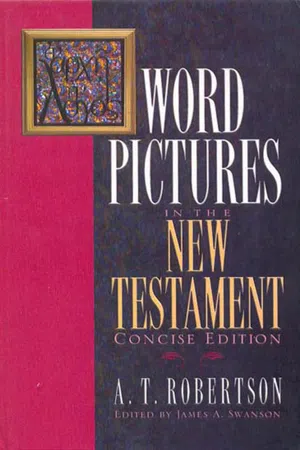
- 704 pages
- English
- ePUB (mobile friendly)
- Available on iOS & Android
eBook - ePub
Word Pictures in the New Testament
About this book
Information
Topic
Theology & ReligionSubtopic
ReligionTHE ACTS OF THE APOSTLES
AUTHOR: Luke the Beloved Physician, friend of Apostle Paul
RECIPIENTS: To Theophilus/ for Romans and Jews
DATE: About A.D. 63
FROM: Finished in Rome (started in Caesarea Maritima?)
OCCASION: Partly a defense of Paul before the Romans, and to have him be set right with the Jews in Rome; the whole purpose is not known.
THEME: A selected account of the birth and early growth of the church
BY WAY OF INTRODUCTION
Acts is important because it has historical worth; without it we would have only the Epistles for historical information. Acts was written as part two, and continuation of the Gospel according to Luke; they are a unity (Luke 1:3; Acts 1:1). They are not merely two independent writings from the same pen; they are a single, continuous work (even the “we” sections of Acts 16:10–40; 20:6–28:31). Acts is neither an appendix nor an afterthought. The traditional view that Luke is the author holds the field with those who are not prejudiced against it (see Luke Introduction in this work). Luke and Acts have the same style; and this can be conclusively defended. The effort to disprove the unity of the Acts has failed. It stands as the work of the same author as a whole and the same author who wrote the Gospel.
Beyond a doubt Luke employed a variety of sources (including himself in the “we” sections and also Paul) for this great history as he did for the Gospel (Luke 1:1–4). Luke's Gospel used the same historical method for Acts. He had great opportunity for documentation in Jerusalem and Palestine, besides contacts in Antioch. He could have contacted sources such as Peter, Philip, Barnabas, and of course Paul.
Acts was once decried as wholly untrustworthy, not above the legendary stage. But the spade of history and archaeology has done well by Luke, for inscriptions and papyri have brought remarkable confirmation for scores of points where Luke once stood all alone and was discounted because he stood alone. In every instance where discoveries have been made they have confirmed the testimony of Luke.
The book is not a history of all early Christianity. Peter (beginning to Acts 15) and Paul (Acts 8 to the end) dominate the atmosphere of the book with Paul as the great hero of Luke.
It is possible that the book was given no title at all by Luke, for it is plain that usage varied greatly even in the same writers. If there is a title, the manuscript evidence may suggest The Acts of the Apostles, as probably correct.
But one can easily see that the work is done with consummate skill. The author is a man of culture, of Christian grace, of literary power. The book pulses with life today.
CHAPTER 1
1. {Which Jesus began…} Here we see the life and teachings of Jesus grammatically bound together, as if to say that Jesus is still carrying on from heaven the work and teaching of the disciples which he started while on earth before his ascension.
2. {Until the day in which… was received up} (cf. Luke 24:51). This refers to the Ascension of Jesus to heaven (Mark 16:19; Acts 1:2, 11, 22; 1 Tim. 3:16). This same verb is used of Elijah's translation to heaven in the LXX (2 Kgs. 2:11). {Had given commandment} This is the Greek verb entellô (from en and tellô, to accomplish), to enjoin. This special commandment refers directly to what we call the commission given the apostles before Christ ascended on high (John 20:21–23; Matt. 28:16–20; Mark 16:15–18; 1 Cor. 15:6; Luke 24:44–49).
3. {By many proofs} Lit. “in many proofs.” Luke does not hesitate to apply the definite word “proofs” to the evidence for the Resurrection of Christ after full investigation on the part of this scientific historian. {By the space of forty days} During this time there were ten appearances known to us. The Ascension was ten days before Pentecost when the Holy Spirit came. Moses was in the mount forty days (Exod. 24:18) and Jesus fasted forty days (Matt. 4:2). {The things concerning the Kingdom of God} “Kingdom” applies to the present and the future and covers so much that it is not strange that the disciples with their notions of a political Messianic kingdom (Acts 1:6) were slow to comprehend the spiritual nature of the reign of God.
4. {Being assembled together with them} An alternate rendering of this Greek verb sunalizô, is “eating with them.” Jesus did on occasion eat with the disciples (Luke 24:41–43; Mark 16:14) and there is other evidence that this might be translated so. Still the alternate rendering is likely better. {To wait for the promise of the Father} Greek tense translates, “to keep on waiting for” the promise which refers to the Holy Spirit.
5. {Baptized with water…and with the Holy Ghost} This baptism of the Holy Spirit was predicted by John (Matt. 3:11) as the characteristic of the Messiah's work. Now the Messiah himself in his last message before his Ascension proclaims that in a few days (ten to be exact) the fulfillment of that prophecy will come to pass.
6. {They therefore} The Greek particle is resumptive and refers to the introductory verses (Acts 1:1–5), which served to connect the Acts with the preceding Gospel. The narrative now begins.
7. {Times or seasons} Lit. “periods or points” of time. It is curious how eager people have always been to fix definite dates about the second coming of Christ. The sovereign Father keeps all such matters to himself.
8. {Power} Not military power, this is Holy Spirit enablement to grapple with the spread of the gospel in the world. {My witnesses} (cf. Luke 24:48 and Acts 1:22; 10:39). This key verse to the book shows the expanding sphere of their witness when the Holy Spirit comes upon them is to the ends of the earth. Once they had been commanded to avoid Samaria (Matt. 10:5), but now it is included in the world program as already outlined on the mountain in Galilee (Matt. 28:19; Mark 16:15). Jesus is on Olivet as he points to Jerusalem, Judea, Samaria, the last part of the earth. The program still beckons us on to world conquest for Christ.
9–10. {As they were looking…} There is a grammatical emphasis of the fact that they were looking directly at Jesus. {Received} “hid” is lit. “took under him.” He seemed to be supported by the cloud (cf. 1 Tim. 3:16). They saw him slipping away from their eyes as the cloud bore him away.
11. {Why?} Jesus had told them of his coming Ascension (John 6:62; 20:17) so that they should have been prepared.
13. {Into the upper chamber} (cf. Mark 14:15; Luke 22:12). This is a room up under the flat roof for retirement or prayer (Acts 9:37, 39), sometimes a large third story room suitable for gatherings (Acts 20:9). It was in a private house as in Luke 22:11 and not in the temple as Luke 24:53 might imply. {They were abiding} The Greek word shows they were abiding permanently for prayer (though constant residence is also possible). It is possible that this is the house of Mary the mother of John Mark where the disciples later met for prayer (Acts 12:12).
14. {They were abiding} They “stuck to” the praying for the promise of the Father until the answer came. {And Mary the mother of Jesus} A delicate touch by Luke that shows Mary with her crown of glory at last. She had come out of the shadow of death with the song in her heart and with the realization of the angel's promise and the prophecy of Simeon. It was a blessed time for Mary. {With his brethren} Once disbelieving (John 7:5), Jesus had appeared to James (1 Cor. 15:7) and now it is a happy family of believers including the mother and half-brothers.
16. {It was needful…} (cf. Ps. 69:25; 109:8). Peter here assumes that Jesus is the Messiah and finds scripture illustrative of the treachery of Judas. The Holy Spirit has not yet come upon them, but Peter feels moved to interpret the situation. He feels that his mind is opened by Jesus (Luke 24:45).
17. {Received his portion} Lit. “obtain the lot.” The focus here is persons chosen by divine appointment (1 Pet. 5:3), a divine lot. The Master chose Judas and gave him his opportunity.
18. {Falling headlong} Lit. “became flat on the face” as opposed to being on the back. Judas hung himself (Matt. 27:5) and, the rope breaking, fell flat on his face and burst open like the crack of a falling tree.
19. {Akeldama…the field of blood} Is it so named because “blood money” bought it (cf. Matt. 27:7); or because literally Judas' blood poured out there (Acts 1:18)?
22. {Beginning…} The ministry of Jesus began with the baptism of John and lasted until the Ascension. {A witness with us of his resurrection} The essential thing about a successor was to pick one to be a personal witness who can speak from his own experience of the ministry, resurrection, and ascension of the Lord Jesus.
23. {They put forward two} Somebody nominated two names, Justus and Matthias.
24. {Show us the one whom thou hast chosen} That is, Lord make it plain who you (God) have picked. In this prayer they assume that God has made a choice. They only wish to know his will.
25. {Apostolic} This means the office and dignity of an apostle (Acts 1:25; Rom. 1:5; 1 Cor. 9:2; Gal 2:8). {To his own place} This is a bold and picturesque description of the destiny of Judas worthy of Dante's Inferno.
26. {He was numbered…} Not gambling,...
Table of contents
- Cover
- Title
- Copyright
- Table of Contents
- Transliteration of the Greek
- Preface
- Half Title
- The Gospel According to Matthew
- The Gospel According to Mark
- The Gospel According to Luke
- The Gospel According to John
- Acts of The Apostles
- The Epistle to The Romans
- The First Epistle to The Corinthians
- The Second Epistle to The Corinthians
- The Epistle to The Galatians
- The Epistle to The Ephesians
- The Epistle to The Philippians
- The Epistle to The Colossians
- The First Epistle to The Thessalonians
- The Second Epistle to The Thessalonians
- The First Epistle to Timothy
- The Second Epistle to Timothy
- The Epistle to Titus
- The Epistle to Philemon
- The Epistle to The Hebrews
- The Epistle of James
- The First Epistle of Peter
- The Second Epistle of Peter
- The First Epistle of John
- The Second Epistle of John
- The Third Epistle of John
- The Epistle of Jude
- The Revelation of John
Trusted by 375,005 students
Access to over 1.5 million titles for a fair monthly price.
Study more efficiently using our study tools.
Frequently asked questions
Yes, you can cancel anytime from the Subscription tab in your account settings on the Perlego website. Your subscription will stay active until the end of your current billing period. Learn how to cancel your subscription
No, books cannot be downloaded as external files, such as PDFs, for use outside of Perlego. However, you can download books within the Perlego app for offline reading on mobile or tablet. Learn how to download books offline
Perlego offers two plans: Essential and Complete
- Essential is ideal for learners and professionals who enjoy exploring a wide range of subjects. Access the Essential Library with 800,000+ trusted titles and best-sellers across business, personal growth, and the humanities. Includes unlimited reading time and Standard Read Aloud voice.
- Complete: Perfect for advanced learners and researchers needing full, unrestricted access. Unlock 1.5M+ books across hundreds of subjects, including academic and specialized titles. The Complete Plan also includes advanced features like Premium Read Aloud and Research Assistant.
We are an online textbook subscription service, where you can get access to an entire online library for less than the price of a single book per month. With over 1.5 million books across 990+ topics, we’ve got you covered! Learn about our mission
Look out for the read-aloud symbol on your next book to see if you can listen to it. The read-aloud tool reads text aloud for you, highlighting the text as it is being read. You can pause it, speed it up and slow it down. Learn more about Read Aloud
Yes! You can use the Perlego app on both iOS and Android devices to read anytime, anywhere — even offline. Perfect for commutes or when you’re on the go.
Please note we cannot support devices running on iOS 13 and Android 7 or earlier. Learn more about using the app
Please note we cannot support devices running on iOS 13 and Android 7 or earlier. Learn more about using the app
Yes, you can access Word Pictures in the New Testament by A. T. Robertson in PDF and/or ePUB format, as well as other popular books in Theology & Religion & Religion. We have over 1.5 million books available in our catalogue for you to explore.