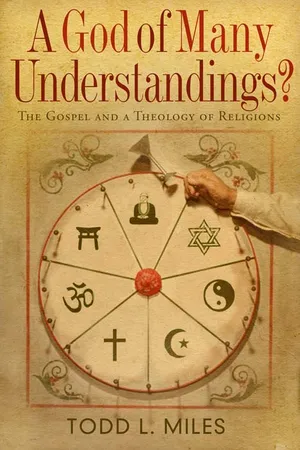
Western Christianity's interaction with world religions used to be, for the most part, overseas. Today, "religious others" often live next door. At a changing time when one public prayer spoken during the 2009 U.S. presidential inauguration festivities was addressed to "O god of our many understandings, " the evangelical Christian church should do more than simply dismiss non-Christian religions as pagan without argument or comment. The Church needs a theology of religions that is Christ-honoring, biblically faithful, intellectually satisfying, compassionate, and that will encourage Spirit-powered mission. Oregon-based theology professor Todd L. Miles writes to that end in A God of Many Understandings?, attempting, as the scholar Veli-Matti Kärkkäinen puts it, "to think theologically about what it means for Christians to live with people of other faiths and about the relationship of Christianity to other religions."
- 416 pages
- English
- ePUB (mobile friendly)
- Available on iOS & Android
eBook - ePub
A God of Many Understandings
About this book
Information
Topic
Teologia e religioneSubtopic
Teologia cristianaChapter One

The Exclusivity of Christ and a Christian Theology of Religions
INTRODUCTION
On Sunday morning, January 18, 2009, Gene Robinson, the Episcopal bishop of New Hampshire, stepped to a podium near the Lincoln Memorial in Washington, DC, to open the inauguration festivities for Barack Obama with an invocation and began his prayer, “O god of our many understandings, we pray that you will . . .”1 Rather than national outrage at the blasphemous and nonsensical address of the One who controls the destinies of nations, the invocation was hailed by many as a demonstration of inclusiveness. Robinson, an openly homosexual Episcopal priest, had studied previous inaugural prayers and was “horrified” at how “specifically and aggressively Christian they were.”2 He promised that his prayer would not be overtly Christian, nor would he quote Scripture because he wanted “all people to feel that this is their prayer.”3
Confusion over the identity of God is especially rampant among the younger generations. Lillian R. Mongeau, writer and blogger for the millennial generation, comments, “God, Allah, Yahweh, the Creator, the One, the Energies, goes by as many names in this country as ever. . . . I do believe that God is in everyone, though by what name he resides there seems to me to be up to the person in question.” This is logical and theological nonsense, but she defends the oddity of her statements by explaining that for her generation believing such things “is simply considered good manners.”4
Postmodernity’s skepticism toward truth claims, the elevation of tolerance as the prevailing human virtue, and the shrinking of the world due to rapid advancements in transportation and communications technology have caused a radical alteration in the theological and missiological landscape. This is exemplified in Western Christianity’s interaction with world religions. For the Western church, participants in the religions of the world other than Christianity, or “religious others,” used to be overseas. Today religious others live next door. Western Christians used to learn of religious others primarily through Christian missionary presentations at their local churches or by reading National Geographic. Today they learn of religious others through personal encounters at their workplaces and schools. The reality of religious pluralism has occasioned a call for a renewed Christian theology of religions—an investigation into the biblical understanding of world religions and how they fit into the redemptive purposes of God.5
The purposes of this book are many, but all are related to the promotion of the proclamation of the gospel of Jesus Christ. First, I will defend the basic biblical assertion that there is one supreme God, the Creator, who is sovereign over all. He has revealed Himself as triune and has uniquely and finally revealed Himself in Jesus Christ, the incarnate Son of God, the second member of the Trinity. Humanity, due to its rebellion against God, stands justly condemned before God, under wrath and utterly without hope. God, in His rich mercy and love, has reached out to us in Jesus Christ, paving not just a way, but the only way, for relationship with Him through conscious and intentional repentance and faith in Christ. This assertion is of vital importance. The pluralistic world denies God’s right and ability, uniquely and particularly, to reveal Himself, and in so doing, catastrophically denies the only means of salvation open to it.6
Second, I will maintain on biblical and theological grounds that conscious faith in the gospel, defined as the good news of the life, death, and resurrection of Jesus Christ as anticipated, developed, and presented in Holy Scripture, is necessary for salvation. This position is commonly referred to as exclusivism. Exclusivism is challenged by some evangelical Christians, who while remaining convinced that the only hope and basis of salvation is the work of Christ, question how God could justly condemn those who, through no fault of their own, were not recipients of the proclamation of the gospel. These well-meaning Christians, referred to as inclusivists throughout this book, speculate that perhaps some of the unevangelized who seek God will be saved on the basis of Christ’s death even though they have not consciously repented and believed the gospel.7 My goal is to demonstrate that not only is the reality of Christ’s death and resurrection absolutely necessary for salvation, but it must also be proclaimed and believed. If any are saved, it is through conscious faith in Jesus Christ and His work on the cross.
Third, I will demonstrate that the ministry of the Holy Spirit has been and is focused on the glorification of Jesus Christ, the Son of God. This goal is really a subcategory of the second goal. Currently, many inclusivists are speculating that the Spirit of God is at work in the world, perhaps in other religions, turning people to God and applying the atoning work of Christ to them, even though they have not believed the gospel. To make this claim, inclusivists have to postulate a relative independence of the Spirit from the Son. Contrary to those who assert either an independent work of the Holy Spirit apart from the Son or a work of the Son that is subordinate to the Spirit in world religions, I will argue that the roles of Jesus Christ and the Holy Spirit are inextricably linked: the Holy Spirit always seeks to glorify the Son. When Jesus said of the Holy Spirit, “He will glorify Me, because He will take from what is Mine and declare it to you” (John 16:14),8 Christ was not merely defining one aspect of the work of the Holy Spirit. Rather, He was declaring the nature of the relationship between Himself and the Holy Spirit within the broad scope of trinitarian life and redemptive history. Therefore, those who posit an independent salvific work of the Holy Spirit in world religions are denying the Bible’s own presentation of the relationship between the Son and the Spirit in the economic Trinity. Any proposal that seeks to sever or reverse this relationship fails on grounds of proper theological method, historical theology, biblical theology, and systematic theology.
Fourth, I want to present a positive model for how a Christian theology of religions should be developed. Many questions face the Christian living in the pluralistic world in general and in the post-Christian West in particular. How do the religions of the world fit into God’s sovereign plan of redemption? Why is it that Christians are often no more neighborly than non-Christians? What is the fate of those who have never heard the gospel? Does general revelation convey enough truth to save? Is there truth in non-Christian religions? What role does conscience play in God’s revelation in Christ Jesus? Though each of these questions will be addressed, changing contexts will demand that they be answered again and again. It is crucial for the mission of the Church that answers to these questions and others be developed in a biblically faithful way that communicate effectively to each culture and context that asks them. Indeed, because of the nature of God’s revelation in Christ and Scripture, any answer to these questions that does not communicate to particular people and contexts is by definition not biblically faithful. To build a theology of religions that is true to Scripture and glorifying to Christ, we must build along the lines of the methodology and theology of the Son and Spirit that this book describes and defends.
Finally, I hope to convince the readers of the simple and necessary answer to the question, What about those who have never heard the gospel? The consistent biblical response is, “Go tell them!” In the revelation of God, there is no protracted philosophizing and conjecture over the fate of the unevangelized. There is, however, an urgent call to proclamation and a developed biblical theology of mission. Any theological construction that impedes zealous commitment to evangelism is unbiblical and unfaithful. Concurrent with the investigation of Christian interaction with world religions is a call for a review of the Christian missiological strategy. Doctrines that are being challenged and defended in light of that strategy include soteriology, Christology, and pneumatology.9 Gerald Anderson, writing in 1993, stated, “No issue in missiology is more important, more difficult, more controversial, or more divisive for the days ahead than the theology of religions. . . . This is the theological issue for mission in the 1990s and into the twenty-first century.”10 I am concerned that if an inclusivist understanding of salvation in a pluralistic world wins the day, the heart will be cut out of the motivation to missions.11
WHAT IS A CHRISTIAN THEOLOGY OF RELIGIONS?
Religious and philosophical pluralisms have been empirical realities since shortly after the fall of man.12 The early chapters of Genesis chronicle the sad reality that the world has rarely been unified in acceptable worship of the one true and living God. Early in human history, there were multiple religions, the worship of different gods, and incompatible convictions on the nature of reality and the moral universe. The current cultural milieu shares much in common with that of previous generations. What has changed, however, is the public perception of religious pluralism. In the West, because of factors such as the rise of the global village, increased communications technology, and the relativistic mind-set of postmodernity, what was once a simple reality has been elevated or “cherished” in the Western value system.13 That there are many religions in the world is no longer a simple statement of arithmetic reality. In our shrinking world it is a statement of how things “ought to be.” The implications for Christianity and Christian mission are enormous.
The Church of Jesus Christ was birthed in the context of mission and gospel proclamation. Jesus ascended to the right hand of the Father leaving clear marching orders for His followers. They were to “make disciples of all nations, baptizing them in the name of the Father and of the Son and of the Holy Spirit” (Matt 28:19). To enable this mission, Jesus promised that His authoritative presence would always attend His disciples (Matt 28:20). He promised that He would send His Spirit to empower them to witness of Him to the ends of the earth (Acts 1:8). When Jesus fulfilled His promise by sending the Spirit at Pentecost, the first sermon preached, following the inauguration of the Church by the Spirit, resulted in 3,000 people repenting and believing the gospel (Acts 2:41). The Church exists for the glory of Christ and the sake of missions. When the Church ceases to proclaim, she denies the fundamental reality of who she is.
The purpose of the Church has not changed. Today, as in the first century, the Church is called to proclaim the gospel of Jesus Christ to people “blinded” by “the god of this age” so that “they cannot see the light of the gospel of the glory of Christ” (2 Cor 4:4). The message of the cross of Christ remains “foolishness” to those “who are perishing” (1 Cor 1:18). But today there is enormous cultural pressure, masquerading as a commitment to the “value” of tolerance, to reject any truth claim that assumes superiority to alternatives. The gospel makes just such a claim to superiority. Jesus commissioned the Church with a unique message of salvation. The Church has been motivated to herald that message out of love for and obedience to Christ and because apart from that message there is absolutely no hope for anyone, anywhere. When the prevailing wisdom of the world is that there ought to be religious diversity, then the gospel becomes suspect because the exclusive and necessary nature of its message threatens the way things ought to be. It is the Christian conviction that the world must hear and believe the particular message of Jesus Christ as “the way, the truth, and the life” that runs headlong into contemporary sensibilities. When the Church alters the gospel message into something more palatable to modern sensibilities, it might be respected and embraced by some religious others. But such a message would not be the gospel and would be a denial of who Jesus is and what He did to reconcile the world to God.
Evangelical Christian theologians have been slower to address religious pluralism than their mainline and liberal counterparts.14 Responding to this cultural, social, religious, and epistemological shift is the responsibility of the Church. Evangelicals are beginning to wade into the discussion with their own proposals for how Christianity and other religions relate. It will not do to dismiss non-Christian religions as pagan without argument or comment. The Church needs a theology of religions that is at once Christ-honoring, biblically faithful, intellectually satisfying, compassionate, and that will encourage Spirit-empowered mission.15
A theology of religions seeks, in a coherent and consistent manner, to answer questions concerning the relationships among world religions, special revelation, general revelation, and salvation. A theology of religions is not a description of the doctrines and practices of the various religions of the world. It is not a comparative study of religions, nor is it a specific evangelistic or apologetic strategy tailored to reach any one particular non-Christian religion. Rather, a theology of religions is found...
Table of contents
- Contents
- Abbreviations
- Acknowledgments
- Chapter 1
- Chapter 2
- Chapter 3
- Chapter 4
- Chapter 5
- Chapter 6
- Chapter 7
- Chapter 8
- Chapter 9
- Bibliography
- Name Index
- Subject Index
- Scripture Index
Trusted by 375,005 students
Access to over 1.5 million titles for a fair monthly price.
Study more efficiently using our study tools.
Frequently asked questions
Yes, you can cancel anytime from the Subscription tab in your account settings on the Perlego website. Your subscription will stay active until the end of your current billing period. Learn how to cancel your subscription
No, books cannot be downloaded as external files, such as PDFs, for use outside of Perlego. However, you can download books within the Perlego app for offline reading on mobile or tablet. Learn how to download books offline
Perlego offers two plans: Essential and Complete
- Essential is ideal for learners and professionals who enjoy exploring a wide range of subjects. Access the Essential Library with 800,000+ trusted titles and best-sellers across business, personal growth, and the humanities. Includes unlimited reading time and Standard Read Aloud voice.
- Complete: Perfect for advanced learners and researchers needing full, unrestricted access. Unlock 1.5M+ books across hundreds of subjects, including academic and specialized titles. The Complete Plan also includes advanced features like Premium Read Aloud and Research Assistant.
We are an online textbook subscription service, where you can get access to an entire online library for less than the price of a single book per month. With over 1.5 million books across 990+ topics, we’ve got you covered! Learn about our mission
Look out for the read-aloud symbol on your next book to see if you can listen to it. The read-aloud tool reads text aloud for you, highlighting the text as it is being read. You can pause it, speed it up and slow it down. Learn more about Read Aloud
Yes! You can use the Perlego app on both iOS and Android devices to read anytime, anywhere — even offline. Perfect for commutes or when you’re on the go.
Please note we cannot support devices running on iOS 13 and Android 7 or earlier. Learn more about using the app
Please note we cannot support devices running on iOS 13 and Android 7 or earlier. Learn more about using the app
Yes, you can access A God of Many Understandings by Todd Miles in PDF and/or ePUB format, as well as other popular books in Teologia e religione & Teologia cristiana. We have over 1.5 million books available in our catalogue for you to explore.