![]()
PART I
SHORT-TERM MISSION IN PERSPECTIVE: EXPLORING THE BIGGER PICTURE
I just saw a picture from high school. It was an old photo of five of us hanging out during a lunch break. It was a snapshot of 17-year-old classmates, paused for a minute in a life moving at breakneck pace. At that moment none of us could know that it was a picture of two future wives and mothers, an eventual funeral home director, a White House staff member (yes, that White House), and a married minister with two children.
The picture did not depict those futures, but it did tell us a great deal about that moment in our lives and world. We were all good athletes, in excellent shape. We had a lot of time to connect. We had poor fashion sense (trends in hairstyles have definitely changed). We were once close to one another. Time, neglect of health, frenzied lives, and distance have changed all of that. An image like that could not tell us about our respective futures, but it did capture what was once our present.
In Part I we will take a look at our present and our past. Such an assessment can tell us a great deal about the global mission today, its biblical basis, and what it means to mobilize students for this task now and in the future. It should also help us take a more informed look at the idea of short-term mobilization, especially as it involves your church and your students.
Our hope is that those young people who are a part of your ministry will have pictures they look at years from now that tell them about who they were, what they were doing, and who they wanted to be. We hope these chapters will help you think through how to ensure that when each individual looks back at such images, he sees a globally aware and engaged student determined to become the mission-focused adult he one day embodies.
![]()
CHAPTER 1
HOLDING THE VIEW-MASTER: THE WHERE, WHAT, AND WHO OF GLOBAL MISSION
CLICKING THROUGH SLIDES
Capturing this snapshot of mission around the world involves asking a few basic questions. Really, several pictures are related but different—kind of like a View-Master. If you are too young to remember the chunky red viewing toy with the slot-machine-like arm on the side to make it work, let us give you a brief tutorial. You take a plastic disc (a few usually came with the viewer), and insert it into the top of the View-Master. Along the entire outside edge of these discs were small film windows. As you pull down the plastic arm while looking through the lenses, you click through the slides and see each picture up close. Each slide related to the others on the disc. (Our favorites were the superhero discs; Spider-Man never looked so cool in a frozen pose.) Though related, the pictures were different, because together they often told a story—a story bigger than one frame could contain.
In similar fashion, trying to get a respectable grasp on the state of global mission is a much more expansive task than a chapter will allow. In truth, its complexity and gravity prevents it from being fully outlined or distilled in a series of volumes. Our more reasonable hope here is to click through the View-Master with you, looking at just a few slides. The pictures we view will constitute an exploration of, not an exhaustive answer to, these questions: Where are lives being changed through mission? What types of ministry are taking place? Who are these missionaries? Even at this elemental level, God may begin using these statistics, stories, and details of dynamic movements to shape where and how you and your students connect to His mission. We pray that He would shape your “vision” for mobilizing students as you look at these images.
SLIDE ONE: WHERE IN THE WORLD
Recent estimates are indicative of what is going on in the Church and worldwide mission and where these activities are taking place:
• There are over 700 million Great Commission Christians defined primarily as persons believing in and committed to Christ’s Great Commission and the worldwide mission of the Church.
• Estimates show that Christian believers make up almost a third of the world population, or just over 2,000,000,000 persons.
• The annual increase is 58.4 million newly evangelized for the first time (160,000 a day).
• The world population is expanding by 79.4 million per year (287,530 per day).
• Those unevangelized comprised [sic] 74.6% of the world population in 1800, but by 2007 they . . . [were] 28% of the global population.
• If the actual numbers of the unevangelized are evaluated, the picture is somewhat different. There were 674,350,000 in 1800, whereas the projection of those unevangelized in 2025 will be 2,156,012,000. These people will comprise [sic] 27.3% of the estimated world population.1
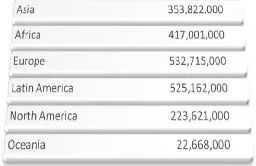
The Church has grown exponentially over the past two centuries, but the need to walk in faithfulness to the Great Commission has never been more crucial. Believers who are called to this global faithfulness are not confined to one discrete world region. Figure 1.1 indicates where the members of the Church, worldwide, call home.
Figure 1.1: The Global Church Population by World Area
As these estimates indicate, the mass of the Church has largely moved south. This shift has prompted some missiologists to conclude that initiatives and trend-setting moves will be generated principally from the “Southern Church” in the years to come.2 It will take future snapshots to determine the breadth of this effect.
AMONG PEOPLE GROUPS
In the meantime, trends in both the Southern and Northern Hemispheres show that missionaries maintain ways to identify populations that they might engage with the gospel. Over time this classification process has taken different shapes. In recent decades missionaries have established ministries based on the identification of people groups, distinct “cultural and/or sociological groupings” of which the global populace is composed.3 The 1982 Lausanne Committee on World Evangelization provided a definition of a “people group”: “For evangelization purposes, a people group is the largest group within which the Gospel can spread as a church planting movement without encountering barriers of understanding or acceptance.”4
UNREACHED PEOPLE PROFILE
HUI OF CHINA
Population
12,695,000 Hui in China
Identity
The Hui are an official minority of China.
Language
The Hui speak standard Mandarin; although, in some locations, Persian and Arabic words have been added to their vocabulary.
History
By the middle of the seventh century, Arab and Persian traders and merchants traveled to China in search of riches. In addition, in the thirteenth century the Mongols turned people into mobile armies during their Central Asian conquests and sent them to China.
Religion
Almost all Hui are Sunni Muslims. They worship in thousands of mosques throughout China.
Christianity
Although there are a small number of scattered Hui believers in China, the Hui are probably the largest people group in the world without a single known Christian fellowship group.
The Joshua Project
www.joshuapr...