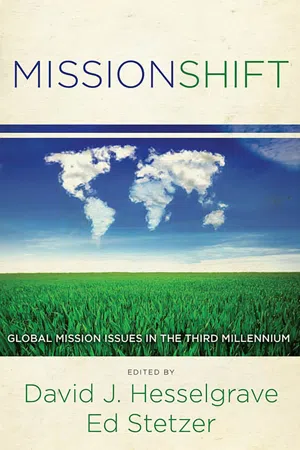
Veteran missionary David Hesselgrave and rising missional expert Ed Stetzer edit this engaging set of conversational essays addressing global mission issues in the third millennium. Key contributors are Charles E. Van Engen ("Mission Described and Defined"), the late Paul Hiebert ("The Gospel in Human Contexts: Changing Perspectives on Contextualization"), and the late Ralph Winter ("The Future of Evangelicals in Mission"). Those offering written responses to these essays include: (Van Engen) Keith Eitel, Enoch Wan, Darrell Guder, Andreas J. Köstenberger; (Hiebert) Michael Pocock, Darrell Whiteman, Norman L. Geisler, Avery Willis; (Winter) Scott Moreau, Christopher Little, Michael Barnett, and Mark Terry.
- 432 pages
- English
- ePUB (mobile friendly)
- Available on iOS & Android
eBook - ePub
MissionShift
About this book
Information
Topic
Theology & ReligionSubtopic
Christian MinistryCHAPTER 1
Introduction
ED STETZER
If you go to a shopping mall this weekend, you’ll notice that the mall has anchor stores at each end. Typically malls are developed around large anchor stores like Macy’s or JCPenney that are well known and advertise widely. These anchor stores attract shoppers to the mall; and while they are there, they also browse the boutiques and enjoy a double mocha latte at Starbucks. This book is like a missions mall. It is anchored by three significant essays, written by three of the foremost missiologists of our time: Charles Van Engen, Paul Hiebert, and Ralph Winter. Charles Van Engen discusses mission’s past in his essay. Paul Hiebert analyzes mission’s present in his articles, and Ralph Winter predicts mission’s future in his. In a sense the three essayists are explaining where we have been, where we are, and where we’re going in missions. We (the editors) also have enlisted outstanding writers in the field of missiology to interact with our essayists. You’ll discover some lively, stimulating debate in their responses. So order your favorite coffee and sit down for an enlightening read.
Charles Van Engen’s Essay: Mission in the Past
In his essay Charles Van Engen explains how the church has understood and defined its mission through the centuries. Van Engen uses this historical survey as a springboard to defining mission today. This is appropriate because how we define mission today determines to a great degree how we’ll do missions today and tomorrow. He quotes Bishop Stephen Neill who wrote, “If everything is mission, then nothing is mission.” Van Engen finds hope in the missional church movement. He believes this redefinition of the church in terms of its obligation to fulfill God’s purpose in the world (missional purpose) will lead to great progress in mission. He concludes his essay by offering his personal and lengthy definition of mission. Because I’ve interacted with each of the essays and the responders, I won’t share my responses now, but you’ll find those in each section of the book.
Keith Eitel and Andreas Köstenberger express concern with Van Engen’s essay, especially his enthusiasm for the missional church movement. They both fear that the missional church movement and the emergent churches have deemphasized biblical authority in order to interact with postmodern North American culture. Eitel is concerned that missiological creativity, while desirable in some respects, may lead Evangelicals away from a biblically defined mission. Of course, this was the crux of the debate between Evangelicals and the World Council of Churches in the 1960s. Who or what defines the church’s mission in the world and in a particular locality? The World Council insisted that the context (the culture) must define the church’s mission, while Evangelicals held that the Bible must define the church’s mission. Andreas Köstenberger is a Bible scholar of note, so it is not surprising that his “12 theses” emphasize the inspiration and authority of the Scriptures. He also reminds his readers that good hermeneutics are not just necessary but a divine mandate.
Enoch Wan finds much to like in Van Engen’s essay. He appreciates Van Engen’s historical survey, and he likes the concept of missional churches. Wan criticizes Van Engen’s theology of mission as insufficiently trinitarian. For his part Wan espouses a theology of mission that is thoroughly trinitarian.
Darryl Guder perhaps is the most affirming and appreciative responder to Van Engen. As a key figure in the missional church movement, Guder is grateful for Van Engen’s endorsement, and like Van Engen he sees the missional church movement as the way forward for Protestant missions. Guder finds his theological inspiration in the missiology of Karl Barth, and he commends Barth’s Christocentrism to a new generation of seminary students.
Paul Hiebert’s Essay: Mission in the Present
This essay is one of the last that Paul Hiebert wrote before he died. In the essay he addresses mission’s present in terms of contextualization. Of course, contextualization is not the only thing going on in Evangelical missions today, but it is surely the most controversial. It is hard to imagine a writer more qualified than Paul Hiebert to address this topic. His writings on contextualization have shaped the thought of a whole generation of missionaries, and missions professors too.
In his essay Hiebert explains the development of contextualization in the history of missions. The early missionaries practiced minimal contextualization. That is, they did little to contextualize the gospel. This was due to ignorance of cultural anthropology and a firm belief in the absolute truth of the Bible and their theology. Later missionaries felt embarrassed by the lack of contextualization by the pioneer missionaries of the nineteenth century, and they practiced uncritical contextualization. This uncritical approach allowed the culture to dominate. The result was often syncretism (the combination of two or more religions). Hiebert rejects these two extremes and argues for critical contextualization, a contextualization that is true to biblical teaching and also sensitive to the culture.
Michael Pocock responds to his former professor at Trinity Evangelical Divinity School with great respect and affirmation. Pocock views Hiebert’s critical contextualization as the solution to the problem of appropriate contextualization. In recent years much of the debate about contextualization has swirled around the radical contextualization advocated by missionaries to Muslims, such as John Travis. Pocock discusses the C1-C6 Model as an example of this debate. For himself Pocock views the C5 approach as too extreme, but he does approve the C4 approach advocated by Phil Parshall.
Darrell Whiteman expresses great appreciation for Paul Hiebert. In his response Whiteman explains that the gospel affirms most of culture, confronts some aspects of culture, and transforms all of culture. He agrees with Hiebert that critical contextualization is an appropriate response of missionaries to cultural issues. However, he applies critical contextualization to the radical contextualization employed by some missionaries to Muslims and affirms the C5 approach. Thus, both Pocock and Whiteman affirm critical contextualization, but they come to different conclusions.
Norman Geisler is a theologian, not a missiologist, much less a professor of missionary anthropology like Hiebert and Whiteman. Geisler applies a theological template to Hiebert’s essay and finds it lacking. He believes Hiebert’s view of propositional truth is weak, and that weakness leads to a concern about Hiebert’s belief in the inerrancy and authority of the Scriptures. Geisler holds that the way to improved evangelism on the part of field missionaries is not to be found in critical contextualization but rather in worldview research and apologetics.
Avery Willis also affirms Paul Hiebert and critical contextualization. Having affirmed Hiebert’s approach, he devotes much of his response to an application of contextualization—orality. In recent years Willis has been an ardent advocate of contextualized communication with people in oral cultures. As oral learners comprise approximately 60 percent of the world’s population, Willis sees orality as an absolute necessity for contextualization.
Ralph Winter’s Essay: Mission in the Future
Ralph Winter was given the assignment of writing about the future of missions. Before he addresses missions in the future, Winter recounts the history of evangelicalism. As part of that discussion, he discusses evangelical awakenings, which he calls First-Inheritance Evangelicalism and Second-Inheritance Evangelicalism. Winter combines the First Great Awakening and Second Great Awakenings into First-Inheritance Evangelicalism. This period lasted from the beginning of the First Great Awakening, about 1726, until the popularity of Dwight L. Moody (1880). In Winter’s view Evangelicals during the First Inheritance engaged in intellectualism and civic leadership. They sought both to preach the gospel and to minister to the needy. Second-Inheritance Evangelicalism was dominated by the Bible college movement and the Fundamentalist movement. Both movements were anti-intellectual, and their premillennial eschatology led them to reject social ministry. In his essay Winter affirms missionaries that engage in micro-projects to alleviate suffering in the world, but he challenges Evangelicals to develop and implement macro-projects on a continental scale. Though Winter does briefly mention some future trends in missions, his essay primarily is an exhortation to Evangelicals to engage in large-scale human needs ministries. He sees these ministries as a preevangelism strategy that will open doors for the gospel.
Scott Moreau agrees that evangelical missions should be holistic, but he is not sure that Evangelicals have the financial resources to operate on the scale Winter desires. Moreau undertakes to write the essay that Winter did not. He forecasts the future of missions, emphasizing the role of technology, especially the Internet, in the future of missions.
Mark Terry takes a similar track to that of Scott Moreau. Terry laments that Winter did not share his views on the future of missions. Terry agrees that the New Testament and church history support a holistic approach to missions. He then shares his vision of the future of Evangelical missions, listing a number of trends in Evangelical missions, especially missions to youth.
Chris Little’s response to Winter is worth the cost of the book. He provides a thorough biblical and theological critique of Winter’s call for massive human needs projects. While Little affirms the need to respond to human suffering, his biblical and theological findings lead him to reject Winter’s challenge. Little sees Evangelism as the priority for evangelical missions.
Mike Barnett, who holds a Ph.D. in church history, sees Winter’s historical survey of Evangelicalism as overly broad and simplistic. Barnett is not convinced that Second-Inheritance Evangelicalism was as socially deficient as Winter claims. Barnett agrees that Evangelicals need to engage in social ministry; however, he disagrees with Winter that the social ministry should come first. In Barnett’s view we must see situations as different and deal with them on a case-by-case basis. Regardless of whether missionaries begin with the gospel or with social ministry, both Word and deed are necessary for a balanced approach. Ultimately, the church is the key. Churches must be mobilized to fulfill the Great Commission and the Great Commandment.
The editors wish to thank the writers, both the essayists and the responders. All wrote for their love of the Lord and a concern for missions, not for money. Mark Terry, Bob Hughes, Keith Whitfield, and Philip Nation also gave additional help to make this book what it is today.
CHAPTER 2
ESSAY 1: “Mission” Defined and Described
CHARLES VAN ENGEN
Thesis: The purpose of this essay is to offer a brief historical overview of some ways in which the Christian church has defined “mission” down through the centuries and to demonstrate how the various definitions have influenced the thought and practice of the Christian Church’s ministries in the world. In this sense this essay addresses the PAST of what has traditionally been termed “missions.”
Introduction
It was a Sunday noon, and I was invited to eat lunch with the members of the Global Outreach Task Force of a local church. Earlier that morning we had all been inspired by the wonderfully uplifting and celebrative worship at the church’s three Sunday morning worship events at which I had been asked to preach. It was their Global Outreach Weekend. Toward the end of our lunch I turned to Gloria (not her real name), the task force’s chairperson, and remarked:
I am very impressed with the task force’s organization and creative approach to this mission’s weekend. The Friday evening dinner was so well done, including the interviews of members of your church involved in ministries locally and globally. The mission fair had such a large number of display booths that highlighted all the mission activities and missionaries your church supports locally and globally. The international and local multicultural aspects of the music, the reports, and the visual presentations were so well done! Thank you for inviting me to be a part of this celebration!
Gloria grinned and replied:
Thank you for your feedback. Your observations are important to us. But please notice that we did not call this our “missions weekend.” If we had called it Missions Emphasis Weekend, no one would have come. We know; we tried it before. The word mission turns everyone off. The members of our church do not want to be associated with anything called “mission.” When we changed the name to Global Outreach, everything changed. You see, Chuck, no one seems to know what “mission” is. But a majority of our members want to be involved in some kind of local and global ministries that will benefit those in need. They are especially interested in short-term projects and visits to different parts of the world. Now you see why, when I invited you to preach, I asked you not to use the word mission in your sermon.
I nodded thoughtfully as I listened to Gloria. During the last several years, I have often heard comments like hers. It would appear that mission and missionaries are two of the most misunderstood words in the vocabulary of North American churches today.
The Word Mission as It Is Used Today
Part of the confusion over the word mission may be the result of the way it is being overused today in numerous arenas. Out of curiosity I did a Google search for the word mission and received 247 million hits! Some states have towns with the name “Mission.” So far there have been three Mission Impossible movies, and (closer to our theme here) a religious movie called The Mission came out in 1986. When NASA sends a shuttle to dock with the international space station, that trip is called a “missio...
Table of contents
- Chapter 1: Introduction - Ed Stetzer
- Chapter 2: ESSAY 1: Mission Defined and Described - Charles Van Engen
- Chapter 3: On Becoming Missional: Interacting with Charles Van Engen - Keith E. Eitel
- Chapter 4: Mission and Missio Dei: Response to Charles Van Engens Mission Defined and Described - Enoch Wan
- Chapter 5: Defining and Describing Mission: A Response to Charles Van Engen, Keith Eitel, and Enoch Wan - Darrell L. Guder
- Chapter 6: Twelve Theses on the Churchs Mission in the Twenty-first Century: In Interaction with Charles Van Engen, Keith Eitel, and Enoch Wan - Andreas J. Kstenberger
- Chapter 7: Responding to Mission Defined and Described and the Four Responders - Ed Stetzer
- Chapter 8: ESSAY 2: The Gospel in Human Contexts: Changing Perceptions of Contextualization - Paul G. Hiebert
- Chapter 9: Response to Paul G. Hiebert: The Gospel in Human Contexts: Changing Perceptions of Contextualization - Michael Pocock
- Chapter 10: Response to Paul G. Hiebert: The Gospel in Human Contexts: Changing Perceptions of Contextualization - Darrell L. Whiteman
- Chapter 11: A Response to Paul G. Hiebert: The Gospel in Human Contexts: Changing Perceptions of Contextualization and to Darrell Whiteman and Michael Pocock - Norman L. Geisler
- Chapter 12: Response to Hieberts Article: The Gospel in Human Contexts and to the Responses of Pocock and Whiteman - Avery T. Willis Jr.
- Chapter 13: Responding to The Gospel in Human Contexts: Changing Perceptions of Contextualization - Ed Stetzer
- Chapter 14: ESSAY 3: The Future of Evangelicals in Mission - Ralph D. Winter
- Chapter 15: Looking Backward While Going Forward: A Response to Winters Vision - Scott Moreau
- Chapter 16: In Response to The Future of Evangelicals in Mission - Christopher R. Little
- Chapter 17: The Missing Key to the Future of Evangelical Mission - Mike Barnett
- Chapter 18: In Response to Ralph Winters The Future of Evangelicals in Mission - J. Mark Terry
- Chapter 19: Responding to The Future of Evangelicals in Mission - Ed Stetzer
- Chapter 20: Conclusion: A Scientific PostscriptGrist for the Missiological Mills of the Future - David J. Hesselgrave
- List of Contributors
- Name Index
- Subject Index
- Scripture Index
Trusted by 375,005 students
Access to over 1.5 million titles for a fair monthly price.
Study more efficiently using our study tools.
Frequently asked questions
Yes, you can cancel anytime from the Subscription tab in your account settings on the Perlego website. Your subscription will stay active until the end of your current billing period. Learn how to cancel your subscription
No, books cannot be downloaded as external files, such as PDFs, for use outside of Perlego. However, you can download books within the Perlego app for offline reading on mobile or tablet. Learn how to download books offline
Perlego offers two plans: Essential and Complete
- Essential is ideal for learners and professionals who enjoy exploring a wide range of subjects. Access the Essential Library with 800,000+ trusted titles and best-sellers across business, personal growth, and the humanities. Includes unlimited reading time and Standard Read Aloud voice.
- Complete: Perfect for advanced learners and researchers needing full, unrestricted access. Unlock 1.5M+ books across hundreds of subjects, including academic and specialized titles. The Complete Plan also includes advanced features like Premium Read Aloud and Research Assistant.
We are an online textbook subscription service, where you can get access to an entire online library for less than the price of a single book per month. With over 1.5 million books across 990+ topics, we’ve got you covered! Learn about our mission
Look out for the read-aloud symbol on your next book to see if you can listen to it. The read-aloud tool reads text aloud for you, highlighting the text as it is being read. You can pause it, speed it up and slow it down. Learn more about Read Aloud
Yes! You can use the Perlego app on both iOS and Android devices to read anytime, anywhere — even offline. Perfect for commutes or when you’re on the go.
Please note we cannot support devices running on iOS 13 and Android 7 or earlier. Learn more about using the app
Please note we cannot support devices running on iOS 13 and Android 7 or earlier. Learn more about using the app
Yes, you can access MissionShift by David Hesselgrave, Ed Stetzer, David Hesselgrave,Ed Stetzer in PDF and/or ePUB format, as well as other popular books in Theology & Religion & Christian Ministry. We have over 1.5 million books available in our catalogue for you to explore.