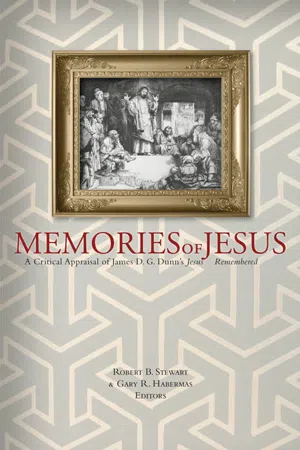
Memories of Jesus gathers essays from a variety of contributors that critically assess the influential book, Jesus Remembered, written by James D. G. Dunn, one of today's most significant New Testament theologians. Considered a landmark in Jesus research, the book's insights and impact are further explored by scholars including Craig L. Blomberg, Gary R. Habermas, and Charles L. Quarles who also receive a direct closing response from Dunn.
- 352 pages
- English
- ePUB (mobile friendly)
- Available on iOS & Android
eBook - ePub
Memories of Jesus
About this book
Information
Topic
Theology & ReligionSubtopic
Biblical Studies1
FROM REIMARUS TO DUNN
SITUATING JAMES D. G. DUNN IN THE HISTORY OF JESUS RESEARCH
ROBERT B. STEWART
A Brief History of Jesus Research
According to James D. G. Dunn, “The key issue in any attempt to talk historically about Jesus of Nazareth has been and continues to be the tension between faith and history, or more accurately now, the hermeneutical tension between faith and history” (emphasis added).1 In this chapter, I intend to lay out broad contours of the historical methods—paying particular attention to hermeneutical issues—of certain key thinkers in the history of historical Jesus research and to situate Dunn within a broad continuum of contemporary Jesus scholars. Significant thinkers and their methods in the history of Jesus research thus need to be briefly examined to understand more fully how they impacted Jesus research. The amount of space that can be allotted to any individual in this section is limited. Some significant scholars will be overlooked entirely, a matter that is unavoidable. It is hoped, however, that enough of a sketch will be provided that one may make out the general features of historical Jesus research over approximately the past 230 years.
The Original Quest2
Albert Schweitzer dates the beginning of the quest of the historical Jesus to 1778, when G. E. Lessing’s edition of Hermann Samuel Reimarus’s essay “On the Aims of Jesus and His Disciples” was published.3 Prior to Reimarus, there were many harmonies of the Gospels,4 but there had been no scholarly attempt to study the Gospels as historical documents.5 All that changed with Lessing’s posthumous publication of Reimarus’s work in a series Lessing named Fragmente eines Ungenannten (Fragments from an Unnamed Author), commonly referred to today as the Wolfenbüttel Fragments.6
H. S. Reimarus was born in Hamburg in 1694 and taught in Wittenberg and Wismar before spending 1720 to 1721 in Holland and England, where he became acquainted with Deism.7 The influence of Deism may be seen in his attempt to ground understanding of the historical Jesus in deistic Vernunft (reason). Reimarus is consumed with answering one basic question: “What sort of purpose did Jesus himself see in his teachings and deeds?”8 Reimarus concludes that the preaching of Jesus was separate from the writings of the apostles. He thus argues that the Gospels, not the New Testament epistles, are where one finds the historical Jesus.
However, I find great cause to separate completely what the apostles say in their own writing from that which Jesus himself actually said and taught, for the apostles were themselves teachers and consequently present their own views; indeed, they never claim that Jesus himself said and taught in his lifetime all the things that they have written. On the other hand, the four evangelists represent themselves only as historians who have reported the most important things that Jesus said as well as did. If now we wish to know what Jesus’ teaching actually was, what he said and preached, that is a res facti—a matter of something that actually occurred; hence this is to be derived from the reports of the historians. . . . Everyone will grant, then, that in my investigation of the intention of Jesus’ teaching I have sufficient reason to limit myself exclusively to the reports of the four evangelists who offer the proper and true record. I shall not bring in those things that the apostles taught or intended on their own, since the latter are not historians of their master’s teaching but present themselves as teachers. Later, when once we have discovered the actual teaching and intention of Jesus from the four documents of the historians, we shall be able to judge reliably whether the apostles expressed the same teaching and intention as their master.9
Reimarus defines the essence of religion as “the doctrine of the salvation and immortality of the soul.”10 This generic liberal description of the essence of religion masks Reimarus’s eventual conclusions concerning Jesus. He concludes that Jesus (a) was a pious Jew; (b) called Israel to repent; (c) did not intend to teach new truth, found a new religion, or establish new rituals; (d) became sidetracked by embracing a political position; (e) sought to force God’s hand; and (f) died alone, deserted by his disciples. What began as a call for repentance ended up as a misguided attempt to usher in the earthly, political kingdom of God.11
He also posits that after Jesus’ failure and death, his disciples stole his body and declared his resurrection in order to maintain their financial security and ensure themselves some standing.12 Peter Gay writes that this sort of conspiracy theory is typical of Deism: “Even the sane among the deists had a paranoid view of history and politics: they saw conspiracies everywhere.”13
In typical deistic fashion, Reimarus insists that there are “no mysteries” or “new articles of faith” in the teachings of Jesus.14 This grows out of his conviction that Jesus was essentially Jewish, not Christian. The uniquely Christian doctrines that one finds in the New Testament originate with the apostles, not Jesus. Reimarus maintains that Jesus’ mind-set was eschatological in nature. He correctly discerns that the historical Jesus is never to be found in a non-Jewish setting but wrongly sees Christianity as discontinuous with Judaism.
Reimarus explicitly rejects the twin pillars of traditional Christian apologetics concerning the deity of Jesus: miracles and prophecy.15 He accepts the basic historicity of the Gospels but reasons the supernatural away through the use of deistic explanations. In short, his rejection of portions of the Gospels is not the result of literary criticism but rather of a prior commitment to the deistic worldview. In this sense, his project can be said to be precritical. Reimarus is critical of supernaturalism and the miracle stories in the Gospels, but he does not read the Gospels critically as literature.
Friedrich Daniel Ernst Schleiermacher is best known for his pioneering contributions to modern theology: Der christliche Glaube (The Christian Faith) and Über die Religion: Reden an die Gebildeten unter ihren Verächtern (On Religion: Speeches to Its Cultured Despisers).16 He was, however, also a pioneer in hermeneutical method and life-of-Jesus research. Schleiermacher was the first scholar to lecture on life of Jesus research in a university. Although he never wrote a book on the historical Jesus, the notes from his class lectures, along with the comments of five of his students, were edited by K. A. Rütenik and published in 1864, 30 years after his death.17
Schleiermacher divides the exegetical task into two subcategories: higher and lower criticism. His higher criticism is concerned with establishing the New Testament canon. His lower criticism is concerned with arriving at an accurate original reading of a particular text. In other words, he practiced something approaching canonical criticism and textual criticism.18
For Schleiermacher, the Old Testament was not normative in the same way as the New Testament. It was the Scripture of Judaism, not Christianity. It could serve to help one understand the New Testament Scriptures but could not serve as the basis for Christianity, which was, in his estimation, an entirely new faith. Furthermore, the Christian interpreter was prone to read foreign ideas and concepts into the Old Testament and thus to obscure its original historic sense. Nevertheless, he concluded that it could be a useful appendix in Christian Bibles rather than part of the Christian Scriptures.19
Hermeneutics, as opposed to exegesis, consists of two parts: the grammatical (universal) and the psychological (particular). The former focuses on the syntactical structure of a text, whereas the latter addresses the intentions of the author. In practice, however, the two are interwoven. The role of the interpreter is first to recognize distinctive markings of a particular biblical author. This is the comparative reading of a text. The second role of the reader is to intuit or divine the thought processes involved in writing the text.20
Schleiermacher primarily focuses on Jesus’ proclamation and the time period of his public ministry. He considers issues such as the virgin birth, crucifixion, and resurrection unhistorical. For Schleiermacher, what matters most in interpretation is the intention of the writer (or the historical person written about). He thus inquires of Jesus’ intentions and his perfect God-consciousness.21
In summary, Schleiermacher understood the importance of grammatical-historical exegesis of texts and anticipated critical methods to come. Yet, in good romanticist style, he was most concerned with intuiting Jesus’ intentions and religious consciousness.
David Friedrich Strauss wrote three best-selling books about Jesus (or perhaps three different versions of one book). Each of the three was different. In retrospect, his first book has proven to be most significant. Therefore, this section will primarily focus on his first offering, The Life of Jesus Critically Examined.22
In his first Life of Jesus, Strauss seeks to apply Hegel’s historical dialectic to understanding Jesus. To this end, he applies the concept of myth to the Gospels, something his teacher F. C. Baur had already done in Old Testament studies. Jesus understood mythically is the synthesis of the thesis of supernaturalism and the antithesis of rationalism. As a committed Hegelian, Strauss maintains that the inner nucleus of Christian faith is not touched by the mythical approach.
The author is aware that the essence of the Christian faith is perfectly independent of his criticism. The supernatural birth of Christ, his miracles, his resurrection and ascension, remain eternal truths, whatever doubts may be cast on their reality as historical facts. The certainty of this alone can give calmnes...
Table of contents
- Cover
- Title
- Copyright
- Dedication
- Contents
- Contributors
- Preface
- Introduction
- Chapter 1
- Chapter 2
- Chapter 3
- Chapter 4
- Chapter 5
- Chapter 6
- Chapter 7
- Chapter 8
- Chapter 9
- Chapter 10
- Chapter 11
- Chapter 12
- Chapter 13
- Chapter 14
- Name Index
- Subject Index
- Scripture Index
Trusted by 375,005 students
Access to over 1.5 million titles for a fair monthly price.
Study more efficiently using our study tools.
Frequently asked questions
Yes, you can cancel anytime from the Subscription tab in your account settings on the Perlego website. Your subscription will stay active until the end of your current billing period. Learn how to cancel your subscription
No, books cannot be downloaded as external files, such as PDFs, for use outside of Perlego. However, you can download books within the Perlego app for offline reading on mobile or tablet. Learn how to download books offline
Perlego offers two plans: Essential and Complete
- Essential is ideal for learners and professionals who enjoy exploring a wide range of subjects. Access the Essential Library with 800,000+ trusted titles and best-sellers across business, personal growth, and the humanities. Includes unlimited reading time and Standard Read Aloud voice.
- Complete: Perfect for advanced learners and researchers needing full, unrestricted access. Unlock 1.5M+ books across hundreds of subjects, including academic and specialized titles. The Complete Plan also includes advanced features like Premium Read Aloud and Research Assistant.
We are an online textbook subscription service, where you can get access to an entire online library for less than the price of a single book per month. With over 1.5 million books across 990+ topics, we’ve got you covered! Learn about our mission
Look out for the read-aloud symbol on your next book to see if you can listen to it. The read-aloud tool reads text aloud for you, highlighting the text as it is being read. You can pause it, speed it up and slow it down. Learn more about Read Aloud
Yes! You can use the Perlego app on both iOS and Android devices to read anytime, anywhere — even offline. Perfect for commutes or when you’re on the go.
Please note we cannot support devices running on iOS 13 and Android 7 or earlier. Learn more about using the app
Please note we cannot support devices running on iOS 13 and Android 7 or earlier. Learn more about using the app
Yes, you can access Memories of Jesus by Robert B. Stewart, Gary R. Habermas, Robert B. Stewart,Gary R. Habermas in PDF and/or ePUB format, as well as other popular books in Theology & Religion & Biblical Studies. We have over 1.5 million books available in our catalogue for you to explore.