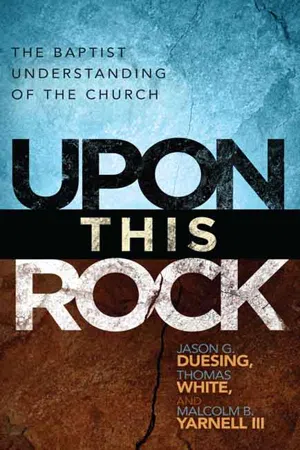
A recent conference at Southwestern Baptist Theological Seminary featured speakers addressing topics set forth in the article on "The Church" in the Southern Baptist Convention's Baptist Faith and Message statement. Upon This Rock gathers those presentations and answers such questions as: • What is the basis for our denominational distinctives? • Are they merely a collection of "faded traditions" or true doctrinal necessities rooted in the Bible alone? • Are they theologically rich cornerstones of faith that easily transcend time, culture, and preference?Contributors include Malcolm B Yarnell III ("Upon This Rock I Will Build My Church: A Theological Exposition of Matthew 16: 13-20"), Paige Patterson ("Observing the Two Ordinances of Christ"), Thomas and Joy White ("Church Officers and Gender: Can Women Be Pastors? Or Deacons?") and Bart Barber ("A Denomination of Churches: Biblical and Useful") as well as Jason G. Duesing, David Allen, Emir F. Caner, James Leo Garrett, Jr., and Byron McWilliams.
The eight verses in Matthew that describe the confession of Simon regarding Jesus as the Son of God have generated much controversy in Christian history. The subsequent discussions around what has been called the “storm center of New Testament exegesis”1 have put more attention upon the person and office of Simon than upon the Messiah that Simon confessed. This is unfortunate, for Simon put the emphasis upon his teacher, Jesus, rather than upon himself, a disciple of the teacher, in his own life and writings. The same emphasis, moreover, is evident in the Gospel of Matthew. The hope in this essay is to unravel the controversy in an effort to reemphasize the Christ-centeredness that Simon confessed and Matthew recorded. Let us first recollect the text.
Coming into the area of Caesarea Philippi, Jesus queried His disciples, saying, “Who are men saying that I, the Son of man, am?”
And they said, “Some John the Baptist, others Elijah, yet others Jeremiah or one of the prophets.”
He said to them, “But who do you say that I am?”
And answering, Simon Peter said, “You are the Christ, the Son of the living God.”
And answering, Jesus said to him, “Blessed are you, Simon, son of Jonah, because flesh and blood did not reveal this to you, but My Father who is in heaven. And I also say to you that you are Petros, and upon this petra I will build My church, and the gates of Hades will not be victorious over it. I will give to you the keys of the kingdom of heaven, and what you bind upon the earth will have been bound in heaven, and what you loose upon the earth will have been loosed in heaven.”
Then He warned His disciples that they should tell no one that He was Jesus the Christ (Matt 16:13–20; author’s translation).
In order to arrive at a proper theological interpretation of this passage, we shall follow a grammatical-historical approach and interact with the major interpretations offered in the history of Christian churches. In agreement with Gerhard Ebeling and Brevard S. Childs, this approach to biblical theology laments the unfortunate divorce of biblical exegesis from the theological interpretation of the church and laments the atomization of the canon.2 While rejecting the modernist hubris involved in such a willful lack of historical awareness regarding prior Christian interpretations of the whole canon, this approach also rejects any hint that the Christian tradition is the final arbiter of proper theological exegesis. Systematically, after analyzing the linguistic nature of the passage, we shall turn to the historical and canonical context in which it was written, then the historical context in which it has been interpreted. Only then may we attempt to offer some preliminary theological conclusions.
1. LINGUISTIC CONSIDERATIONS
Literary Structure
The literary structure of this passage exhibits a striking “unity” and “symmetry.”3 Indeed, for some modern interpreters, the symmetry is so profound that it is difficult for them to believe that the passage is anything but an interpolation the Matthean redactor has put into the mouth of Jesus Christ. For others, this and the coordinate passage in Matt 18:15–18 resulted from “the strained encounter between Hellenistic and Jewish Christian traditions.”4 Although we find the literary structure of Matthew reflects a highly nuanced redaction, we deny the insupportable presupposition that because the result is theologically complex the words do not fully reflect the teachings of Jesus and the confession of Peter. Moreover, we affirm the canonical presupposition that the author and his text were inspired by the Holy Spirit and, therefore, the original Matthean manuscript remains free of historical error, even as the extant manuscript tradition is infallible (2 Tim 3:16; 2 Pet 1:21).
Structural Outline of Matthew 16:13–20
Elth
n de ho I
sous eis ta mer
Kaisareias t
s Philippou
r
ta tous math
tas autou leg
n·
• tina legousin hoi anthr
poi einai ton huion tou
anthr
pou;
hoi de eipan
• hoi men I
ann
n ton baptist
n,
• alloi de Elian,
• heteroi de Ieremian
hena t
n proph
t
n.
legei autois
• humeis de tina me legete einai;
apokritheis de Sim
n Petros eipen·
• su ei ho Christos ho huios tou theou tou z
ntos.
apokritheisde ho I
sous eipen aut
·
• makarios ei, Sim
n Bari
na,
• hoti sarx kai haima ouk apekalupsen soi
• all’ ho pat
r mou ho en [tois] ouranois.
• kag
de soi leg
hoti su ei Petros
• kai epi taut
t
petra oikodom
s
mou t
n ekkl
sian
• kai pulai hadou ou katischusousin aut
s.
• d
s
soi tas kleidas t
s basileias t
n ouran
n,
• kai ho ean d
s
s epi t
s g
s estai dedemenon en tois ouranois,
• kai ho ean lus
s epi t
s g
s estai lelumenon en tois ouranois.
tote epetim
sen tois math
tais hina m
deni eip
sin hoti autos estin ho Christos.
With these presuppositions made plain, we now turn to the linguistic structure of the passage in question. There are four sections in the subject pericope, with the opening line of the first section and the entire fourth section providing the transitions required for placing the pericope within the historical progress of the Gospel of Matthew. The first three sections of the pericope follow a conversational format; specifically, Matthew relates a rhetorical discourse of question and answer between a Jewish Teacher, Jesus, and some students, the disciples of Jesus. We have taken the liberty of identifying the structure of the words of the Rabbi and His students in a bullet format. In this way it becomes noticeable that the first and second sections each contain a query and a response, while the first and third sections each contain a triplex delineation.
The threefold delineation of the first and third sections gives special prominence to the second section, which does not contain such a complex delineation. The unique nature of the second section’s answer, with its relative simplicity and placement in the structural center of the discourse, thereby grammatically highlights the Christological confession of Simon. That the third section does not contain a query, but nevertheless contains a long response, indicates the authority of the speaker. In other words, the literary structure gives prominence to the Teacher, on the one hand, and to the confession of the student regarding the Teacher, on the other hand.
Son of Man and Son of God, and Son of Jonah
Also within the purview of linguistic considerations may be considered the frequent wordplays that are employed throughout the pericope and in its relationship with the preceding and following pericopes. Within the pericope the wordplays focus on the mutual naming between Jesus and Simon. To Simon’s su ei, Jesus responds also with a su ei. The wordplays begin with their unique parental generation. Jesus is, on the one hand, self-described as “the Son of Man,” a title that could have been taken as an appellation of nothing more than his own humanity,5 especially when coupled with Jesus’ query regarding what other “men” are saying. But Jesus is, on the other hand, confessed by Simon as “the Son of the living God,” a title that sets off Jesus as so much more than any other human. Indeed, Simon’s ascription of divine generation to Jesus is endorsed by the latter as a revelation by “my Father who is in heaven.” Jesus, who is the son of man, is concurrently the Son of God. This God is, moreover, no mere deity; rather, He is the only God who lives; He is “the living God.”
In comparison with such an exalted ascription, the third time that “son” is mentioned, in the identification of Simon as the “son of Jonah,” the listener is reminded not only of Simon’s father, John, but also of a rebellious prophet. The fallen humanity of Simon—his limited “flesh and blood”—is thereby placed in sober comparison with the exalted humanity and unique deity of Jesus. The title of “Christ” is also here ascribed to Jesus, and comprises part of the reason for the enthusiastic response by Jesus. But “Christ” was believed to be also a “Son of David,” a title already being ascribed to him in Matthew (Matt 9:27; 12:23). Interestingly, “Son of God” had also already been ascribed to Jesus but with increasing degrees of certitude (4:1–11; 14:33).
The critical point seems to be the concurrent accumulation of these titles in a personal confession voiced by a human directly to Jesus. The personal nature of the confession is key to understanding its meaning, as is the accumulation...
Table of contents
Cover
Title
Copyright
Contents
Acknowledgments
Dedication
The Baptist Faith and Message, 2000
Author Introduction
Introduction
Chapter 1
Chapter 2
Chapter 3
Chapter 4
Chapter 5
Chapter 6
Chapter 7
Chapter 8
Chapter 9
Author Index
Scripture Index
Trusted by 375,005 students
Access to over 1.5 million titles for a fair monthly price.
Study more efficiently using our study tools.
Frequently asked questions
Yes, you can cancel anytime from the Subscription tab in your account settings on the Perlego website. Your subscription will stay active until the end of your current billing period. Learn how to cancel your subscription
No, books cannot be downloaded as external files, such as PDFs, for use outside of Perlego. However, you can download books within the Perlego app for offline reading on mobile or tablet. Learn how to download books offline
Perlego offers two plans: Essential and Complete
Essential is ideal for learners and professionals who enjoy exploring a wide range of subjects. Access the Essential Library with 800,000+ trusted titles and best-sellers across business, personal growth, and the humanities. Includes unlimited reading time and Standard Read Aloud voice.
Complete: Perfect for advanced learners and researchers needing full, unrestricted access. Unlock 1.5M+ books across hundreds of subjects, including academic and specialized titles. The Complete Plan also includes advanced features like Premium Read Aloud and Research Assistant.
Both plans are available with monthly, semester, or annual billing cycles.
We are an online textbook subscription service, where you can get access to an entire online library for less than the price of a single book per month. With over 1.5 million books across 990+ topics, we’ve got you covered! Learn about our mission
Look out for the read-aloud symbol on your next book to see if you can listen to it. The read-aloud tool reads text aloud for you, highlighting the text as it is being read. You can pause it, speed it up and slow it down. Learn more about Read Aloud
Yes! You can use the Perlego app on both iOS and Android devices to read anytime, anywhere — even offline. Perfect for commutes or when you’re on the go. Please note we cannot support devices running on iOS 13 and Android 7 or earlier. Learn more about using the app
Yes, you can access Upon This Rock by Jason G. Duesing, Thomas White, Malcolm B. Yarnell, Jason G. Duesing,Thomas White,Malcolm B. Yarnell in PDF and/or ePUB format, as well as other popular books in Theology & Religion & Christian Denominations. We have over 1.5 million books available in our catalogue for you to explore.