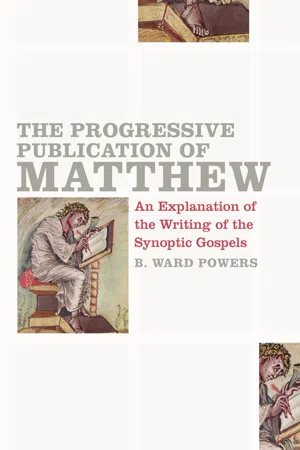
Fresh research, advancing further the work of numerous scholars over a great many decades, points convincingly to a new basis for explaining the Synoptic Problem: the Gospel of Matthew was published in stages.Scholars have long debated the Synoptic Problem--questions about why and how the Gospels of Matthew, Mark, and Luke share so much common material, and yet differ in so many ways.Assessing all the primary evidence, and the widely differing scholarly views about the SynopticProblem, B. Ward Powers draws attention to the evidence pointing to Matthew's Gospel having been published progressively, with identifiable sections of his material then being seen and utilized by Luke. After both of these Gospels had been published in their current form, they together with the preaching of the Apostle Peter were the three sources used by Mark in producing a special-purpose Gospel for preachers and evangelists. The Progressive Publication of Matthew fleshes out this proposal, measuring it in detail against other hypotheses.This book also sets out a clarification of the reason and purpose of Mark's Gospel, and a comprehensive explanation of pericope order in all three Synoptics. Endorsement " The Progressive Publication of Matthew is a tour de force both in its scope and depth. No serious student of the synoptic Gospels can afford to ignore it." David Alan Black
Professor of New Testament and Greek, Southeastern Baptist Theological Seminary
Author of Why Four Gospels?
- 624 pages
- English
- ePUB (mobile friendly)
- Available on iOS & Android
eBook - ePub
The Progressive Publication of Matthew
About this book
Information
Topic
Theology & ReligionSubtopic
Biblical Studies1
WHAT THIS BOOK IS ALL ABOUT
An overview of the Progressive Publication of Matthew Hypothesis, with a presentation of the five basic propositions to which the evidence points.
The Synoptic Problem is an important matter. . . . When we recognize the solution to the Synoptic Problem to be a central building block in our understanding of how to answer questions about the trustworthiness of the Gospels and the distinctive theologies of each evangelist, we cannot help but appreciate its importance.
—Craig Blomberg
(advocate of Markan Priority),
in Black and Beck (2001, 40)
A BRIEF DESCRIPTION
This book is about the relationship between the first three Gospels in the New Testament. In the pages to follow I give you two good reasons why it is not worth your while to bother with this book—it is simply a waste of your valuable time. But I also give you a response to those reasons. And you might decide that the response is in fact better than the two good reasons, so that this book is worth looking at after all. But first of all, I need to clarify what I am discussing in this book.
The first three Gospels—Matthew, Mark, and Luke—are often called the Synoptic Gospels or simply the Synoptics. The word synoptic means “to look at or see together,” that is, to compare things side by side. When you do this, you will immediately be impressed by two striking features about the Synoptics: their similarities, the things they have in common; and their differences, the places where they are unlike each other—and occasions where they seem to contradict each other.
These similarities are at times quite remarkable and cry out for explanation. There are places where two and even three Synoptics are identical, ranging from several words to entire sentences. Now when this occurs in a teaching that Jesus gave or a story that he told, then the explanation could simply be that this is indeed what was said (or reported) and thus the authors got it right—whatever their sources. But if it occurs in a piece of narrative, a description that some author has written, then this explanation is not adequate and we need to look for another. The most obvious one that comes to mind is that of a common source: either one Gospel copied from the other, or two of them used a third source, whether written or oral.
But the differences between the Synoptics are also at times quite remarkable and cry out for explanation. If one used another—if A used B—why does A change so much of B? By accident? To make a point? For correction? Because of some external consideration, such as a later church tradition or doctrine? All these possibilities and more have been advocated in the wealth of literature that discusses these matters. This issue is often called the Synoptic Problem, and these Synoptic differences are so great and so varied that a large number of solutions to the Synoptic Problem have been proposed to account for them.
The differences are of three main kinds: (1) differences of points of detail in the stories in which they are found; (2) differences of content in the stories overall, including some stories or units of material—called pericopes—found in only one Gospel, others in two, and still others in all three; and (3) where two or three of the Synoptics do contain the same pericopes, differences in Synoptic order, that is, differences in the sequence of events they record.
An explanation of Synoptic relationships (i.e., a solution to the Synoptic Problem) needs to address all these Synoptic features, and it will be—or ought to be—judged on the basis of its explanatory power. A proposed solution to the Synoptic Problem is valuable only to the extent that it can supply a convincing and satisfactory account of what we observe in these Gospels.
IS THIS BOOK WORTHWHILE?
There are two good reasons for not reading any further in this book. The first of these is that the Synoptic Problem was solved years ago so scholars in general agree on the solution. Thus G. M. Styler said (1962, 223), “After a century or more of discussion, it has come to be accepted by scholars almost as axiomatic that Mark is the oldest of the three Synoptic Gospels and that it was used by Matthew and Luke as a source. This has come to be regarded as ‘the one absolutely assured result’ of the study of the Synoptic Problem.”
The second reason for dismissing the issue is that it doesn’t really seem to matter anyway. We can just go on and read the Gospels and use them without bothering with any question of relationships between them. Since all three were inspired by the Holy Spirit, we can just take each one as it stands.
My response to the first reason is that the Markan Priority Hypothesis is widely accepted, not because it explains everything satisfactorily, but because it seems to do a better job than any other alternative. There are indeed many problems with Markan Priority as an explanation of the data and with the traditional reasons given in support of it—reasons going back to B. H. Streeter, who gave it its classic form in 1924.
It deserves to be noted that a substantial volume of literature exists—some from years ago and some of recent origin—that casts grave doubt on the validity of Markan Priority. The individual arguments for Markan Priority have all been tested, assessed, and rebutted by a variety of authors. A string of monographs and detailed studies has exposed the weaknesses of the grounds for the Markan Priority Hypothesis, which has difficulty in explaining observable Synoptic data apart from a resort to subjective opinion or dependence on coincidence. The snag is that while it is pretty easy to find holes in the case for Markan Priority, there have been similar holes in the other explanations that have been offered.
Styler himself recognized that the Markan Priority Hypothesis was not without its problems. But he holds firmly to Markan Priority because it has fewer problems than any other explanation. For example, Styler demolished the view of Bishop B. C. Butler (1951, 90–92), who contended that the order of writing is Matthew-Mark-Luke, and said about this view, “Butler’s treatment of this leaves me quite unconvinced” (ibid., 228). In summary, Styler wrote, “Our explanation of his favourite cases may be cumbersome; but his explanation of our favourite cases is incredible” (ibid.).
Styler concluded, “Until some less incredible explanation is forthcoming, the natural conclusion that Mark is prior to Matthew will continue to hold the field” (ibid., 231). In my judgment Styler’s analysis remains valid. Most scholars hold to Markan Priority with or without postulating another source designated Q to explain Matthew-Luke agreements. But this is not because they cannot see the problems with that hypothesis; it is because Markan Priority seems to hold up as a better explanation than any other alternative and can be said to cover more of the observable data.
If we are going to adhere to Markan Priority, honesty demands that we at least be aware of the flimsy and dubious nature of the foundation on which it rests. This book explains all the arguments known to me for Markan Priority and summarizes the rebuttal of those arguments that competent scholars have given over the years. The reader can then judge whether any objective, factual, valid support for this hypothesis remains. I also offer an explanation of Synoptic interrelationships that I believe answers all the problems that exist both with Markan Priority and the other hypotheses, and this explanation accords both with internal observable data and external evidence.
But what about the second objection, that it doesn’t really seem to matter? Actually, it matters seriously, for several important reasons.
First, at the academic level this is a significant issue in New Testament research that has had a focus on Gospel scholarship for more than two centuries. If there is now a hypothesis propounded that has greater explanatory power than those offered so far, then it should be examined and assessed and a verdict given on its validity. All kinds of repercussions flow from the explanation one adopts for Synoptic differences. For example, certain variations of the literary interdependence hypothesis will push one toward giving the Gospels a late date, which in turn affects one’s approach to questions of authorship, which interacts with one’s assessment of how close in time the Gospel writings are to the events they record—which then becomes (for some scholars) a measure of their reliability.
In 2000 D. Black and D. Beck convened a conference at Southeastern Baptist Theological Seminary that gathered together (to quote the conveners) “some of the world’s leading experts in the field of New Testament studies” (2001, 13). The purpose was to assess the current state of scholarship relating to the Synoptic Problem. The papers presented at that conference have been published (2001) with the title Rethinking the Synoptic Problem, edited by D. A. Black and D. R. Beck. One point of consensus amongst the differing viewpoints expressed at the conference was the crucial nature of this issue in New Testament scholarship. C. Blomberg expressed this consensus when he wrote (Black and Beck 2001, 40) that “the Synoptic Problem is an important matter. . . . When we recognize the solution to the Synoptic Problem to be a central building block in our understanding of how to answer questions about the trustworthiness of the Gospels and the distinctive theologies of each evangelist, we cannot help but appreciate its importance.”
Second, at the practical and pastoral level, what are we to make of the Gospel accounts where they differ? For example, when Jairus the synagogue ruler came to Jesus, was his daughter still alive (though close to death), or already dead (Mark 5:23 and Luke 8:42 compared with Matt 9:18)? And regarding the rich ruler who came to Jesus, was he still young, or does his claim to have kept the commandments from the time of his youth indicate that he was young no longer (Matt 19:20,22 compared with Mark 10:20 and Luke 18:21)? Did Jesus encounter blind Bartimaeus when entering or leaving Jericho (Luke 18:35 compared with Matt 20:29 and Mark 10:46)?
When teaching from one of these stories, one can avoid these problems by simply choosing one of the Gospel accounts and ignoring the others. While considering two or three accounts of the same event, one could say that all of the accounts are quite independent—there was no literary copying at all, and the differences in the stories are exactly the kind that would be found between the accounts of any two (or three) witnesses of the same event. Fair enough, this “complete independence” view could account for the Synoptic differences, but what about the remarkable similarities of wording and pericope order one often encounters in the Synoptics?
When proposing that the accounts are independent, one has begun seeking an explanation for those similarities and differences. And this is exactly what this present book is about: examining the Gospel material and seeking an explanation that accounts for the observable data.
At the 2000 Synoptic Problem conference referred to above, there were three points of agreement among all participants: (1) the central importance of this issue, as already mentioned; (2) the Complete Independence view of the three Synoptics does not hold up in the light of the data we have; and (3) Mark is clearly the middle factor between the two major Synoptics, so that there are two basic hypotheses that correspond with the data: (a) Mark was written first and was used by Matthew and Luke (i.e., some version of Markan Priority); or Mark was written third and used Matthew and Luke as sources (i.e., some version of Markan Posteriority, or Markan Dependence on the other two Gospels). S. McKnight summed it up this way: “Whether first or third, Mark is the middle factor. . . . We are reasonably confident that Matthew, Mark and Luke are related at the literary level and that it is highly likely that they are mutually dependent, however one might see that relationship or set of relationships” (Black and Beck 2001, 76–77).
McKnight’s own position (ibid., 67) is that the so-called proofs of Markan Priority put forward by B. H. Streeter in 1924 are not decisive for Markan Priority as against Markan Dependence, and that either explanation is possible. The choice between them is to be made on the basis of probability. When weighing alternative explanations, he said, “We are dealing with probabilities, not possibilities. I don’t rule out the possibilities. I only ask which is more probable” (ibid., 86). McKnight’s assessment of the evidence brings him down on the side of Markan Priority, which by his own admission he maintained because of the balance of probabilities.
In fact, McKnight asked in 2000 (see Black and Beck 2001, 80, 83, 89–90, 95), as Styler did in 1962 (ibid., 232), “Where is the more convincing alternative?” I am offering, for your consideration, such an alternative to Markan Priority.
In putting this alternative forward, I draw attention to the way that scholars investigating the Synoptic Problem throughout the years seem to agree on the acceptance of one fundamental presupposition. They differ as to the order and interrelationship of the Synoptics; they differ concerning the nature, scope, contents, language, date, and so forth, of the sources, written and oral, lying behind the Synoptics; but they all seem to accept that Matthew, Mark, and Luke were written (or, at least, were published) in some particular order, and the nature of the Synoptic Problem is to decide, on the basis of the evidence, what that order was.
This presupposition, regarded virtually as axiomatic, was stated explicitly by W. Farmer (1976, 199) in this way:
However important the part oral tradition and other written sources may have played in the composition of the Synoptic Gospels, the problem of determining which was written first, which second, and which third still persists. One of the three was written before the other two. One was written after the first, and before the third. And one was written after the other two.
But my question would be, “Is this necessarily so?” I suggest that the key to the Synoptic Problem lies in the recognition that one of the Gospels was written and published in stages, and that Gospel was Matthew. In other words, Matthew’s Gospel had its beginnings in a series of separate documents authored by the apostle Matthew over a period of some years, which thereafter were circulating independently in the churches before being edited and expanded by this same apostle Matthew into the Gospel we now have.
Thus the distinguishing characteristic of the position I am presenting is its proposal of the progressive publication of Matthew. To indicate this and to differentiate this hypothesis from others with which it partly agrees, I have referred to it throughout this book as the Progressive Publication Hypothesis.
It is well worthwhile, then, to see if this new Synoptic hypothesis can do a better job of accounting for the observable data, to see if it has greater explanatory power than the other hypotheses. Indeed, I would contend that when this hypothesis is seriously examined, it will be seen that it meshes well with what we know of the situation in the early church and with the external evidence of church history, and that it explains all the observable data of the Synoptic Gospels.
I intend in this book to indicate how this hypothesis derives from several propositions, which I submit are abundantly supported by the evidence and which together offer the most convincing explanation of all the observable data. This is a new hypothesis in that it has not been presented before in this manner, with its components assembled and defended in these propositions. But almost all of these ind...
Table of contents
- Cover
- Dedication
- Copyright
- Contents
- Chapter 1
- Chapter 2
- Chapter 3
- Chapter 4
- Chapter 5
- Chapter 6
- Chapter 7
- Chapter 8
- Chapter 9
- Chapter 10
- Chapter 11
- Chapter 12
- Bibliography
- Name Index
- Subject Index
- Scripture Index
Trusted by 375,005 students
Access to over 1.5 million titles for a fair monthly price.
Study more efficiently using our study tools.
Frequently asked questions
Yes, you can cancel anytime from the Subscription tab in your account settings on the Perlego website. Your subscription will stay active until the end of your current billing period. Learn how to cancel your subscription
No, books cannot be downloaded as external files, such as PDFs, for use outside of Perlego. However, you can download books within the Perlego app for offline reading on mobile or tablet. Learn how to download books offline
Perlego offers two plans: Essential and Complete
- Essential is ideal for learners and professionals who enjoy exploring a wide range of subjects. Access the Essential Library with 800,000+ trusted titles and best-sellers across business, personal growth, and the humanities. Includes unlimited reading time and Standard Read Aloud voice.
- Complete: Perfect for advanced learners and researchers needing full, unrestricted access. Unlock 1.5M+ books across hundreds of subjects, including academic and specialized titles. The Complete Plan also includes advanced features like Premium Read Aloud and Research Assistant.
We are an online textbook subscription service, where you can get access to an entire online library for less than the price of a single book per month. With over 1.5 million books across 990+ topics, we’ve got you covered! Learn about our mission
Look out for the read-aloud symbol on your next book to see if you can listen to it. The read-aloud tool reads text aloud for you, highlighting the text as it is being read. You can pause it, speed it up and slow it down. Learn more about Read Aloud
Yes! You can use the Perlego app on both iOS and Android devices to read anytime, anywhere — even offline. Perfect for commutes or when you’re on the go.
Please note we cannot support devices running on iOS 13 and Android 7 or earlier. Learn more about using the app
Please note we cannot support devices running on iOS 13 and Android 7 or earlier. Learn more about using the app
Yes, you can access The Progressive Publication of Matthew by B. Ward Powers in PDF and/or ePUB format, as well as other popular books in Theology & Religion & Biblical Studies. We have over 1.5 million books available in our catalogue for you to explore.