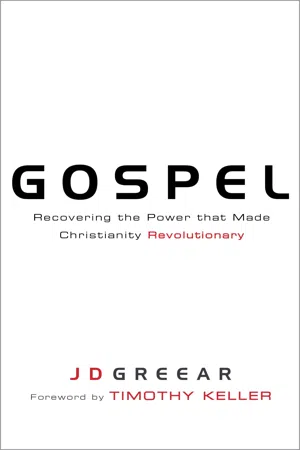
Could the gospel be lost in evangelical churches? In this book, J.D. Greear shows how moralism and legalism have often eclipsed the gospel, even in conservative churches. Gospel cuts through the superficiality of religion and reacquaints you with the revolutionary truth of God's gracious acceptance of us in Christ. The gospel is the power of God, and the only true source of joy, freedom, radical generosity, and audacious faith. The gospel produces in us what religion never could: a heart that desires God. The book's core is a "gospel prayer" by which you can saturate yourself in the gospel daily. Dwelling on the gospel will release in you new depths of passion for God and take you to new heights of obedience to Him. Gospel gives you an applicable, exciting vision of how God will use you to bring His healing to the world.
eBook - ePub
Gospel
Recovering the Power that Made Christianity Revolutionary
- 288 pages
- English
- ePUB (mobile friendly)
- Available on iOS & Android
eBook - ePub
About this book
Information
Topic
Theology & ReligionSubtopic
Biblical StudiesPart 1
How the Gospel Does What Religion Cannot
Chapter 1
The Missing Gospel
Is the gospel really missing? If so, where did it go?
Most Christians have the facts straight: Jesus was born of a virgin, lived a perfect life, died on the cross in our place, and was raised from the dead. All those who place their faith in Him will be forgiven and have everlasting life. So, the gospel is not missing.
Not so fast.
I mentioned in the introduction that there is a difference in knowing that honey is sweet and having that sweetness burst alive in your mouth. Being able to articulate the gospel with accuracy is one thing; having its truth captivate your soul is quite another.
The gospel is not just supposed to be our ticket into heaven; it is to be an entirely new basis for how we relate to God, ourselves, and others. It is to be the source from which everything else flows.
Being able to articulate the gospel with accuracy is one thing; having its truth captivate your soul is quite another.
Let me lay all my cards on the table: I believe evangelicalism, as a whole, desperately needs a recovery of the gospel as the center of Christianity. Even in conservative denominations like my own (the Southern Baptist Convention), the gospel has been eclipsed by any number of secondary stimuli for growth.
I don’t mean that we have corrupted the gospel—no, we’ve still got those facts right. But the goal of the gospel is not just that we pass some kind of test by accurately recounting the importance of Jesus. The goal of the gospel is to produce a type of people consumed with passion for God and love for others. We certainly don’t seem to have that right.
A Christianity that does not have as its primary focus the deepening of passions for God is a false Christianity, no matter how zealously it seeks conversions or how forcefully it advocates righteous behavior. Being converted to Jesus is not just about learning to obey some rules. Being converted to Jesus is learning to so adore God that we would gladly renounce everything we have to follow Him.
A Christianity that does not have as its primary focus the deepening of passions for God is a false Christianity, no matter how zealously it seeks conversions or how forcefully it advocates righteous behavior.
In graduate school my roommate kept a dog named Max in our house. Because poor Max was crippled in his back legs, his life consisted of lying on our doorstep and staring up at us when we walked by. I remember looking at him one day and thinking, “Based on how most people see Christianity, Max would make a fine Christian: he doesn’t drink; he doesn’t smoke; he doesn’t cuss; he doesn’t get angry; we’ve had him neutered so his thought-life is under control.”
Jesus’ disciples are not supposed to be merely compliant, neutered dogs. Jesus’ followers are to be alive with a love for God. When you love God and love others, Jesus said, all the rest of the Christian life falls naturally into place (Matt. 22:37–39).
How Do We Learn to Love God?
How, then, do we learn to love God? That’s the dilemma of the “great commandment”: “You shall love the Lord your God with all your heart and with all your soul and with all your mind” (Matt. 22:37). But how can true love be commanded?
Being commanded to love someone you have no natural affection for becomes wearisome. True love grows as a response to loveliness. The first time I saw my wife, I felt the beginnings of love for her. The more I’ve gotten to know her over the years, and the more I’ve seen of her beauty, the more I’ve grown to love her. My love is a response.
Love for God is commanded in Scripture, but the command can only truly be fulfilled as our eyes are opened to see God’s beauty revealed in the gospel. The Spirit of God uses the beauty of the gospel to awaken in our hearts a desire for God. “We love Him,” the apostle John would say, “because He first loved us” (1 John 4:19 nkjv). Love for God grows out of an experience of the love of God.
Love for God grows out of an experience of the love of God.
When we focus primarily on behavior change, we are ignoring the real issue: a heart that doesn’t want to love God. That’s certainly not to say that we should only obey God when we feel like it; only that preaching Christianity primarily as a set of new behaviors will create people who act right without ever loving the right.1 This creates hypocrites, weary and resentful of God.
What Is “Real” Spiritual Growth?
In the last message Jesus gave to His disciples, He told them that the way to fruitfulness and joy—the “secret” to the Christian life—was to abide in Him. They wouldn’t produce “abundant fruit” by reading books, intensifying their self-discipline, memorizing Scripture, or getting in accountability groups. Those things all have their place, but real fruit comes only from one place: abiding in Jesus.
“Abiding in Jesus” may sound like spiritual mumbo jumbo to you. It always did to me. I assumed that when you were “abiding in Jesus” you’d walk around with an ethereal glow in your eye and inexplicably wake up at 4 a.m. strumming passion tunes on the golden harp you keep beside your bed. But the word abide is much more straightforward than that. The Greek word meno means literally “to make your home in.” When we “make our home in” His love—feeling it, saturating ourselves with it, reflecting on it, standing in awe of it—spiritual fruit begins to spring up naturally from us like roses on a rosebush.
When we “make our home in” His love, spiritual fruit begins to spring up naturally from us.
Spiritual “fruit,” you see, is produced in the same way physical “fruit” is. When a man and woman conceive physical “fruit” (i.e., a child), they are usually not thinking about the mechanics of making that child. Rather, they get caught up in a moment of loving intimacy with one another, and the fruit of that loving intimacy is a child.
In the same way, spiritual fruit isn’t made by focusing on the commands of spiritual growth. You can’t just grit your teeth and say, “I will have more loving feelings toward God! I will be more patient! I will have self-control!” I’ll explain later the role for denial of the flesh and self-disciplines, but true spiritual fruit comes from getting swept up in intimate, loving encounters with Jesus Christ. His love is the soil in which all the fruits of the Spirit grow. When our roots abide there, then joy, peace, patience, kindness, gentleness, and self-control grow naturally in our hearts.
So if you want to see spiritual fruit in your life, don’t focus primarily on the fruits. Focus on Jesus’ acceptance of you, given to you as a gift. Focusing on spiritual fruit will usually produce only frustration and despair, not fruitfulness.
Have you ever looked at your life and thought, “Why am I still so impatient? How could I really be saved and still have such a problem with self-control?” I certainly have. If anything, the more I’ve walked with Jesus the more aware I’ve become of my sinfulness. Jesus, however, did not tell me to “abide” in my fruitfulness. He told me to abide in Him—in His acceptance of me, given to me freely as a gift.
To see spiritual fruit in your life, don’t focus primarily on the fruits. Focus on Jesus’ acceptance of you, given to you as a gift.
Abiding in Jesus means understanding that His acceptance of us is the same regardless of the amount of spiritual fruit we have produced. Ironically, it is only when we understand that His love is not conditioned on our spiritual fruitfulness that we gain the power to become truly fruitful. Only those who abide in Him produce much fruit. In other words, those people who get better are those who understand that God’s approval of them is not dependent on their getting better.
So what I really want to help you do in this book is abide in Jesus. The by-product of abiding in Jesus is that you will become more patient in your marriage; you will develop self-discipline; you will become generous. Abiding in Jesus will produce all of the fruits of the Spirit in you—but not by having you concentrate particularly on any of those things. You concentrate on Jesus. You rest in His love and acceptance, given to you not because of what you have earned, but because of what He has earned for you.
Without Love, It’s Ultimately Worthless
My senior year of high school, I started a relationship with an incredible girl for whom I should have been head over heels. “On paper” she was perfect. The problem was that when we were together there was just no magic, if you know what I mean. I couldn’t find a reason to quit dating her, however, so we kept on dating, even after I left for college 1,200 miles away.
I returned home for the first time over Christmas break, and we agreed to see each other the day before Christmas. All was well and good until the afternoon before I went to her house, when I had an alarming thought: Was I supposed to get her a Christmas present? It was, after all, the day before Christmas. If she got me a Christmas present and I didn’t get her one, then I would look like a total sleezeball.
Just to be safe, I stopped at the mall on my way to see her. I went into a sporting goods shop, the natural place you look for romantic gifts, and there I saw it—the absolutely perfect gift: an Adidas snow-skiing neck-warmer. It was $7. I wrapped up the woolen masterpiece and put it under the seat in my car and drove the forty-five minutes over to her hou...
Table of contents
- Foreword
- Introduction
- Part 1: How the Gospel Does What Religion Cannot
- Part 2: The Gospel Prayer
- Part 3: Toward a Gospel-Centered Understanding of Life
- Conclusion: You’ll Never Find the Bottom
- Appendix 1: The Gospel Project
- Appendix 2: A Gospel-Centered Warning to Young Zealous Theologians
- Notes
Trusted by 375,005 students
Access to over 1.5 million titles for a fair monthly price.
Study more efficiently using our study tools.
Frequently asked questions
Yes, you can cancel anytime from the Subscription tab in your account settings on the Perlego website. Your subscription will stay active until the end of your current billing period. Learn how to cancel your subscription
No, books cannot be downloaded as external files, such as PDFs, for use outside of Perlego. However, you can download books within the Perlego app for offline reading on mobile or tablet. Learn how to download books offline
Perlego offers two plans: Essential and Complete
- Essential is ideal for learners and professionals who enjoy exploring a wide range of subjects. Access the Essential Library with 800,000+ trusted titles and best-sellers across business, personal growth, and the humanities. Includes unlimited reading time and Standard Read Aloud voice.
- Complete: Perfect for advanced learners and researchers needing full, unrestricted access. Unlock 1.5M+ books across hundreds of subjects, including academic and specialized titles. The Complete Plan also includes advanced features like Premium Read Aloud and Research Assistant.
We are an online textbook subscription service, where you can get access to an entire online library for less than the price of a single book per month. With over 1.5 million books across 990+ topics, we’ve got you covered! Learn about our mission
Look out for the read-aloud symbol on your next book to see if you can listen to it. The read-aloud tool reads text aloud for you, highlighting the text as it is being read. You can pause it, speed it up and slow it down. Learn more about Read Aloud
Yes! You can use the Perlego app on both iOS and Android devices to read anytime, anywhere — even offline. Perfect for commutes or when you’re on the go.
Please note we cannot support devices running on iOS 13 and Android 7 or earlier. Learn more about using the app
Please note we cannot support devices running on iOS 13 and Android 7 or earlier. Learn more about using the app
Yes, you can access Gospel by J. D. Greear,J.D. Greear in PDF and/or ePUB format, as well as other popular books in Theology & Religion & Biblical Studies. We have over 1.5 million books available in our catalogue for you to explore.