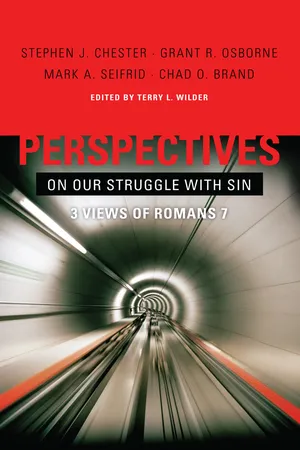
"For I do not understand what I am doing, because I do not practice what I want to do, but I do what I hate." —Romans 7: 15, HCSB Perspectives on Our Struggle with Sin presents in point-counterpoint form three differing views of a Christian's relationship with the law, flesh, and spirit as illustrated through Paul's often-debated words in Romans 7. Stephen Chester (North Park Theological Seminary) writes "The Retrospective View of Romans 7: Paul's Past in Present Perspective, " suggesting the apostle's description of his struggle speaks more to his pre-Christian self. Grant Osborne (Trinity Evangelical Divinity School) offers "The Flesh Without the Spirit: Romans 7 and Christian Experience, " perceiving Romans 7 as an accurate representation of what believers go through even after their conversion. Mark Seifrid (The Southern Baptist Theological Seminary), in "The Voice of the Law, the Cry of Lament, and the Shout of Thanksgiving, " asserts that Paul is not speaking of his past or his present Christian experience in Romans 7, but more fundamentally and simply about "the human being confronted with the Law." Chad Owen Brand (The Southern Baptist Theological Seminary) writes a conclusion on the theological and pastoral implications of Romans 7. Acclaim for Perspectives on Our Struggle with Sin: "One difficult and disputed text, three fine scholars, and three views of the passage. How is one to read Romans 7? This book takes you through all the options and rationale with detail, charity, and clarity. This is how to have a discussion over a disputed text. Read and learn about Romans 7. Decide who is right and why. And, above all, learn about how to discuss a difficult text." Darrell L. Bock
Research professor of New Testament Studies
Dallas Theological Seminary"The meaning of Romans 7 continues to bedevil and puzzle readers. This volume does not simply rehearse arguments and positions from the past. The authors approach the text from fresh and illuminating perspectives, and hence this work represents a significant contribution to scholarship." Thomas R. Schreiner
James Buchanan Harrison professor of New Testament Interpretation
The Southern Baptist Theological SeminaryChristians have long debated how Paul's moving depiction of a struggle with sin in "Romans 7 should influence our theology and practice of the Christian life. Now, in one book, Christians are given a wonderful opportunity to engage the different views, see how they differ, and come to their own conclusions. Chester, Osborne, and Seifrid clearly and capably defend their positions; and they do so with enough of a difference in method that the reader is given a good sense of the scope of the issues and their significance." Douglas J. Moo
Kenneth T. Wessner Chair of Biblical Studies
Wheaton College
- 224 pages
- English
- ePUB (mobile friendly)
- Available on iOS & Android
eBook - ePub
About this book
Information
Topic
Theology & ReligionSubtopic
Biblical StudiesCHAPTER 1
The Flesh Without the Spirit:
Romans 7 and Christian Experience
GRANT R. OSBORNE
Romans 7:7–25 is one of the most difficult exegetical and theological conundrums in the New Testament. A general consensus never has been and never will be reached on its meaning, for simply too many viable options seem to fit the context of Romans 5–8. All of the options presented in this work fit the data, and it would be arrogant to try to claim that only my view can be correct. This text is another of the many biblical passages where we simply have to admit that we will not know the true meaning until we get to heaven—and then Paul himself can tell us what he meant! Nevertheless, this chapter will argue that of these options, the one which claims that Paul was describing Christian experience best answers all the variables.
Romans 7: The Importance of Context
It is critical at the outset to establish the context, for in the end the answer that best fits the developing argument of Romans 5–8 will be preferable. The first half of Romans contains two parts: (1) 1:1–4:25 centers on the utter sinfulness of mankind, with the only solution being the justification (God declaring people righteous on the basis of the atoning sacrifice of Christ) provided by God and the necessity of faith in Christ as the only way people can find salvation; (2) 5:1–8:39 details the new life in Christ that justification effects.1 This latter section can best be described as a “ring composition” or chiasm in which this life in Christ and the Spirit is celebrated.2
A Results 1—hope and assurance of future glory, 5:1–11
B Basis for assurance—the work of the “New Adam,” 5:12–21
C The problem of sin and death, 6:1–23
C´ The problem of sin and the law, 7:1–25
B´ Basis for assurance—new life in the Spirit, 8:1–17
A´ Results 2—glory and security in the Spirit, 8:18–39
Chapter 7 is part of the central section of what could be called Paul’s doctrine of sanctification. In 1:18–3:18 the problem of sin is discussed in terms of the unbeliever, detailing that depravity that makes it impossible to achieve salvation. In 6:1–23 sin is described as still an active force in the life of the believer, invading and trying to establish a bridgehead in their lives to gain power over them. “The first section (vv. 1–14) reiterates that we have died to sin and are now alive to God in Christ. The second section (vv. 15–23) explains that we have been liberated from enslavement to sin and are now slaves to righteousness.”3 We will be asking whether in chap. 7 Paul returns to the pre-Christian life or continues the theme of chap. 6, namely, the struggle of the Christian against sin.
In chap. 7 Paul turns to an issue he has mentioned often, that of the Torah or Law. He had already spoken frequently regarding the place of the law. In 3:21 he stated that justification (= “righteousness from God,” cf. 1:17) can only be experienced “apart from the law,” meaning that God has instituted a new age of salvation that cannot be attained by Torah observance.4 He clarified this further in 3:28 by asserting directly that “a person is justified by faith apart from observing the law.” Faith rather than works is central to the new covenant initiated by Christ. Then in 4:13–16 he refined the point in another direction in the example of Abraham, whose faith or belief in God was “credited to him as righteousness” (4:3 from Gen 15:6). Paul explained that this denotes explicitly that “Abraham and his offspring” (Gentile as well as Jew) receive the “promise” not “through the law” but by grace through faith.
But now Paul goes a step further. It is not just that the law cannot produce salvation; it also becomes an instrument of sin (3:20; 4:15; 7:5). In 5:20 it says that God “brought in” the law “so that the trespass might increase,” that is, to deepen the intensity of people’s awareness of sin by proving to them the serious nature of sin as direct transgression of the laws of God. Finally, in 6:14 Paul concludes that due to the grace of God in Christ “sin shall no longer be your master” because “you are not under the law,” that is, no longer part of the old eon in which sin could use the law to draw people away from God.
This teaching about the law is summed up in 7:1–6. Here Paul has decided to address the whole question of the law that he has introduced in the several spots noted above, and a good title for this section would be “Freedom from the Law in the Death of Christ.”5 Especially, he wishes to clarify the meaning of “not under the law” in 6:14 and to clarify the relation of the law to sin and then to the believer. To do so, he utilizes the metaphor of marriage to demonstrate the principle that “the law has authority over someone only as long as that person lives” (7:1). To illustrate this, Paul appeals to the fact that a married woman is “bound” under the authority of her husband so long as he is alive, but once he dies she is free from that marriage bond (vv. 2–3). This is then applied to the authority of the law in vv. 4–6, making the point that in this same way death removes a person from the authority of the law. The law has authority only over the living, so death is a liberation. Since Christians have been “baptized” into the death of Christ (Rom 6:3) and been “buried with him” (6:4), they have “died to sin” (6:2). Paul now extends this death to the law. Believers have “died to the law through the body of Christ” and been united with Christ (7:4), meaning both to be set free from the condemnation of the law and to leave the old realm of sin, death, and the law and enter the new realm of Christ and life. The law had become a tool in which “the sinful passions” were aroused by it (7:5), so in Christ the follower has been “released from the law” to “serve in the new way of the Spirit” (7:6).
On the one side of 7:7–25 lay the context of 5:1–7:6, dealing with the results of justification in the Christian life, including the relationship of the believer to sin and the law. While at one level sin and the law produced condemnation and defeat, at the other level the believer had victory over both in Christ and had entered another realm, the new covenant reality of life in Christ and the Spirit. On the other side of 7:7–25 lay 8:1–39, detailing the new life in the Spirit. The defeatism caused by sin and the law operating in the flesh in chap. 7 has been overturned in the victory caused by life in the Spirit. The key term is πνεῦμα, occurring 21 times in chap. 8, and the eschatological battle with sin and the law is solved in the eschatological presence of the Holy Spirit in the believer’s life.
There are four parts to Romans 8: (1) in vv. 1–11 the joy and hope promised in 5:1–11 are realized via the indwelling power of the Spirit, who enables God’s people to overcome sin, obey God, and find life and peace in Christ; (2) in vv. 12–17 this life in the Spirit entails a new family relationship, as believers are adopted as God’s children, cry out to him as “Abba, Father,” and are promised a glorious inheritance; (3) in vv. 18–30 the presence of the Spirit produces a new hope in the midst of our “groanings” in affliction; participating in Christ’s suffering is the path to glory, and God’s sovereignty guarantees our salvation and that final glory; (4) in vv. 31–39 this security is absolute because it is anchored in the love of God and the love of Christ.
The task of this chapter is to examine the various options for understanding 7:7–25 from the standpoint of which one best fits the context we have just highlighted. What was Paul trying to say about the presence of sin and the law in this world, and how are we to understand the straw man Paul develops to illustrate his point? In one sense Paul provides an “apology or defense for the law,” clarifying that the law is not evil but has a God-given purpose. In another sense he extends his study of sin from chap. 6 by noting the power of sin over people, then the solution for overcoming sin. Our purpose now is to delineate the options and then through a deep study of the text itself see which one emerges as the most likely thrust for 7:7–25.
Romans 7: Options for Understanding It
The two basic questions are quite clear to anyone who reads this passage at all clearly: to whom does Paul refer when he switches from the third person style he has used in Romans to the first person “I” throughout this passage, and is Paul describing the spiritual experience of an unregenerate or a regenerate person? These two issues have spawned a multiplicity of theories. In the ensuing material we will look at the major options on the first issue and will cover the second when we get to 7:14–25. It is important to realize that these theories are not mutually exclusive. Most scholars combine two or three of them.
Autobiographical. The most natural understanding would be that by using “I” in 7:7–25 Paul is speaking of himself as an example of what people experience. According to this view Paul is describing his own experience when as a youth he first realized the implications of keeping the law (so Zahn, Godet, Dodd, Jeremias, Bruce, Gundry). Those who take this approach believe that the strong emotional outpouring and powerful personal tone of Romans 7 demands that Paul has to be speaking primarily of his own experiences. J. Knox Chamblin states, “He is too deeply involved in what he is saying—the existential anguish of these verses is too real—for us to regard the ‘I’ as merely a rhetorical device.”6 Stott adds, “What he writes seems too realistic and vivid to be either a purely rhetorical device or the impersonation of somebody else.”7 J. I. Packer thinks that the issue is “beyond dispute” because any suggestion that the “wretched man” was uttered of someone else rather than of Paul himself “seems so artificial and theatrical as to be incredible.”8 These scholars do not go so far as Theissen, et al., who read the text from the viewpoint of psychoanalysis and see Paul providing an existential analysis of himself,9 but still autobiography is seen as central. This view is easiest to understand in vv. 14–25 where the text shows the “I” struggling to put what he “knows to do” into practice but being unable to do so. Every Christian has agonized over the problem of sin in just this way.
Everyman. This view understands Paul as describing the struggle of every person with sin (so Kümmel, Bornkamm, Lambrecht, Fitzmyer). Peter Borgen believes that Paul gives this biographical form but in actuality is describing a “contrite wrongdoer” who “admits his misdeed, affirms the authority of the law/the divine rule, reacts existentially, and faces punishment and/or deliverance.”10 This view has become a dominant one. Kümmel sees it as purely rhetorical for all people under the law and points to three places in the Talmud where he believes a Stilform or basic type of writing...
Table of contents
- Cover
- Copyright
- Contents
- Dedication
- Contributors
- Acknowledgments
- Introduction
- Chapter 1
- Chapter 2
- Chapter 3
- Conclusion
Trusted by 375,005 students
Access to over 1.5 million titles for a fair monthly price.
Study more efficiently using our study tools.
Frequently asked questions
Yes, you can cancel anytime from the Subscription tab in your account settings on the Perlego website. Your subscription will stay active until the end of your current billing period. Learn how to cancel your subscription
No, books cannot be downloaded as external files, such as PDFs, for use outside of Perlego. However, you can download books within the Perlego app for offline reading on mobile or tablet. Learn how to download books offline
Perlego offers two plans: Essential and Complete
- Essential is ideal for learners and professionals who enjoy exploring a wide range of subjects. Access the Essential Library with 800,000+ trusted titles and best-sellers across business, personal growth, and the humanities. Includes unlimited reading time and Standard Read Aloud voice.
- Complete: Perfect for advanced learners and researchers needing full, unrestricted access. Unlock 1.5M+ books across hundreds of subjects, including academic and specialized titles. The Complete Plan also includes advanced features like Premium Read Aloud and Research Assistant.
We are an online textbook subscription service, where you can get access to an entire online library for less than the price of a single book per month. With over 1.5 million books across 990+ topics, we’ve got you covered! Learn about our mission
Look out for the read-aloud symbol on your next book to see if you can listen to it. The read-aloud tool reads text aloud for you, highlighting the text as it is being read. You can pause it, speed it up and slow it down. Learn more about Read Aloud
Yes! You can use the Perlego app on both iOS and Android devices to read anytime, anywhere — even offline. Perfect for commutes or when you’re on the go.
Please note we cannot support devices running on iOS 13 and Android 7 or earlier. Learn more about using the app
Please note we cannot support devices running on iOS 13 and Android 7 or earlier. Learn more about using the app
Yes, you can access Perspectives on Our Struggle with Sin by Terry L. Wilder in PDF and/or ePUB format, as well as other popular books in Theology & Religion & Biblical Studies. We have over 1.5 million books available in our catalogue for you to explore.