In 1948 the author of this volume was invited by the Education Commission of the Southern Baptist Convention to prepare a textbook on the Old Testament for use by college students. The book is intended primarily for students on the freshman and sophomore level. While some attention has been given to background materials such as geography and antiquities, the chief purpose of the writer has been to present the leading facts in the history of the Hebrew people as given in the Old Testament.
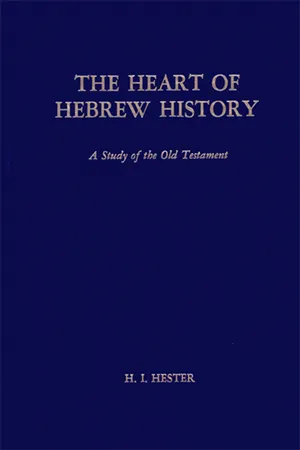
- 330 pages
- English
- ePUB (mobile friendly)
- Available on iOS & Android
eBook - ePub
About this book
Information
Chapter 1
THE BOOK WE STUDY
CHAPTER I
The Book We Study
1. Introduction.
Nearly every young person today knows at least something of the Bible. It is such a significant and important book, has had such a vital part in the making of our nation, and is so often quoted that all of us have some idea of its general character. Many of us have become familiar with parts of it by our experiences in the program of our churches. Parents, Sunday School teachers and other friends have told us some of its charming stories and have taught us some of its familiar precepts. However, the large majority of people have but a very limited knowledge of this remarkable book because their study of it has been unorganized. Too often we have “dipped into” it here and there without any plan to see it as a whole, or to appreciate it as a remarkable library of history, literature and religion.
2. A Big Book.
We should understand that the Bible is a very big book. In reality it is a large collection of books—sixty-six in number. These books, written by many different authors over a long period of time, contain many kinds of literature such as history, laws, prophecy, poetry, biography and letters. To gain a thorough knowledge of it will require years of study. However, it is possible for the college student, with one year in a well-planned course, to gain a basic understanding of it. This study should be a delightful and rewarding experience.
Before attempting to study the contents of the Bible we should become acquainted with some of the important facts about the book itself. Such knowledge will make our study much more meaningful.
3. Written by the Hebrews.
The Bible is the book of the Hebrew people. With the single exception of Luke, who wrote the Gospel of Luke and the book of Acts, every other writer who contributed to this volume was of the Hebrew race. Almost all of the events and experiences recorded in the Bible had to do with the Hebrew people. To be sure, numbers of other peoples are mentioned in the Old Testament, but only incidentally. It is true that after the death of Jesus the New Testament records the story of how Christianity worked its way out of the strict limits of Jewish life and assumed international importance, but it is to be noted that it was the Jews themselves who crossed these frontiers and gave their teachings to other races.
4. Meaning of the Word Bible.
The word Bible comes from the Greek word biblos which at first meant the bark of the papyrus plant. The word was later used to designate the pith of papyrus plants from which writing material was made. Still later the word was applied to the writings themselves, that is, the scrolls or sheets of paper. In this sense it meant a book. Through Latin usage the word came over into the English language as Bible. Hence, this volume consisting of many smaller books is known as the Bible or the Book.
5. Nature of Its Contents.
The Bible has two main divisions called the Old Testament and the New Testament. The word testament means covenant or will. Hence the meaning is old and new covenant, or more specifically, the covenant of God with his people before Christ, and the new covenant made possible through Christ. The Old Testament closes with the period previous to the birth of Christ. The New Testament begins with the events connected with the birth of Christ and closes about the end of the first Christian century.
There are sixty-six books in the Bible. Thirty-nine of these are included in the Old Testament and twenty-seven in the New Testament. In reality, the Bible is a great library consisting of these sixty-six books. Several different classifications of these books have been made. The Jews have one for the Old Testament, and others have been used by different scholars. For the sake of brevity and convenience we may divide the Old Testament into three divisions. (1) The seventeen historical books: Genesis, Exodus, Leviticus, Numbers, Deuteronomy, Joshua, Judges, Ruth, I Samuel, II Samuel, I Kings, II Kings, I Chronicles, II Chronicles, Ezra, Nehemiah, and Esther. (2) The sixteen books of prophecy, usually called the “major” and “minor” prophets: Isaiah, Jeremiah, Ezekiel, Daniel, Hosea, Joel, Amos, Obadiah, Jonah, Micah, Nahum, Habakkuk, Zephaniah, Haggai, Zechariah, Malachi. The first four mentioned are called the “major” prophets and the other twelve, “minor” prophets. (3) The following books of poetry make up the third section: Job, Psalms, Proverbs, Ecclesiastes, Song of Solomon, and Lamentations.
The New Testament books may be classified as follows: (1) The four gospels, Matthew, Mark, Luke, John; (2) One book of history, Acts; (3) Twenty-one epistles or letters. Thirteen of these were written by Paul: I Thessalonians, II Thessalonians, Galatians, Romans, I Corinthians, II Corinthians, Philippians, Colossians, Philemon, Ephesians, I Timothy, Titus, II Timothy. Eight of these are classified as general letters: Hebrews, James, Jude, I Peter, II Peter, I John, II John, III John; (4) One apocalyptic book, the Revelation.
6. How It Was Written.
There is a wide difference of opinion as to the time when the different books of the Bible were written. Many competent scholars believe that the earliest books were written around 1300 B.C. and that the New Testament was completed about 100 A.D. Thus it may be said that these sixty-six books were written during a period of some fourteen hundred years. It is generally held that there were about thirty authors. The Old Testament was written in the Hebrew language, except some small sections written in the Aramaic tongue. The writers of the New Testament used Greek. These men used finely prepared sheepskin, vellum, and the material known as papyrus, which was something like our paper. Their writings were preserved, not in the form of a book as we have them today, but in a scroll or long strip of papyrus rolled at either end. These were used sparingly, were closely guarded and were carefully preserved.
7. Divinely Inspired.
Christian people regard these writings as divinely inspired. Of course there are various theories as to the meaning of inspiration. In fact this subject is so important that a great many books have been written to explain it. We may say that in general there are three views of inspiration. (1) One extreme view, held by some liberal scholars, is that these original writers were inspired only in the sense that any writer is inspired when producing his best work. By this view Shakespeare, Browning, Goethe, Tennyson or any other were equally inspired and consequently their works have the same value. (2) Another extreme view, held by some ultra-conservative scholars, is that these writers were inspired to the degree that every minute detail of their work was automatically directed, even to the extent of proper spelling. In other words the writers were mechanically directed by a higher force and they were absolutely infallible. (3) There is a third view held by the majority of Bible students which comes in between these two. “Holy men of God spoke as they were moved by the Holy Spirit.” These writers were men of ability and holy life and were “inbreathed” or inspired by God to write. The Holy Spirit directed them as they wrote the message of God. They were the instruments used for this important service, and yet they were men who were conscious of what they were doing and whose individuality is revealed in their writings. They were aware of divine leadership and because of this fact their writings have divine sanction and authority. It is the word of God, and as such it has a value and an authority which can be claimed for no other writing. Through the centuries Christian people have accepted the Bible as the word and revelation of God. It is authoritative and final and is sufficient for all the needs of men in spiritual matters.
8. Miraculously Preserved.
Each book of the Bible was written for some specific and immediate purpose. However, its value and use would not be exhausted with this particular occasion. The book would be needed for other situations, so it would be preserved. Usually they were highly prized and carefully guarded. When one considers the fact that the writings of some thirty men were kept through a period of more than 1000 years of changing fortunes, it seems nothing less than miraculous. Indeed we can not refuse to believe that God had a part in preserving these precious writings. The limits of space will not permit us to discuss here the story of how these books were kept from destruction and were later gathered into the volume of the Old Testament and the New Testament. Two or three facts ought to be mentioned. There were other writings similar in nature to the books of both Testaments written during these years. Some of these have been kept and are found in certain versions of the Bible like the Vulgate, which is the official Bible of the Roman Catholic Church. From all these books written during these years certain ones were selected and later were recognized as the Bible. These selected ones which met the test were included in the list known as the canon of the scriptures. Scholars are almost unanimously agreed that this process of selection was completed by about 400 A.D. Since that time the Bible has consisted of these selected books. The most remarkable thing in the history of literature is the fact that these sixty-six books, written by thirty or more men in different situations over a period of more than 1000 years, constitute one great book in which there are no contradictions or inconsistencies. Indeed, the marvel is that these various books, arranged in their present form, make up a volume which is marked by complete unity and through which one great purpose runs.
9. Ancient Manuscripts.
We do not have today the original manuscript of any of the books of either the Old Testament or the New Testament. These original manuscripts have long since perished. Every student is shocked when he first learns this fact. However, this feeling of disappointment soon disappears when he discovers that this fact does not affect the authenticity of these books as they now appear in our Bible. Ancient peoples guarded such precious documents with the greatest care. Copies were made from the originals as accurately as humanly possible and were distributed to various parts of the world at that time. No part of these sacred writings was allowed to be without many witnesses. We have abundant evidence that the writings we now have are substantially the same as in the days of the first Christian century.
We do have certain very old manuscripts of the books of both Testaments. While they are not the originals they are old enough to be very accurate copies. Of course, these are of inestimable value. They are to be found in various libraries of the world and are guarded with the greatest care.
Up to 1947-48 the oldest known manuscript of the Old Testament was dated at 900 A.D. The famous Dead Sea Scrolls (1947-48) date back to the first or second Christian century. These scrolls thus have tremendous significance in the study of the Old Testament text. Altogether there are some 1700 manuscripts of the Hebrew Scriptures in existence, but most of these are of comparatively late dates.
We can mention only three of the important manuscripts of the New Testament. The oldest of these is the Vatican Codex which is dated around 350 A.D. This Codex is in the Vatican Library in Rome. It has nearly 800 pages, 10x101/2 inches and contains practically all of the Old and New Testaments. The Sinai Codex, dated about 375 A.D., is next to the Vatican Codex in importance. It is now in the British Museum. The Alexandrian Codex consisting of 776 pages, and containing practically all of our Bible goes back to about 425 A.D. It also is in England. In addition to these three there are several other important manuscripts which we need not name here. All of these ancient manuscripts have priceless value as surviving witnesses of the works of the inspired writers of old.
10. Some of the Translations.
The Old Testament, written in the Hebrew language, naturally was used by the Jews. About 275 B.C. when the Jews, along with other peoples of the Roman world, began to use the Greek language they felt that their scriptures ought to be in the spoken language of the day. So the famous Septuagint, the Old Testament in Greek, was produced. This was a monumental achievement...
Table of contents
- Chapter I: THE BOOK WE STUDY
- Chapter II: THE OLD TESTAMENT WORLD
- Chapter III: ARCHAEOLOGY AND THE BIBLE
- Chapter IV: THE HEBREWS AS A NATION
- Chapter V: PERIOD OF BEGINNINGS
- Chapter VI: THE HEBREW PATRIARCHS
- Chapter VII: DELIVERED FROM BONDAGE
- Chapter VIII: CONQUEST AND SETTLEMENT IN CANAAN
- Chapter IX: THE UNITED HEBREW MONARCHY
- Chapter X: THE RIVAL KINGDOMS
- Chapter XI: THE RIVAL KINGDOMS (CONTINUED)
- Chapter XII: THE CAPTIVITY AND THE RESTORATION
- Chapter XIII: THE PROPHETS
- Chapter XIV: THE POETICAL LITERATURE OF THE OLD TESTAMENT
- Chapter XV: THE INTER-BIBLICAL PERIOD
Trusted by 375,005 students
Access to over 1.5 million titles for a fair monthly price.
Study more efficiently using our study tools.
Frequently asked questions
Yes, you can cancel anytime from the Subscription tab in your account settings on the Perlego website. Your subscription will stay active until the end of your current billing period. Learn how to cancel your subscription
No, books cannot be downloaded as external files, such as PDFs, for use outside of Perlego. However, you can download books within the Perlego app for offline reading on mobile or tablet. Learn how to download books offline
Perlego offers two plans: Essential and Complete
- Essential is ideal for learners and professionals who enjoy exploring a wide range of subjects. Access the Essential Library with 800,000+ trusted titles and best-sellers across business, personal growth, and the humanities. Includes unlimited reading time and Standard Read Aloud voice.
- Complete: Perfect for advanced learners and researchers needing full, unrestricted access. Unlock 1.5M+ books across hundreds of subjects, including academic and specialized titles. The Complete Plan also includes advanced features like Premium Read Aloud and Research Assistant.
We are an online textbook subscription service, where you can get access to an entire online library for less than the price of a single book per month. With over 1.5 million books across 990+ topics, we’ve got you covered! Learn about our mission
Look out for the read-aloud symbol on your next book to see if you can listen to it. The read-aloud tool reads text aloud for you, highlighting the text as it is being read. You can pause it, speed it up and slow it down. Learn more about Read Aloud
Yes! You can use the Perlego app on both iOS and Android devices to read anytime, anywhere — even offline. Perfect for commutes or when you’re on the go.
Please note we cannot support devices running on iOS 13 and Android 7 or earlier. Learn more about using the app
Please note we cannot support devices running on iOS 13 and Android 7 or earlier. Learn more about using the app
Yes, you can access The Heart of Hebrew History by H. I. Hester in PDF and/or ePUB format, as well as other popular books in Theology & Religion & Biblical Criticism & Interpretation. We have over 1.5 million books available in our catalogue for you to explore.