The book of Revelation belongs to a special class of writings known as apocalyptic. There is a certain amount of obscurity about such literature. Some readers frankly neglect Revelation because of this seeming obscurity. It is far better to recognize that in this type of writing we have an unveiling of a message. This unveiling comes only as we search diligently the writer's purpose and method of making that purpose known. The Greek word
is a compound word which means “an unveiling.” The purpose of the writer was not to cover up his message but to make it increasingly vivid by “unveiling” through signs and symbols. This type of literature is one of the most familiar types of religious thinking. While other religions have their apocalyptic side, this place of apocalyptic literature in religion has been especially notable in Judaism. For that reason, and because of its connection with Christian literature, the discussion of apocalyptic literature here will be confined largely to Jewish work.
I. JEWISH APOCALYPTIC LITERATURE
After the great period of Old Testament prophecy closed, the Jews fell into difficult times. “It was such troublous times as these that gave birth to apocalyptic literature.”1 This is a series of pseudepigraphic works which appeared during the period between 210 B.C. and A.D. 200. They have many features in common, the most prominent thing being the use of “vision” as a literary device by which to introduce their conceptions.
1. The Background of Apocalyptic Literature
When the Jews returned from Babylon to Palestine, though surrounded by heathen of various creeds, they were strongly monotheistic. There was little attempt to molest the Jews so long as the Persian influence with its near-monotheistic Zoroastrianism held sway. With the coming of the Greek power a different state of affairs emerged. The calm contempt of the Greek culture influenced the whole people and seduced many of them into disloyalty to the religion of their fathers. While many in political circles tended thus to be seduced into idolatry, there was a large class utterly uninfluenced by Hellenic culture. No small portion of this class hated fanatically all tampering with their religion and all apostasy of their fellow Jews. As the years passed, this feeling became intensified. Gradually all those who shared this feeling were drawn together. It was but natural that out of this movement would come expressed desires for release from the undesirable conditions. In this group were many mystics who felt the personal power of Deity. As is natural with mystics, their feelings led them to see visions and dream dreams. These visions and dreams pointed always to a glorious day of release from the darkened conditions of the fateful present.
Political events always aided these tendencies. This is reflected even in the days of Daniel when visions were given which assured the ultimate vindication of Gods people and the establishment of an eternal kingdom with God as its Ruler. When the Jews came under the reign of Antiochus Epiphanes (175–164 B.C.), they experienced the darkest days they had known since the period of the Exile. He saw that the best way to destroy their national life was to uproot their religion. He prohibited, on pain of death, the observance of their religious rites and set up the image of a heathen god in their Temple. The persecutions under Antiochus Epiphanes led not only to the revolt under the Maccabees but also to the release of another series of apocalyptic visions and hopes from the mystics of the day.
The next political event to cause conditions calling for apocalyptic literature was the iron fist of the Romans under Nero and Domitian. This is reserved for subsequent discussion.
2. Conditions out of Which This Literature Grew
It is readily seen that troublous times gave birth to apocalyptic literature. Trial, suffering, sorrow, and near-despair furnished the soil in which this type of writing grew. Written in days of adversity, this form of expression always set forth the present as a time of great persecution and suffering, but, in glorious contrast, the future as a time of deliverance and triumph. This was expected to come through the intervention of God in human affairs, bringing judgment to the unrighteous powers and setting up his own government. In days of such extreme difficulty as is here pictured, men were prone to doubt and compromise, and in some cases to apostatize. The purpose of these writings was to stress the virtue of loyalty and to stimulate faith by showing in vivid fashion the certain overthrow of evil and final victory for God's righteous cause. The writers of apocalyptic books performed an invaluable service in encouraging faith and loyalty under such conditions.
Often one is led to question as to why literature is presented in such a cryptic manner as characterizes apocalypses. The answer to such a question is seen in the fact that this literature was written in dangerous times. The personal safety of both writer and reader was endangered if the persecutors understood the true meaning of the book. For this reason the message of the apocalypse was written so as to conceal and to reveal–to conceal the message from the outsider but to reveal its message to the initiated.2 Thus, this kind of writing is to be found in the Old Testament after Israel passed under the heel of foreign domination. It is found in the New Testament in the most dangerous days faced by Christianity during the first century.
Revelation is rightly placed in this class of literature. In many ways it differs from Old Testament and noncanonical apocalyptic, but it cannot be understood apart from these modes of thought and expression. An understanding of this type of literature is essential to a right understanding of Revelation. It may well be added that in placing Revelation in this type of literature, most of which lies outside the canon of Holy Scripture, we do not detract from its practical value or its canonical character. The superiority of Revelation from a theological point of view does not place it in a different literary category from the corresponding noncanonical works.
This study reveals the truth that apocalyptic literature grew out of dangerous and trying days. This within itself furnishes a long step in the direction of understanding the work. It is, however, only one in a long series of steps necessary to the understanding of this type of literature.
3. Comparison of Prophecy with Apocalyptic
It has been observed previously that apocalyptic followed prophecy. It is a mistaken idea, however, that the two are one and the same. They are alike in many ways touching their general fields, but they are quite different when it comes to a specific application of method to field. They differ both in matter and in form.
(1) Differences from prophecy in content.–The predictive element is present in apocalypses, as in prophecy, but it is more prominent and relates to longer periods and involves a wider grasp of the condition of the world at large. Alike in prophecy and apocalypse there is reference to the coming of the Messiah, but in apocalyptic writings the references are wider and the messianic hope more defined. In the prophets and psalmists the Messiah had mainly to do with Israel. He would save his people. He would die for them. His people would all be righteous. All this applies to Israel. There is little if any imperial outlook. In the apocalypses the imperial outlook is prominent. Beginning with Daniel, we find mentioned the establishment of a worldwide kingdom of which there would be no end.3 This idea reaches the acme of apocalypse in Revelation when we find “the kingdom of the world is become the kingdom of our Lord and of his Christ” (11:15).
While the prophet was primarily one who spoke “for God,” a preacher of righteousness who used prediction either as a guarantee of his divine mission or as an exhibition of the natural result of rebellion against God's righteous laws, to the apocalyptist prediction was the main thing. In the typical apocalypse there is very little exhortation.
The scope of apocalyptic is incommensurably greater than that of prophecy. Prophecy dealt with the past in an incidental way and devoted itself to the present and the future as the two of them grew out of the past. On the other hand, apocalyptic took within its scope things past and present even though its main interest was in the future. While the common man looked at the surface, the writer of apocalyptic tried to get behind the surface, to delve to the bottom of the essence of things and find their real significance. With this in view the apocalyptist frequently sketched the whole course of world affairs with a view to presenting the ultimate complete triumph of righteousness over evil.4 Apocalyptic was the first type of literature to grasp the great idea that all history is a unity–a unity following naturally as a corollary of the unity of God.
Prophecy and apocalyptic differ essentially in their views on eschatology. Eschatology of the prophets dealt almost exclusively with the destiny of Israel as a nation, and the destinies of the Gentile nations, but it had little message of light or comfort for the individual beyond the grave. According to Charles,5 we owe every advance beyond this conception to apocalyptic. This great authority lists the following as permanent contributions of apocalyptic: (1) The doctrine of a future blessed life springs not from prophecy but from apocalyptic; (2) The doctrine of a new heaven and a new earth is derived from apocalyptic; (3) The doctrine of a catastrophic end of the world comes from apocalyptic.
From this study it is readily observed that prophecy and apocalyptic are kindred though different types of thought and literature from the viewpoint of content.
(2) Differences from prophecy in form.–In the literary form employed there are marked differences between prophecy and apocalyptic. Both make use of vision, but in prophecy in the more restricted sense of the word these visions are as a rule implied rather than described. Although Isaiah calls much of his prophecy “vision,” yet in only one instance does he describe what he sees. The only instance in which he describes what he sees (chap. 6) is not at all predictive; the objective is exhortation. In the case of apocalypses the vision is the vehicle by which the prediction is conveyed. In Ezekiel there are visions, but only one of these, “the valley of dry bones” (chap. 37), is predictive. In prophecy the symbols used are always natural; in apocalyptic, they are largely arbitrary. A good contrast is seen here between Ezekiel and Daniel. Ezekiel's vision of the dry bones naturally suggests death. The reader feels that the process by which they are revived is the natural course which would be taken in such an event. But what is told in Daniel relative to the he goat has no natural reason for the changes which take place, only a symbolic one. The weird, the gorgeous, the unreal, or the terrible features of the vision described in apocalyptic are thrown into all the higher relief by the boldness of the narrative. This constitutes a great difference between prophecy and apocalyptic from the viewpoint of literary form. Apocalyptic has a form as well as a purpose all its own.
4. Summary of the Main Noncanonical Apocalypses
In the times of distress men of vision often ventured to peer into the secrets of heaven and wrote accounts of their visions for the admonition and encouragement of their contemporaries. A piece of literature thus produced was called a Revelation, or, to use the Greek equivalent, an
. These writings were very popular among both Jews and Christians. Examples of this work may be found in Daniel, Ezekiel, Isaiah, and Joel. Several Jewish apocalypses which never found a place in the canon of the Old Testament were highly prized and widely used by both Jews and Christians. Because of their importance in the realm of apocalyptic literature, a brief survey of each will be made here.
(1) The Book of Enoch.–This book, sometimes called 1 Enoch, is perhaps the most important of the noncanonical apocalypses. In its present form it appears to be a composite containing several different apocalypses which were written during the second and first centuries B.C. These writings, pseudonymously ascribed to the patriarch Enoch, represent the attempts of different authors to help their contemporaries by disclosing to them the content of numerous visions dealing with a wide variety of subjects.
In its present arrangement, which is probably the form in which it was read by early Christians, the book begins with Enoch's declaration that his eyes had been opened by God. An angel showed him a vision and then explained everything to him in order that he might record the revelation, not for those of his own generations but for a remote age yet to come. The first thing to be revealed was the fact that the Holy Great One was to come to execute judgment upon all and to destroy all the ungodly. This was to be a time of trembling for sinners, but the righteous had nothing to fear because they would find God's mercy and would be established in everlasting joy and peace all the days of their life. The fate of the fallen angels is described along with the place where they dwell in eternal imprisonment. Enoch visited Sheol in this vision, observing the throne of God situated on one of seven magnificent mountains. He was permitted to see the tree of life prepared for the enjoyment of the righteous after the final judgment. He then returned to earth and gazed upon Jerusalem, situated upon the holy mountain where joys awaited the faithful, and beyond it he saw the accursed valley where sinners were to be punished in the sight of the righteous.
The content of the second vision is disclosed in a series of parables, each concerned mainly with the impending destruction of evil and the triumph of righteousness. The first parable opens with a description of the coming judgment when sinners shall be judged and driven from the face of the earth. Enoch is sure that it would have been better for them if they had never been born. In contrast to this the dwelling place of the righteous is seen to be a place of blessedness under the wings of the Lord of Spirits. The writer is quite overcome by the glory of the scene as he beholds the majesty of the Lord of Spirits who knows before the world was created what is to be forever from generation to generation. In the presence of God stand thousands of thousands and ten thousand times ten thousand angelic beings. The elect among men are given mansions in heaven, but sinners who deny the name of the Lord of Spirits are dragged off to punishment.
This same theme is carried out in the second parable. Destruction is decreed for sinners who will be permitted neither to ascend into heaven nor to dwell upon the earth. Presently God will send his Messiah to execute judgment and put down the kings and mighty ones from their seats. In the interim the righteous are being slaughtered, but their prayer for vengeance will not be in vain. The fountain of righteousness is inexhaustible, and the coming judgment to be inaugurated with the advent of the Son of man will mean a complete vindication of the righteous. The dead also will be raised to share the blessings of the new age.
The final scene of this second parable is the attack of heathen powers upon the Messiah and his righteous companions. The Parthians and Medes will be incited by evil angels to break forth as lions and wolves among the flocks. They will invade Palestine, but their attack will come to naught. Upon arriving before Jerusalem they will be smitten by a mania for self-destruction. This slaughter will rage until dead bodies are innumerable; all their hosts will be swallowed up in Sheol while the righteous gaze in safety upon the destruction of their enemies. After this all the Jews of the Dispersion will return in triumph to Jerusalem, brought there in a single day by the winds of heaven.
The third parable also depicts the final judgment to be enacted by the Messiah. It begins with rich blessings pronounced upon the saints, who are promised an eternal life of righteousness in the presence of the Lord of Spirits. Terrible retribution is to overtake sinners, particularly kings and those who exalt themselves among men. As the Messiah sits in judgment on his throne, the word of his mouth slays all sinners and unrighteous ones who are before him. They are the objects of his vengeance because they have oppressed his children. The righteous are incited to rejoice over this destruction of these who feel the wrath of the Messiah. In contrast to this, the right...
Table of contents
Front Cover
Half Title Page
Title Page
Copyright Page
Dedication
Preface
Table of Contents
Introduction
Part I
Part II
Conclusion
Bibliography
Back Cover
Trusted by 375,005 students
Access to over 1.5 million titles for a fair monthly price.
Study more efficiently using our study tools.
Frequently asked questions
Yes, you can cancel anytime from the Subscription tab in your account settings on the Perlego website. Your subscription will stay active until the end of your current billing period. Learn how to cancel your subscription
No, books cannot be downloaded as external files, such as PDFs, for use outside of Perlego. However, you can download books within the Perlego app for offline reading on mobile or tablet. Learn how to download books offline
Perlego offers two plans: Essential and Complete
Essential is ideal for learners and professionals who enjoy exploring a wide range of subjects. Access the Essential Library with 800,000+ trusted titles and best-sellers across business, personal growth, and the humanities. Includes unlimited reading time and Standard Read Aloud voice.
Complete: Perfect for advanced learners and researchers needing full, unrestricted access. Unlock 1.5M+ books across hundreds of subjects, including academic and specialized titles. The Complete Plan also includes advanced features like Premium Read Aloud and Research Assistant.
Both plans are available with monthly, semester, or annual billing cycles.
We are an online textbook subscription service, where you can get access to an entire online library for less than the price of a single book per month. With over 1.5 million books across 990+ topics, we’ve got you covered! Learn about our mission
Look out for the read-aloud symbol on your next book to see if you can listen to it. The read-aloud tool reads text aloud for you, highlighting the text as it is being read. You can pause it, speed it up and slow it down. Learn more about Read Aloud
Yes! You can use the Perlego app on both iOS and Android devices to read anytime, anywhere — even offline. Perfect for commutes or when you’re on the go. Please note we cannot support devices running on iOS 13 and Android 7 or earlier. Learn more about using the app
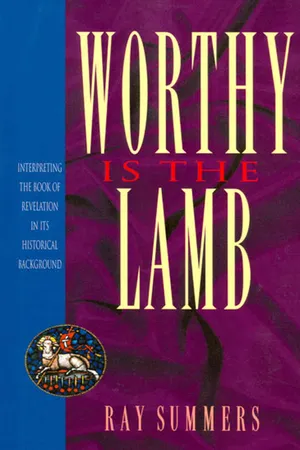
Yes, you can access Worthy Is the Lamb by Ray Summers in PDF and/or ePUB format, as well as other popular books in Théologie et religion & Religion. We have over 1.5 million books available in our catalogue for you to explore.