Designed for use in upper-level college courses and seminary courses on the prophets

- 388 pages
- English
- ePUB (mobile friendly)
- Available on iOS & Android
eBook - ePub
About this book
Information
Topic
Theology & ReligionSubtopic
Biblical StudiesChapter 1
Communication
that Transforms
Everyone would like to change something or transform some policy. Some people do not like early morning classes; others dread going to dentists; and most wish they did not have to pay so many taxes. How does one go about changing these unpleasant experiences? A child can be warned with a strong “NO!” Wrong behavior can be corrected with an appropriate punishment, but how does one change the way adults or governments think and behave? Employers may provide job training to increase productivity or offer monetary incentives to affect the behavior of employees. A teacher can motivate adults in an educational setting by offering a letter grade for good performance. But how does one bring about change in another person's beliefs or attitudes where there is freedom to choose between two or three different views?1
It may seem impossible to bring about some changes, yet people do change in small ways all the time. Most people are unconsciously affected by a multitude of subtle pressures. Change occurs because of social pressures like the desire for approval, the psychological need to avoid conflict, or in response to an emotional appeal. People desire to learn better ways to meet their needs and are open to suggestions that are persuasively presented. Technological innovations are quickly accepted because they make life easier, but habits are more difficult to alter.
Persuasion was one of the key tools Old Testament prophets used to transform the way people acted.2 By orally communicating with their audiences, they motivated some to reconsider the way they thought about themselves, God, and their relationship with God and others. If they would transform their way of thinking (repent), God would restore His relationship with them. If the people would forsake the customs of the nations and follow God's ways, His covenant would continue.
The Role of Communication
Prophetic Communication
The prophets functioned as spokesmen for God (Ex. 7:1-2; Jer. 1:4-10)3 so their main role was to communicate God's words to others. As God's messengers, they were not interested in just declaring the truth.4 Their purpose went far beyond the goal of simply repeating what they heard.
The prophets were preachers who communicated God's words in order to transform their audience's thinking and social behavior.5 They were not primarily concerned with writing a record of an historical period, an eschatological chart of future events, or a systematic presentation of their theology. They were real people attempting to communicate urgent messages to friends, and even to some enemies. They were persuading people to look at life in a radically different way (Jer. 3:6-13). They offered hope to the hopeless and a realistic assessment of the nation's weakness to the country's proud military leaders (Amos 6:1-14). They encouraged people to look at themselves from God's perspective and not conform to the prevailing political perspective of the day because of social pressures. They exhorted people to put off their old ways, to take an oath to change, and to transform their lives by breaking new ground (Jer. 4:1-4).
Models of Communication
Communication is the ongoing process in which a source person transmits an intended meaning to a receiving person in order to elicit a response from the listener.6
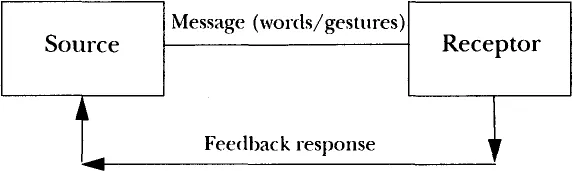
Since people have unique personalities, life experiences, and perceptions of the world, the dynamics of communication vary from conversation to conversation. This three-step communication process (sending-receiving-responding) takes place over a period of time and through a series of events. Burke envisions a complete conversation as a drama with acts, scenes, agents, agency, and purpose.7 Since most communication involves a series of interactions between two people, a helical model illustrates the dynamics of communication.8
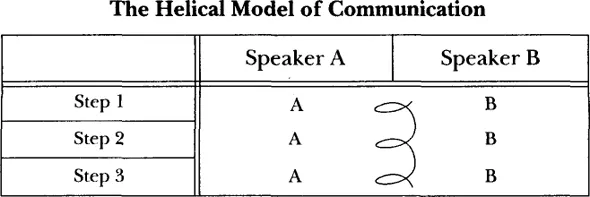
These models of communication diagram some regular traits of conversation, but most people have also experienced the unpredictable dynamics of communication. A woman you do not know may say, “Watch out for the car!” You may hear her words, but not be sure she is talking to you. You look again and notice she is looking at you and pointing frantically to your left. Now you realize she is trying to warn you of danger. Quickly, you respond to avoid the car unexpectedly backing up toward you. Then you thank the woman.
The process only took seconds, but it involved the transmission of a meaningful idea through words and gestures so that the listener could understand the warning and take action. If you continued thinking the stranger was speaking to someone else, communication would not occur. If you understood the words to be, “Watch out for the star,” miscommunication would occur.
Successful communication involves the reception of the intended idea from the source person.9 Sounds and gestures convey an intended meaning that may or may not be correctly interpreted. If the message does not make sense to the listener or is interpreted to mean something unintended, a breakdown occurs in communication.10 Barriers to communication might include: noise which distorts or interrupts the message, ignorance about the topic, or preconceived attitudes about the speaker. A poorly structured speech, unsupported claims, or exaggerated conclusions may also interfere with communicating ideas effectively.
Theological Communication
Communication theory does not address the theological dimension in this process, but it does provide a helpful examination of human interaction.11 The divine factor must be added to the communication paradigm, for both God and the messenger play key roles in convincing listeners to change their thinking. Messengers cannot control or limit God's work, but they need to be aware of the human factors which influence good communication. This will complement God's work in the listener's mind, rather than discourage it.
When the divine factors are inserted at two points in this communication framework, a more complete model of prophetic discourse is portrayed. The impact of the transcendent power on the communication process is difficult to quantify, but prophetic texts insist on God's part in communication (Mic. 3:8; Ezek. 11:5).
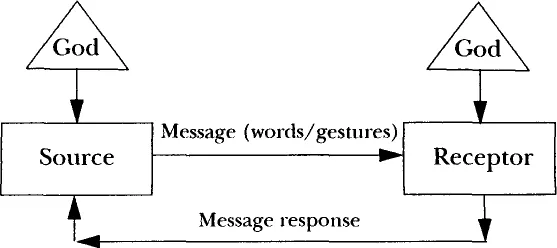
The prophets transmitted God's message to their audiences to elicit a response. After the listener decoded these words (reproducing the speaker's intended meaning), the mysterious influence of God worked in the receptor's mind to bring about conviction and the will to act. 12The audience may choose to respond to human persuasion and the divine working either positively, with neutrality, or negatively.
Prophetic Cross-Cultural Communication
The prophets spoke to Israelites as well as foreigners from diverse cultural backgrounds. These people spoke several languages, had different laws, and followed unique social customs. They honored many gods and worshiped in a variety of ways. This cultural diversity was most evident when a prophet went to preach in a foreign city like Nineveh (Jon. 3:1-9), but it also existed in Israel itself. Not all the residents in Israel were Jews, and Israelites themselves differed from one another. Some grew up with rural values, while others were impacted by commercial practices in the city. A noble, a judge, or a priest in Jerusalem had a social status of privilege and wealth that poor nomadic shepherds in the Sinai desert did not share. Laws, family custom, and religious commitments varied from group to group and family to family.
Culture is defined as “the cumulative deposit of knowledge, experience, meanings, beliefs, values, attitudes, religions, concepts of self, the universe … hierarchies of status, expectations, spacial relations, and time concepts acquired by a large group of people.”13 Culture is the learned behavior and thought patterns shared by a group of people. Although one can speak in a general way of an Israelite culture, it is more helpful to recognize that many subcultural groups existed within Israel. These smaller groups were the primary units that defined norms and behavior. They were the sources of information that provided paradigms for understanding the social, spiritual, and natural world.14
Cultural differences need to be minimized if two people from different cultural groups are going to communicate. This can be done by finding common points of mutual identification that provide a basis for the transmission of shared meanings. For the word “knife,” the cultural context of a woodcarver calls to mind a very positive image of a favorite and much-loved tool. The word “knife” makes a mother think immediately of a dangerous object that might hurt her child. The greater the social, behavioral, philosophical, and linguistic diversity between individuals, the greater the potential for misunderstanding not only what is connoted (the secondary meaning of a word), but also what is denoted (the main meaning of a word). The diagram illustrates the nature of the cross-cultural communication process.
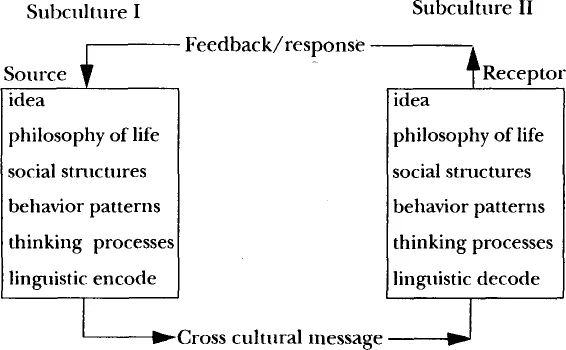
The meaning of an idea intended by the source person passes through several cultural filters that define the encoded words in a culturally specific way. When the receptor hears these words, they are decoded and passed through a different series of cultural filters that may produce a meaning not identical to the idea the source intended. If a messenger does not recognize and compensate for the different cultural or social background of a listener, that person may not accurately understand the intended meaning. For cross-cultural communication to take place, the speaker must know how the audience thinks and then must use terms that fit that frame of reference.15 For example, a four-year-old would probably not understand the philosophical arguments for the existence of God, but might believe in God from a story about God's creation of humans.
The prophets did not need to address all of the unique cultural perspectives represented in their audiences, but they did need to speak so people could understand them. Many prophets mentioned how their view of the world contrasted with the cultural perspective of the listening group. Jeremiah reminded his Judean audience of their Baalism, using Baalistic imagery and illustrations (Jer. 2). Ezekiel corrected those who blamed the sinfulness of their parents and the injustice of God for their problems (Ezek. 18:1-29) by showing they were guilty and God was just. The cultural gap between the prophets and their audiences complicated the process of transmitting ideas, making it more difficult to convince people to reject their cultural patterns and accept new ideas from the prophets.
Communication to Bring About Transformation
Transformations involve significant change, alteration, or a major development. Transformations may alter the external form, texture, or looks of an object or person; but the most dynamic changes are internal variation. Changing clothes brings a minimal differentiation in the way a person looks, but information can change the way people think or behave. Minor alterations in the way people think take place on a daily basis. If a new discovery or a different way of looking at life proves to be advantageous, people will gladly change. Political philosophies or religious beliefs are usually deeply connected to the self-identity of a person and are more difficult to change.
The prophets desired to transform the way their audiences thought about themselves, their world, and the supernatural powers that controlled both. They wanted to change the norms that governed people's social relationships, to alter their sinful desires to fulfill their own wishes, and to bring their lives into line with God's will. Although many Israelites listened to the prophetic message and allowed God to transform their thinking, some refused to believe what God said.
The Failure to Communicate
Why do some people continue to worship idols generation after generation? Why do people cling to their old ways and not change their social behavior? Why was it so difficult for the prophets to transform the way the Israelites thought about God? Why did the message of God which the prophets communicated bring about so little change? Several reasons explain why people do not change.
Because God Did Not Speak
Knowledge is liberating, powerful, and the basis for successful transformation. A lack of knowledge leads to fear, ignorance, failure, and an inability to take control of life. Parents teach their children how to act in order to transform their behavior from the selfishness of a two-year-old ...
Table of contents
- Cover Page
- Title Page
- Copyright
- Table of Contents
- List of Illustrations
- Abbreviations
- Preface
- Introduction
- Chapter 1
- Chapter 2
- Chapter 3
- Chapter 4
- Chapter 5
- Chapter 6
- Chapter 7
- Chapter 8
- Chapter 9
- Chapter 10
- Chapter 11
- Chapter 12
- Chapter 13
- Chapter 14
- Chapter 15
- Chapter 16
- Chapter 17
- Chapter 18
- Chapter 19
- Glossary
- Bibliography
- Index of Subjects
- Index of Names
Trusted by 375,005 students
Access to over 1.5 million titles for a fair monthly price.
Study more efficiently using our study tools.
Frequently asked questions
Yes, you can cancel anytime from the Subscription tab in your account settings on the Perlego website. Your subscription will stay active until the end of your current billing period. Learn how to cancel your subscription
No, books cannot be downloaded as external files, such as PDFs, for use outside of Perlego. However, you can download books within the Perlego app for offline reading on mobile or tablet. Learn how to download books offline
Perlego offers two plans: Essential and Complete
- Essential is ideal for learners and professionals who enjoy exploring a wide range of subjects. Access the Essential Library with 800,000+ trusted titles and best-sellers across business, personal growth, and the humanities. Includes unlimited reading time and Standard Read Aloud voice.
- Complete: Perfect for advanced learners and researchers needing full, unrestricted access. Unlock 1.5M+ books across hundreds of subjects, including academic and specialized titles. The Complete Plan also includes advanced features like Premium Read Aloud and Research Assistant.
We are an online textbook subscription service, where you can get access to an entire online library for less than the price of a single book per month. With over 1.5 million books across 990+ topics, we’ve got you covered! Learn about our mission
Look out for the read-aloud symbol on your next book to see if you can listen to it. The read-aloud tool reads text aloud for you, highlighting the text as it is being read. You can pause it, speed it up and slow it down. Learn more about Read Aloud
Yes! You can use the Perlego app on both iOS and Android devices to read anytime, anywhere — even offline. Perfect for commutes or when you’re on the go.
Please note we cannot support devices running on iOS 13 and Android 7 or earlier. Learn more about using the app
Please note we cannot support devices running on iOS 13 and Android 7 or earlier. Learn more about using the app
Yes, you can access The Prophets as Preachers by Gary V. Smith in PDF and/or ePUB format, as well as other popular books in Theology & Religion & Biblical Studies. We have over 1.5 million books available in our catalogue for you to explore.