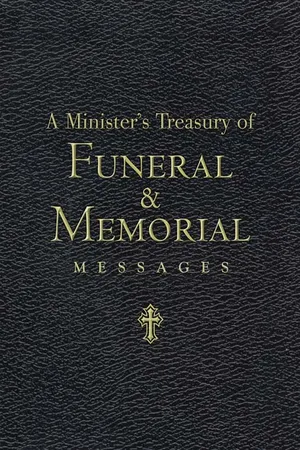
A "must have" for all pastors, this new handbook will help you as you minister to persons in the critical time of grief. Jim Henry is pastor of a 10, 000-member church in Orlando, Florida. He has been a pastor in service for thirty-six years and also served as president of the Southern Baptist Convention. Part 1 includes guidelines in seven vital areas of grief ministry including, what to do in the following situations: On Receiving Notification of a Death When Visiting in the Home Scheduling During the Funeral Home Visit During the Service When Concluding the Service At the Gravesite Part 2 includes funeral messages for different situations including the following: Sudden unexpected death One who battled a long illness A military person of faith A child A student A godly wife, mother, or woman This is a much-needed manual for pastors, ministers, and laymen alike who are called on to minister in funeral and memorial services.
- 208 pages
- English
- ePUB (mobile friendly)
- Available on iOS & Android
eBook - ePub
A Minister's Treasury of Funeral and Memorial Messages
About this book
Trusted by 375,005 students
Access to over 1.5 million titles for a fair monthly price.
Study more efficiently using our study tools.
Information
Topic
Theology & ReligionSubtopic
Biblical Reference
PART I
GUIDELINES
Chapter 1
When the Death Bell Rings
I will never forget the great Baptist preacher Ramsey Pollard relating his first experience officiating a funeral service as a young pastor. He served a country church and was called on to officiate the service of one of its members. The usual apprehensions filled his mind. Seminary had not prepared him for this basic pastoral task.
Somewhere he had read that the officiate was to walk in front of the casket and read Scripture en route to the burial place. Having successfully navigated the service itself, he proceeded out the door in front of the casket to lead the funeral procession to the adjacent cemetery. Opening his Bible, he began to read words of comfort in reverent tones. So engrossed was he in reading that he failed to see the looming cavity of the gravesite and promptly fell foot-first into the six-foot hole!
Panicked by the mortifying thoughts of being in a grave and the obvious embarrassment of his misstep, he scrambled out quickly and began to run. He related that he was grateful a deacon caught him as he was climbing a fence trying to escape. The deacon urged him to return and finish his funeral duties. Pollard said that had he not, he probably would still be running.
Most of us can relate to this story in one way or another. After all, how do you practice doing death services? That's one of the reasons behind my writing this book. With over forty years of walking down the concourse of grief, death, and funeral/memorial services, I have picked up a few things that I believe can be of help to those who are called to assist in one of the most difficult areas of ministry.
The following are practical pointers that have served me well in rural, suburban, and urban settings, while subsequent chapters are written around funeral or memorial messages. Some of the pointers in this chapter are specific while others are more general in nature.
Tip #1: What to Do on Receiving
Notification of a Death
1. See the family as soon as possible at the home, hospital, or emergency room.
- Pray with them.
- Listen to them.
- Lend your shoulder.
- Don't use such phrases as, “It must be the will of God,” “God needed another angel,” etc. They're not ready for that.
- Remember: your presence is what counts.
2. Seek a family member or close family friend with whom you can talk.
- Find someone who is not so emotionally distraught.
- Begin discussing some preliminary planning for the next steps that must be taken.
3. Schedule to go back in the next day or two to plan the memorial service. If possible, see them again before they go to the funeral home.
4. Sometimes you may be asked to assist in the selection of a casket, a burial place, even clothes for the deceased.
- Be helpful when asked, but do not take over.
- Personal note: I try to steer the families away from high-priced accessories that family members often have a tendency to prefer because of their desire to honor their deceased loved ones. Some people have the resources to handle this, but many do not. They can be burdened with debt long into the future, and we can help them by encouraging more moderate costs.
Tip #2: What to Do When Visiting in the Home
1. Ask about the desired place and time for the service: Church, funeral home, or graveside? If they are faithful church members, I encourage the use of the church facilities—a place of warmth, familiarity, memories, and a major part of their lives.
2. Ask about the type of service: memorial if cremation or funeral if body present?
3. Ask who will officiate: pastor, former pastor, staff member, family member, or a friend who is a minister?
4. Ask what type of music is preferred.
- Live, piped-in, tape, or CDs?
- Hymns, praise songs, favorites? Keep in mind the family members who remain, for the loved one is in glory.
- Choir, ensembles, solos, organ, piano, or other music?
5. Ask about favorite Scriptures: family preferences, life passages, or favorite verses of the deceased? Often I have used the deceased's Bible from which to read. This is most appreciated by the family.
6. Ask about any eulogy.
- Pastor can deliver one he has written (if he knows the deceased well), or read one the family has composed.
- Extended family members and friends can also do this.
- Sometimes more than one eulogy is used. If so, be sure to have the participants write the eulogies. This will guard the time as well as help them if they should be overcome with emotion. It also keeps people from rambling.
7. Ask the family if they want a visitation: Night before? Afternoon? Prior to the service? None?
8. Where will the committal be?
- Cremation or ground burial?
- Do they want ashes to be scattered or kept?
- Will there be a military salute, service, or club recognition?
9. Ask about the people they prefer for active pallbearers.
- Family, friends, or both?
- Honorary pallbearers?
- The funeral director will also assist in this.
10. Try to be there with the immediate family as much as possible when planning the service.
Tip #3: What to Do When Scheduling the Service
1. Be sure space is available and the church calendar is checked.
2. Times must be very clear.
3. Contact musicians.
4. If necessary, check with technical assistants for lighting, sound, recording, or videotaping.
5. Prepare the order of service for musicians, tech crew, and funeral directors.
6. Look at a time frame of thirty-five minutes to one hour for most services.
Tip #4: What to Do During the Funeral Home Visit
1. Try to visit with the family during the scheduled funeral home visitation.
- If possible, meet with the family for a few minutes prior to their viewing the body for the first time.
- This is a very emotional time for the family as the reality of death sinks in even more deeply.
- This is especially important if a widow or widower and the deceased does not have extended family or strong church support.
2. At some point, you must address whether the family wants to close the casket before or after the service.
- I usually encourage the family to do so before the service. If the casket is left open during the service—or closed and then reopened—this brings a fresh outpouring of grief, and the worship service's message of encouragement and faith may not come across.
- I encourage...
Table of contents
- Cover Page
- Half Title
- Title Page
- Copyright Page
- Dedication Page
- Table Of Contents
- Acknowledgments
- Part 1
- Chapter 1
- Part 2
- Chapter 2
- Chapter 3
- Chapter 4
- Chapter 5
- Chapter 6
- Chapter 7
- Chapter 8
- Chapter 9
- Chapter 10
- Chapter 11
- Chapter 12
- Chapter 13
- Chapter 14
- Chapter 15
- Chapter 16
- Chapter 17
- Chapter 18
- Chapter 19
- Chapter 20
- Chapter 21
- Chapter 22
- Chapter 23
- Chapter 24
- Notes
Frequently asked questions
Yes, you can cancel anytime from the Subscription tab in your account settings on the Perlego website. Your subscription will stay active until the end of your current billing period. Learn how to cancel your subscription
No, books cannot be downloaded as external files, such as PDFs, for use outside of Perlego. However, you can download books within the Perlego app for offline reading on mobile or tablet. Learn how to download books offline
Perlego offers two plans: Essential and Complete
- Essential is ideal for learners and professionals who enjoy exploring a wide range of subjects. Access the Essential Library with 800,000+ trusted titles and best-sellers across business, personal growth, and the humanities. Includes unlimited reading time and Standard Read Aloud voice.
- Complete: Perfect for advanced learners and researchers needing full, unrestricted access. Unlock 1.5M+ books across hundreds of subjects, including academic and specialized titles. The Complete Plan also includes advanced features like Premium Read Aloud and Research Assistant.
We are an online textbook subscription service, where you can get access to an entire online library for less than the price of a single book per month. With over 1.5 million books across 990+ topics, we’ve got you covered! Learn about our mission
Look out for the read-aloud symbol on your next book to see if you can listen to it. The read-aloud tool reads text aloud for you, highlighting the text as it is being read. You can pause it, speed it up and slow it down. Learn more about Read Aloud
Yes! You can use the Perlego app on both iOS and Android devices to read anytime, anywhere — even offline. Perfect for commutes or when you’re on the go.
Please note we cannot support devices running on iOS 13 and Android 7 or earlier. Learn more about using the app
Please note we cannot support devices running on iOS 13 and Android 7 or earlier. Learn more about using the app
Yes, you can access A Minister's Treasury of Funeral and Memorial Messages by Jim Henry in PDF and/or ePUB format, as well as other popular books in Theology & Religion & Biblical Reference. We have over 1.5 million books available in our catalogue for you to explore.