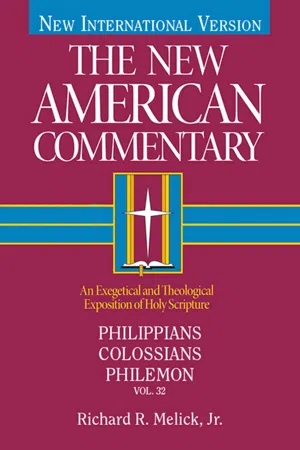
THE NEW AMERICAN COMMENTARY is for the minister or Bible student who wants to understand and expound the Scriptures. Notable features include:* commentary based on THE NEW INTERNATIONAL VERSION;* the NIV text printed in the body of the commentary;* sound scholarly methodology that reflects capable research in the original languages;* interpretation that emphasizes the theological unity of each book and of Scripture as a whole;* readable and applicable exposition.
eBook - ePub
Philippians, Colossians, Philemon
An Exegetical and Theological Exposition of Holy Scripture
- 384 pages
- English
- ePUB (mobile friendly)
- Available on iOS & Android
eBook - ePub
Philippians, Colossians, Philemon
An Exegetical and Theological Exposition of Holy Scripture
About this book
Information
Topic
Theology & ReligionSubtopic
Biblical CommentaryColossians
INTRODUCTION OUTLINE
1. The City and Its People
2. The Founding of the Church
3. The Occasion
4. The Authorship
5. The Date and Origin
6. The Relationship to the Other Prison Epistles
7. The Problem at Colosse
(1) The Data
(2) Historical Context
Nineteenth-Century Contributions
Twentieth-Century Contributions
(3) The Jewish Context
(4) The Focal Text: Colossians 2:8–3:4
Introductory Statement
Paul's Concerns
Thematic Arrangement
Interpretation
Practicality
(5) Conclusions
8. The Theological Structure of the Epistle
INTRODUCTION
Christianity faced one of its most severe challenges in the complex and confusing intellectual climate of ancient Colosse. Perhaps due to the nature of the times, the location, and the ideological climate, what had begun well faced a major threat to Christianity's very existence. False teachers were urging the people to move away from their Christian roots and to accept other religious ideas. Although Paul did not found the church at Colosse, it manifested Pauline traits, and Paul felt the responsibility to address its problems. This little epistle contains distinctive teachings about the person and work of Christ, about Christian living and relationships, and about Paul's conception of his ministry. Studying the epistle is an adventure in Christian theology. It reveals Pauline thought and authentic Christian living. The pages of the text are alive with relevance and challenge the reader to a more reflective and informed faith.
Paul constructed his arguments to counter false teaching and to teach orthodox theology. One theme predominates: the centrality of Christ. No other epistle is as Christocentric as this one. Whether the reader spends countless hours with Colossians or reads it only casually, every encounter with the text brings one face to face with the Lord whom the text introduces so well. Every occasion to read it leaves its mark indelibly on the mind. This commentary provides another exposure to the powerful little letter.1
1. The City and Its People
No one knows when Colosse was founded. As early as the time of Xerxes of Persia (485-465 B.C.), it was a thriving community. Herodotus, a Greek historian, said it was a “great city of Phrygia” in 480 B.C.2 No doubt its early greatness came in part from its location. Colosse sat on the main East-West road from Ephesus to the East, at the entrance to a pass in the Cadmus range of mountains. In this location, westbound travelers came to it first when they entered the Lycus valley. Travelers, such as Paul and his company, traversed this same road from Antioch (Syria) to Tarsus, through the Cilician Gates on to Derbe, Lystra, Iconium, and Colosse. They could continue westward to Laodicea and 100 miles to Ephesus and possibly 1000-1200 land miles to Rome.3
The location of Colosse provided the resources to make the city great. The Lycus River ran through the valley. The river was a branch of the Maeander River and became known as the Little Maeander. The area suffered frequent earthquakes, one of which did severe damage to Laodicea and Hierapolis, neighboring cities, in the year A.D. 60.4 No doubt Colosse suffered as well. The beautiful valley had lush pastures for grazing sheep. The abundance of wool supported a flourishing garment industry. One of the branches of the Lycus River left chalk deposits that were useful for dyeing cloth.5 The valley prospered from both ranching and industry.
By the time of the apostle Paul, Colosse's importance had waned. Strabo, about twenty years before Paul, called the city a “small town.”6 The two neighboring cities eclipsed Colosse. Laodicea, mentioned in Col 4:15–16, was most prominent. The Romans made Asia a province in 190 B.C. and selected Laodicea as a conventus, the capital of a district of twenty-five towns.7 The Romans also changed the road system, and Laodicea became an important junction of the East-West highway and four other roads. This meant it was ideally suited for commerce, banking, and general prosperity (Rev 3:14–22).
Hierapolis almost equally eclipsed Colosse. Located about six miles from Laodicea, it formed the third member of the triangle. Paul mentioned that a joint venture of churches in these three cities supported Epaphras in his ministry to Paul; that was entirely feasible, given the geographical and cultural intercourse among them (Col 4:13). Hierapolis was noted for its mineral baths. One of the hot wells, the Plutonium, issued a deadly vapor. Superstitions about it abounded, and many temples of various sorts surrounded this city.8 By the time of Paul, therefore, for commercial interests one went to Laodicea; for luxury and pleasure, to Hierapolis.
The cities had a mixed population. The natives were Phrygian. Because of the military and commercial heritage of the valley, however, Greeks may have settled in the area during the Greek period of dominance. To this were added Jews of the Diaspora,9 Romans involved in politics, and various ethnic groups drawn by commercial interests. The exact population mixture of Colosse during this time is unknown. From the epistle, both Jews and Gentiles lived there and became part of the church.
2. The Founding of the Church
The origins of the church at Colosse are obscure. Clearly, Paul did not found it since he said as much in 2:1; however, Paul addressed the church as though it were his responsibility. He considered it in some sense a Pauline community, taking liberty to address problems within it as though he had the authority to do so. Some suggest that Paul's authority came because he was the “apostle to the Gentiles” and had a proprietary interest in all Gentile congregations. They support this conclusion from the Letter to the Romans, the other church to whom Paul wrote but whom he had never met. In writing to the Romans, Paul spoke to vital issues of misunderstanding in the fellowship. This suggests that it, too, was Pauline. In Romans, however, Paul introduced himself to gain support for a mission to Spain (Rom 15:24). His advice regarding the problems comes from a “softer voice” than Colossians. The church at Colosse had no resources to offer Paul, as the Roman church did, and Paul's writing to them appears to reveal a special interest in their well-being, though, of course, he shared a similar concern for all the churches. The Colossian church was Pauline in a way that the Roman church was not.
The most common suggestion regarding the founding of the church is that Epaphras founded it. Probably that is correct. Paul identified his fellowprisoner Epaphras as a Colossian (4:12), a servant of Christ (4:12), and an envoy from the other churches in the valley (4:13). Further, Paul stated that the Colossians heard the word from Epaphras (1:7). The church most likely began during Paul's third missionary journey, while he taught in the school of Tyrannus in Ephesus. Luke recorded that all of Asia heard the word during that time (Acts 19:9–10). Epaphras met Paul in Ephesus, became a student and able minister, and took the word to his own people. This reckoning dates the founding of the church at about A.D. 53-55, some seven to ten years before Paul wrote the epistle.
3. The Occasion
Determining the occasion of a letter involves two parts. First, the basic question is, Why did Paul write the letter at all? This deserves serious attention, and most scholars concentrate on that question. The second matter is, Why did Paul write the letter when he did? This is a question of expediency. The two issues do not necessarily intertwine. Conceivably, a reason for writing could be delayed or accelerated depending on the availability of couriers, time of year, circumstances of the author, and many other matters. This fact alone provides insight into the relationships of the four epistles commonly called Prison Epistles, as well as the context of the letter.
Why did Paul write? False teachers threatened to undermine what Epaphras had taught. More disconcertingly, the implications of their teaching threatened to remove the church from its strong Christian foundation. Since Paul saw himself as the apostle responsible for the well-being of the church, he thought it imperative to respond to the teaching personally. The nature of the teaching is discussed later under the heading “The Problem at Colosse,” and that section should be consulted regarding this matter.
Why did Paul write when he did? Three of the Prison Epistles belong together: Colossians, Ephesians, and Philemon. Paul wrote Philemon, urging him to forgive and restore his runaway slave, Onesimus. Significantly, Onesimus and Tychicus traveled together to Colosse with news of Paul's situation, and they carried the letter Paul wrote. Piecing this information together, the following scenario best explains the immediate occasion.
Sometime during Paul's imprisonment, he met the runaway slave Onesimus. Suggestions that Onesimus sought out Paul do not fit the data. It seems highly unlikely that Onesimus had run away as a Christian, and Paul stated in Phlm 10 that he became a son in prison.10 Because of this new commitment to Christ, Paul encouraged Onesimus to return to Philemon. Generally, such a decision came with great anxiety and an urgent need to settle the matter, and Onesimus no doubt felt that way. Therefore, at the earliest convenience, Paul sent Onesimus to Philemon with the letter. Philemon probably belonged to the church at Colosse, and Paul took advantage of the situation to address his other concern: the problem which Epaphras had discussed with him. Epaphras had earlier journeyed to Paul to help him in whatever way he could, representing the three churches of the Lycus valley.11 Further, since Onesimus and Tychicus had to travel through Ephesus to get to Colosse, Paul took advantage of the occasion to write to his good friends at Ephesus. This suggests that the problem at Colosse did not require an emergency response from Paul. At least equally pressing was Paul's desire for Christian ...
Table of contents
- Front Cover
- Half Title
- Front Matter
- Full Title
- Copyright
- Dedication
- Editors' Preface
- Author's Preface
- Abbreviations
- Table of Contents
- Philippians
- Colossians
- Philemon
- Subject Index
- Person Index
- Scripture Index
- Selected Bibliography
Trusted by 375,005 students
Access to over 1.5 million titles for a fair monthly price.
Study more efficiently using our study tools.
Frequently asked questions
Yes, you can cancel anytime from the Subscription tab in your account settings on the Perlego website. Your subscription will stay active until the end of your current billing period. Learn how to cancel your subscription
No, books cannot be downloaded as external files, such as PDFs, for use outside of Perlego. However, you can download books within the Perlego app for offline reading on mobile or tablet. Learn how to download books offline
We are an online textbook subscription service, where you can get access to an entire online library for less than the price of a single book per month. With over 1.5 million books across 990+ topics, we’ve got you covered! Learn about our mission
Look out for the read-aloud symbol on your next book to see if you can listen to it. The read-aloud tool reads text aloud for you, highlighting the text as it is being read. You can pause it, speed it up and slow it down. Learn more about Read Aloud
Yes! You can use the Perlego app on both iOS and Android devices to read anytime, anywhere — even offline. Perfect for commutes or when you’re on the go.
Please note we cannot support devices running on iOS 13 and Android 7 or earlier. Learn more about using the app
Please note we cannot support devices running on iOS 13 and Android 7 or earlier. Learn more about using the app
Yes, you can access Philippians, Colossians, Philemon by Richard Melick in PDF and/or ePUB format, as well as other popular books in Theology & Religion & Biblical Commentary. We have over 1.5 million books available in our catalogue for you to explore.