![]()
Part 1
Apologetics, Culture, and the Kingdom of God
![]()
Chapter 1
Making the Gospel Connection
An Essay Concerning Applied Apologetics
Gregory E. Ganssle
The task of bearing witness to Christ is one to which anyone captured by the gospel is called. The claim that we each have a role as a witness will not strike believers as odd. It is simply part of what it means to be a faithful follower of Jesus. The claim that each believer is called to be an apologist—one who defends Christian belief and practice—might sound strange, however. Surely, the calling to be an apologist is a particular calling, such as the calling to be a pastor, an engineer, or a father. It is not surprising that we often think of being an apologist as a particular calling, given the way most of us think about the nature of apologetics.
My aim in this essay is twofold. First, I wish to broaden our understanding of the nature and scope of apologetics in order see it more firmly embedded in the calling of every believer. Second, I wish to explain some conceptual tools that will help us in this high calling.
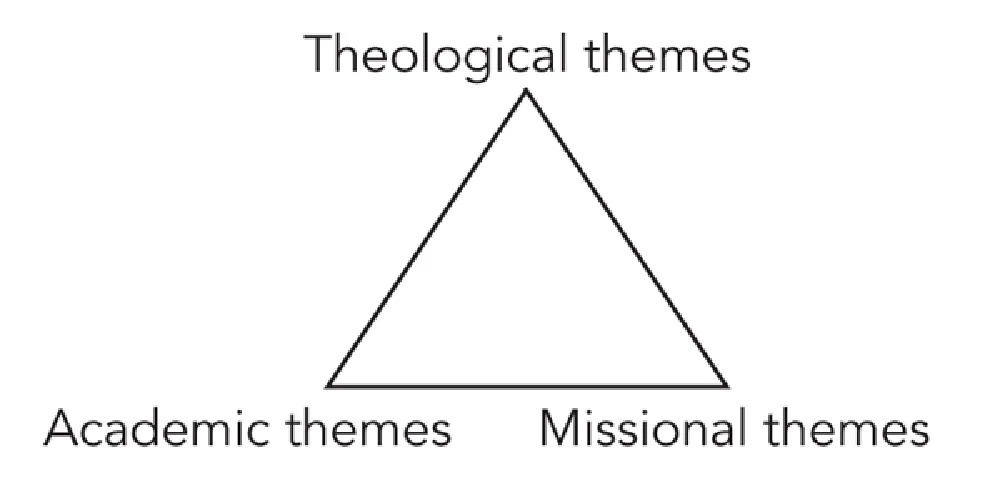
There are, I propose, three basic angles from which we can look at the nature of apologetics. I like to think of them as the corners of a triangle:
The first angle concerns the theological themes raised by the apologetic enterprise. This angle includes a variety of topics, such as the scope of common grace, the nature of general revelation, and the effects of our sinful condition on our reasoning. Exploring these topics theologically helps us develop a realistic understanding of what we ought to expect in our encounters with those who are not yet believers. Theological themes, then, are relevant to our thinking well about apologetics.
The academic themes include most of what people have in mind when they think about apologetics. This area includes the details of particular arguments for the existence of God or for other essential Christian claims such as the resurrection of Jesus. It also includes the investigation of challenges to Christianity, such as the problem of evil, or the notion that there is no objective truth. The academic themes include the content of apologetics, whether we are thinking about the content of a 30-second answer to a question or about the broad outlines of an academic treatise. As we know from experience, a 30-second answer quickly generates more questions that, in turn, lead us into deeper and more complicated answers. Somewhere along the way, what begins as apologetics becomes philosophy of religion, historical criticism, biochemistry, or physics.
The missional themes include what I am calling in this essay applied apologetics. These themes involve the dynamics of communicating to a particular audience, whether it is an audience of one or two or a larger group. We aim to communicate in such a way that the gospel is recognized as connecting with the deep needs at the core of every human being. I like to locate applied apologetics under a broader category: Making the Gospel Connection. This category covers many facets of our lives and ministries. Our own spiritual growth is largely about making the gospel connection to our own core values, identities, characters, and habits. Spiritual formation and discipleship are about helping other believers make the gospel connection to themselves. Evangelism and the missional themes in apologetics are about making the gospel connection to those not yet followers of Jesus. Our hope is to bring facets of the richness of the gospel to bear on the lives, beliefs, values, and identities of lost human beings. Thinking about apologetics under the category of Making the Gospel Connection makes it clear that applied apologetics is evangelism and evangelism is applied apologetics.
Each one of the three angles or themes concerning apologetics is legitimate and fruitful. Each is worthy of careful study. Despite this fact, there are two trends I wish to point out. First, most of the thinking about apologetics has been on the academic themes. While this weight of attention is not in itself a bad thing, it may allow us to forget the other angles of apologetics. Second, most of the criticisms of the usefulness of apologetics find their root in confusing the academic angle of apologetics with the entirety of the apologetic enterprise. Those of us who work in the academic angle bear much of the blame for this confusion. Sometimes we are overzealous about the strength of our arguments or how interesting they ought to be to nonbelievers. Sometimes we neglect the large distinction between arguments that are technically strong and those that might be persuasive to a given person. Sometimes we neglect the missional themes in the apologetic task and thereby reinforce the notion that coming to believe that Christianity is factually true is the main task in our witness. By articulating the importance of the missional angle, as well as of the theological angle, we can defuse many criticisms of apologetics.
Rather than entering the missional angle with a view to defending the apologetic enterprise, however, I shall enter it with a view to helping us be more effective and more faithful in our bearing witness to Christ. So, I will not be concerned with defending apologetics. I will aim to help you think better about how to make the gospel connection with those who are not yet believers. But I must begin by introducing one of my favorite writers.
Apologists as Diagnosticians
Walker Percy (1916–90) was trained as a medical doctor at Columbia University just after World War II. He specialized in pathology. While doing his residency, he caught TB from a cadaver. As part of his treatment, he spent a couple of years in various sanitariums in upstate New York. There was little for him to do except read. He pored over texts from Dostoevsky and Kierkegaard to Sartre and Susanne Langer. As a result, he made two life-changing decisions. First, he was converted to Christ. Second, he dropped medicine to become a writer.
Percy often reflected on the deep connections between his life as a pathologist and his life as a novelist:
My point is that the stance of the physician is appropriate here. For his stance is that of the diagnostician. A diagnostician is a person who stands towards another person in the relation of one who knows that something has gone wrong with the other. He, the physician-novelist, has a nose for pathology.
He observed that both the novelist and the pathologist begin with a hunch that there is something wrong, and each seeks to find and to name the malady. The pathologist pokes around (with a fairly sophisticated set of tools) until he can identify and name what caused the patient to get sick or die. The novelist has essentially the same calling. He pokes around in the remains of human behavior and culture to discern where they are diseased. They begin with a hunch, and they poke around until they identify and name what is wrong.
The notion that there is a calling to be a diagnostician of the human condition is one that ought to strike gospel-oriented people as right on target. It is fruitful to think about our mission as apologists and evangelists as involving a calling to be a diagnostician. We are the diagnosticians of our age, of the institutions of the world, of the global condition, and of the individual souls touched by all of these contours of the contemporary landscape. It is our calling to poke around and identify what it is that is wrong. It is up to us to find and name the maladies that are rampant throughout culture. How are these cultures, institutions, and individuals resistant to thick gospel reality? When we set about diagnosing the ideas of the age or the currents of thought in an academic field or culture-shaping institution, we are involved in the academic angle of apologetics. Notice, however, that we also have the task of diagnosing the contours of an individual's beliefs and values. It is here that we inhabit the missional angle of apologetics. Rather than thinking about arguments that are generally strong or objections that might be raised, we are thinking about objections that are actually at work in a particular person's soul and reasons that might persuade him to turn to Christ.
Analyzing Soil Samples
Careful diagnosis is essential to our work as gospel-minded people, just as it is to the work of a pathologist or a novelist. Shallow diagnosis results in a fruitless prescription or a bad novel. Shallow diagnosis by missional apologists results in shallow and shortsighted recommendations and anemic articulations of gospel solutions. As people who aim to be faithful followers of Jesus, we need to cultivate our diagnostic skills so we can identify and articulate exactly how the remedy Jesus brings will meet the crucial need. Jesus told a story that illustrates our calling as diagnosticians:
And he was teaching them many things in parables, and in his teaching he said to them: "Listen! A sower went out to sow. And as he sowed, some seed fell along the path, and the birds came and devoured it. Other seed fell on rocky ground, where it did not have much soil, and immediately it sprang up, since it had no depth of soil. And when the sun rose, it was scorched, and since it had no root, it withered away. Other seed fell among thorns, and the thorns grew up and choked it, and it yielded no grain. And other seeds fell into good soil and produced grain, growing up and increasing and yielding thirtyfold and sixtyfold and a hundredfold." (Mark 4:2–8 ESV)
When thinking about this story, it is important to recall that there is no growth or life unless the seed takes root. As we learn from 1 Cor 3:6, there are those who plant and those who water, but only God causes growth. The question this parable raises for humans, however, is not about what only God can do. It is not about what causes growth. It is about conditions that are necessary for growth to occur. Even when the seed falls on good soil, it is God who causes the growth. The question here is not about God's role. It is about our role. We are the ones who sow and who encounter various types of soil.
We have the sower, and we have four different kinds of soils. Only one of them is in the kind of condition that makes growth possible. The other three are in various conditions, each of which makes it impossible for the seed to sprout and grow well. There are different reasons that each of these soils is inhospitable to the seed. The effect of the soil on the ability of the seed to sprout varies with the condition of the soil.
Up to this point, I have summarized a pretty common understanding of this passage. There is, however, a question that Jesus did not ask but that everyone listening understood. The question is, "What next?" Thinking about the way we have farmed during the past few centuries, the question is: "What does the farmer do next year?" This year he sows and encounters various kinds of bad soil. What does he do next year? Sometimes we think about evangelism and apologetics as if the answer is: "The farmer throws the seed at the ground harder so that maybe more of it will stick." The answer to this question that I have heard most often is: "The farmer throws the seed only on the good soil." This cannot be the right answer. No farmer can afford to sow only on the shrinking patch of good soil. What does the farmer do? He goes out before he sows his seed, and he chops and plows the hard ground, pulls out the thorns, and pulls out the rocks. Those listening to Jesus would not have thought about what the farmer would do next year. They would have asked the question, "What does the farmer do next?" In Palestine, the farmer sowed the seed first and then plowed over the seed, to work it into the ground.
I live in Connecticut. All over New England, there are beautiful rock walls. They stretch for miles by the roads. Where did they come from? Did the Pilgrims land and think to themselves: The first thing we need to do is build miles and miles of beautiful rock walls? The walls are the results of generations of farmers prying the rocks out of the soil and lugging them to the edge of the field. They undertook this back-breaking task so they could plow effectively and sow the seed in better soil. The soil must be cultivated.
When we think about sowing the seed (doing evangelism), we must think about the preparation of the soil. Just as the task of the farmer is not only to...