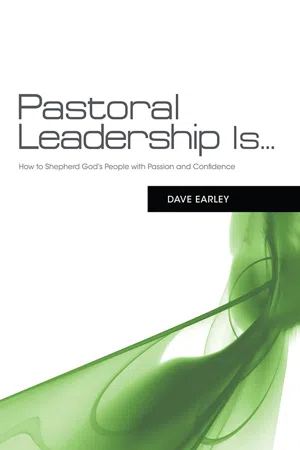
Pastoral Leadership Is... presents in dozens of brief yet powerful chapters a practical, Bible-based, and highly readable guide to leading the local church. This guidebook to the great adventure of being a pastor follows the directions God gave Moses in order to effectively shepherd Israel: Pray, Teach and Preach, Lead and Multiply.Believing the western world has traded the biblical model of pastoral leadership in favor of a traditional one, author Dave Earley writes to encourage pastors to become the spiritual warriors, missional leaders, and multiplying mentors God calls them to be.Each compelling entry is set up to finish the sentence that begins with the book's title. For example, Pastoral Leadership Is... "Abandoning Your Life to the Call of God, " "Following Paul's Example in Praying for Your Flock, " "Cooperating with the Holy Spirit, " "Leading a Church Full of Leaders, " "Resolving Conflict, " and more.Expecting a revolution, Earley says, "Instead of letting traditional church culture tell you who a pastor is and what he is to do, let God tell you through the Bible."
- 320 pages
- English
- ePUB (mobile friendly)
- Available on iOS & Android
eBook - ePub
Pastoral Leadership is...
About this book
Information
Topic
Theology & ReligionSubtopic
Christian Church1
Pastoral Leadership Is . . .
Focusing on the Things Every Pastor Simply Must Do
Incredible!
Moses and the people of God had just experienced the incredible power of God as He delivered them from being the slaves of Egypt. Through the deliberate use of ten miraculous plagues, God had not only struck down the Egyptians’ religion, but had shown His great power and His deep compassion for His people.
Annoying!
It would be easy to feel a little sorry for Moses. At this point, he was more than eighty years old and stuck in the desert with tens of thousands of irritable and immature people.
Instead of sitting back to enjoy retirement, he was leading one of the most frustrating mobs ever assembled. The Israelites had spent decades in slavery, and their new liberty quickly turned to license. Every time he turned around, Moses found them either rebelling or griping.
Moses felt the weight of the responsibility and the depth of the frustration of leading the Hebrew nation safely through the wiles of the wilderness into the Promised Land when they would have preferred to return to the familiar bondage of Egypt. Shepherding them was like trying to herd cats.
Ridiculous!
Moses was trying to be everyone’s pastor, chaplain, counselor, and judge. Jethro, his father-in-law, happened to be visiting. Jethro, a veteran shepherd who oversaw massive herds in Midian, noticed how Moses was shepherding Israel. He could see that Moses was not being very effective.
When Moses’ father-in-law saw everything he was doing for them he asked, “What is this thing you’re doing for the people? Why are you alone sitting as judge, while all the people stand around you from morning until evening?” Moses replied to his father-in-law, “Because the people come to me to inquire of God. Whenever they have a dispute, it comes to me, and I make a decision between one man and another. I teach [them] God’s statutes and laws.” “What you’re doing is not good,” Moses’ father-in-law said to him. “You will certainly wear out both yourself and these people who are with you, because the task is too heavy for you. You can’t do it alone. (Exod 18:14–18)
Amnesia!
Moses knew better than to be the solo-shepherd for the flock of God. God had strategically placed Moses with Jethro for the previous decades in order for Moses to learn the nuances of leading a large flock in difficult terrain. But for some reason, when the people clamored for help, Moses forgot all he had learned and defaulted to trying to meet their needs himself. It was the pathway to burnout and the prescription for failure.
Avoiding the Trap
The majority of the churches in America are struggling. As many as 85 percent of the churches in the United States are plateaued or in decline.1 Most of the struggling churches are led by a solo-pastor, who is falling into the same trap that swallowed Moses. Instead of leading a large, healthy, growing flock into the Promised Land, these “Lone Ranger” pastors are struggling to keep an aging flock of an average of seventy members alive. They are expending all of their energies trying to be everyone’s pastor, chaplain, and counselor, all the while missing the three things every pastor simply must do.
Beyond the struggles of the churches, the majority of the pastors in the United States are struggling personally. The grind of the demands of the solo-pastor is burning American pastors out. Licensed professional counselor Michael Todd Wilson and veteran pastor Brad Hoffman report the following sobering statistics in their book Preventing Ministry Failure.
- 90 percent of American pastors surveyed feel inadequately trained to cope with ministry demands.
- 45 percent say they have experienced depression or burnout to the extent that they needed to take a leave of absence.2
Every month, 1,500 pastors leave the ministry permanently in America. Many more would leave if they could afford it. In a recent survey, more than 50 percent of pastors said they would leave their ministry if they could replace their income.3
In their book Pastors at Greater Risk, H. B. London and Neil Wiseman quote startling statistics from research conducted by Fuller Theological Seminary. These statistics are the reflection of the trap of the “Lone Ranger” pastor.
- 80 percent of pastors say they have insufficient time with spouse and that ministry has a negative effect on their family.
- 40 percent report a serious conflict with a parishioner once a month.
- 75 percent report they have had a significant stress-related crisis at least once in their ministry.
- 45 percent of pastors’ wives say the greatest danger to them and family is physical, emotional, mental, and spiritual burnout.
- 21 percent of pastors’ wives want more privacy.
- Pastors who work fewer than fifty hours a week are 35 percent more likely to be terminated.
- 40 percent of pastors considered leaving the pastorate in the past three months.
- 25 percent of pastors’ wives see their husband’s work schedule as a source of conflict.
- 48 percent of pastors think being in ministry is hazardous to family well-being.4
Of course, this is not the way God planned it. What is the problem? Part of the problem is too many pastors expend all of their energies trying to be the solo-pastor, chaplain, and counselor and are failing to focus on the three things every pastor simply must do.
A Plea for Sanity and the Three Things Every Spiritual Shepherd Simply Must Do
God used Jethro to speak into Moses’ life. As a wise advisor, he not only told Moses that what he was doing was wrong, but he also took the next step and told Moses what it was that he needed to do to correct it.
Now listen to me; I will give you some advice, and God be with you. You be the one to represent the people before God and bring their cases to Him. Instruct them about the statutes and laws, and teach them the way to live and what they must do. But you should select from all the people able men, God-fearing, trustworthy, and hating bribes. Place [them] over the people as officials of thousands, hundreds, fifties, and tens. They should judge the people at all times. Then they can bring you every important case but judge every minor case themselves. In this way you will lighten your load, and they will bear [it] with you. If you do this, and God [so] directs you, you will be able to endure, and also all these people will be able to go home satisfied.” (Exod 18:19–23)
Jethro’s advice is crammed with insight and wisdom. Before we see the requirements, let’s look at the results. Notice that in verses 22–23 Jethro promises Moses that if he focuses on doing the three things every pastor must do, leadership will be less stressful for him, and he will be able to endure the strain of shepherding a massive flock. On top of that, the people will prosper. That is better than a struggling flock with a burnt-out shepherd.
So what are the three things every spiritual shepherd simply must do?
- Pray—“Be the one to represent the people before God and bring their cases to Him” (v. 19).
- Teach the people how to live the Word of God—“Instruct them about the statutes and laws, and teach them the way to live and what they must do” (v. 20).
- Equip and mentor the next layers of leaders—“Select from all the people able men, God-fearing, trustworthy, and hating bribes. Place [them] over the people as officials of thousands, hundreds, fifties, and tens” (v. 21).
Jesus and the Three Things Every Pastor Simply Must Do
Jesus is the Good Shepherd (John 10:11). If anyone can offer insight into that on which an effective spiritual shepherd should concentrate, it is Jesus. So what did Jesus focus on in His ministry? Did He attend board meetings, visit hospitals, or do counseling?
So what did He do?
You guessed it. Jesus primarily focused on the same three things Jethro told Moses to do: pray, teach the Word, and lead leaders.
1. Pray
Yes, Jesus is God, but do not miss the fact that Jesus Christ was also an amazing man of prayer. Samuel Dickey Gordon summarizes the prayer life of the leader Jesus when he writes, “The man Christ Jesus prayed; prayed much; needed to pray; loved to pray.”5 He added, “Jesus prayed. He loved to pray. . . . He prayed so much and so often that it became a part of His life. It became to Him like breathing—involuntary.”6 Edward M. Bounds concurs, “Prayer filled the life of our Lord while on earth. . . . Nothing is more conspicuous in the life of our Lord than prayer.”7
Yes, I have heard the argument that we cannot pray like He did because He was the Son of God. But, that is the point. If Jesus Christ, the Son of God and the Son of Man, needed to pray, how much more do you and I?
In the Gospels there are fifteen accounts of Jesus praying. Eleven are found in Luke’s Gospel. Why? The answer is that of the four Gospel writers, Luke focused most on the human aspect of Jesus. Luke wanted us to see that, as a human leader, Jesus lived a life of prayer. Jesus was fully God and fully man. If Jesus, the human, made time to pray, how much more should you and I?
2. Teach the Word
Jesus was a powerful biblical preacher. Jesus’ first sermon was quoting the law to Satan (Deut 6:13,16; 8:3) and skillfully applying it to the situation (Matt 4:1–11). His second sermon was a dramatic reading of Isa 61:1–2 and the proclamation that this Scripture was being fulfilled as He spoke. As ...
Table of contents
- Foreword
- Introduction
- Chapter 1
- Part 1
- Part 2
- Part 3
- Part 4
- Part 5
- Appendix
Trusted by 375,005 students
Access to over 1.5 million titles for a fair monthly price.
Study more efficiently using our study tools.
Frequently asked questions
Yes, you can cancel anytime from the Subscription tab in your account settings on the Perlego website. Your subscription will stay active until the end of your current billing period. Learn how to cancel your subscription
No, books cannot be downloaded as external files, such as PDFs, for use outside of Perlego. However, you can download books within the Perlego app for offline reading on mobile or tablet. Learn how to download books offline
We are an online textbook subscription service, where you can get access to an entire online library for less than the price of a single book per month. With over 1.5 million books across 990+ topics, we’ve got you covered! Learn about our mission
Look out for the read-aloud symbol on your next book to see if you can listen to it. The read-aloud tool reads text aloud for you, highlighting the text as it is being read. You can pause it, speed it up and slow it down. Learn more about Read Aloud
Yes! You can use the Perlego app on both iOS and Android devices to read anytime, anywhere — even offline. Perfect for commutes or when you’re on the go.
Please note we cannot support devices running on iOS 13 and Android 7 or earlier. Learn more about using the app
Please note we cannot support devices running on iOS 13 and Android 7 or earlier. Learn more about using the app
Yes, you can access Pastoral Leadership is... by Dave Earley in PDF and/or ePUB format, as well as other popular books in Theology & Religion & Christian Church. We have over 1.5 million books available in our catalogue for you to explore.