In this revised and expanded edition of Brothers, We Are Not Professionals that includes a new introduction and select all-new chapters, best-selling author John Piper pleads through a series of thoughtful essays with fellow pastors to abandon the professionalization of the pastorate and pursue the prophetic call of the Bible for radical ministry.
"We pastors are being killed by the professionalizing of the pastoral ministry, " he writes. "The mentality of the professional is not the mentality of the prophet. It is not the mentality of the slave of Christ. Professionalism has nothing to do with the essence and heart of the Christian ministry. The more professional we long to be, the more spiritual death we will leave in our wake. For there is no professional childlikeness, there is no professional tenderheartedness, there is no professional panting after God.
"Brothers, we are not professionals. We are outcasts. We are aliens and exiles in the world. Our citizenship is in Heaven, and we wait with eager expectation for the Lord (Phil. 3: 20). You cannot professionalize the love for His appearing without killing it. And it is being killed.
"The world sets the agenda of the professional man; God sets the agenda of the spiritual man. The strong wine of Jesus Christ explodes the wine- skins of professionalism."
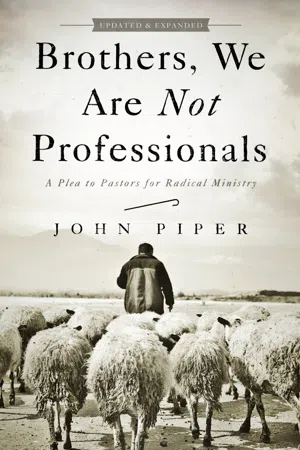
eBook - ePub
Brothers, We Are Not Professionals
A Plea to Pastors for Radical Ministry, Updated and Expanded Edition
- 320 pages
- English
- ePUB (mobile friendly)
- Available on iOS & Android
eBook - ePub
Brothers, We Are Not Professionals
A Plea to Pastors for Radical Ministry, Updated and Expanded Edition
About this book
Information
Topic
Theology & ReligionSubtopic
Christian ChurchThe preacher . . . is not a professional man;
his ministry is not a profession;
it is a divine institution,
a divine devotion.
E. M. Bounds
✦ ✦ ✦
We are fools for Christ’s sake.
But professionals are wise.
We are weak.
But professionals are strong.
Professionals are held in honor.
We are in disrepute.
We do not try to secure a professional lifestyle,
but we are ready to hunger and thirst and be ill-clad and homeless.
1
Brothers, We Are Not Professionals
We pastors are being killed by the professionalizing of the pastoral ministry. The mentality of the professional is not the mentality of the prophet. It is not the mentality of the slave of Christ. Professionalism has nothing to do with the essence and heart of the Christian ministry. The more professional we long to be, the more spiritual death we will leave in our wake. For there is no professional childlikeness (Matt. 18:3); there is no professional tenderheartedness (Eph. 4:32); there is no professional panting after God (Ps. 42:1).
But our first business is to pant after God in prayer. Our business is to weep over our sins (James 4:9). Is there professional weeping? Our business is to strain forward to the holiness of Christ and the prize of the upward call of God (Phil. 3:14); to pummel our bodies and subdue them lest we be cast away (1 Cor. 9:27); to deny ourselves and take up the blood-spattered cross daily (Luke 9:23). How do you carry a cross professionally? We have been crucified with Christ, yet now we live by faith in the one who loved us and gave Himself for us (Gal. 2:20). What is professional faith?
We are to be filled not with wine but with the Spirit (Eph. 5:18). We are God-besotted lovers of Christ. How can you be drunk with Jesus professionally? Then, wonder of wonders, we were given the gospel treasure to carry in clay pots to show that the transcendent power belongs to God (2 Cor. 4:7). Is there a way to be a professional clay pot?
We are afflicted in every way but not crushed, perplexed but not driven to despair, persecuted but not destroyed, always carrying in the body the death of Jesus (professionally?) so that the life of Jesus may also be manifested (professionally?) in our bodies (2 Cor. 4:9–11).
I think God has exhibited us preachers as last of all in the world. We are fools for Christ’s sake, but professionals are wise. We are weak, but professionals are strong. Professionals are held in honor, we are in disrepute. We do not try to secure a professional lifestyle, but we are ready to hunger and thirst and be ill-clad and homeless. When reviled, we bless; when persecuted, we endure; when slandered, we try to conciliate; we have become the refuse of the world, the offscouring of all things (1 Cor. 4:9–13). Or have we?
Brothers, we are not professionals! We are outcasts. We are aliens and exiles in the world (1 Pet. 2:11). Our citizenship is in heaven, and we wait with eager expectation for the Lord (Phil. 3:20). You cannot professionalize the love for His appearing without killing it. And it is being killed.
The aims of our ministry are eternal and spiritual. They are not shared by any of the professions. It is precisely by the failure to see this that we are dying.
The life-giving preacher is a man of God, whose heart is ever athirst for God, whose soul is ever following hard after God, whose eye is single to God, and in whom by the power of God’s Spirit the flesh and the world have been crucified and his ministry is like the generous flood of a life-giving river.1
We are most emphatically not part of a social team sharing goals with other professionals. Our goals are an offense; they are foolishness (1 Cor. 1:23). The professionalization of the ministry is a constant threat to the offense of the gospel. It is a threat to the profoundly spiritual nature of our work. I have seen it often: the love of professionalism (parity among the world’s professionals) kills a man’s belief that he is sent by God to save people from hell and to make them Christ-exalting, spiritual aliens in the world.
The world sets the agenda of the professional man; God sets the agenda of the spiritual man. The strong wine of Jesus Christ explodes the wineskins of professionalism. There is an infinite difference between the pastor whose heart is set on being a professional and the pastor whose heart is set on being the aroma of Christ, the fragrance of death to some and eternal life to others (2 Cor. 2:15–16).
God, deliver us from the professionalizers! Deliver us from the “low, managing, contriving, maneuvering temper of mind among us.”2 God, give us tears for our sins. Forgive us for being so shallow in prayer, so thin in our grasp of holy verities, so content amid perishing neighbors, so empty of passion and earnestness in all our conversation. Restore to us the childlike joy of our salvation. Frighten us with the awesome holiness and power of Him who can cast both soul and body into hell (Matt. 10:28). Cause us to hold to the cross with fear and trembling as our hope-filled and offensive tree of life. Grant us nothing, absolutely nothing, the way the world views it. May Christ be all in all (Col. 3:11).
Banish professionalism from our midst, Oh God, and in its place put passionate prayer, poverty of spirit, hunger for God, rigorous study of holy things, white-hot devotion to Jesus Christ, utter indifference to all material gain, and unremitting labor to rescue the perishing, perfect the saints, and glorify our sovereign Lord.
Humble us, O God, under Your mighty hand, and let us rise, not as professionals, but as witnesses and partakers of the sufferings of Christ. In His awesome name. Amen.
Notes
1. John Piper and Wayne Grudem, Recovering Biblical Manhood and Womanhood: A Response to Evangelical Feminism (Wheaton, IL: Crossway Books, 1991), 16.
2. Richard Cecil quoted in E. M. Bounds, Power through Prayer (Grand Rapids, MI: Baker Book House, 1972), 59.
For my name’s sake I defer my anger,
for the sake of my praise I restrain it for you,
that I may not cut you off. . . .
For my own sake, for my own sake, I do it,
for how should my name be profaned?
My glory I will not give to another.
Isaiah 48:9, 11
✦ ✦ ✦
God’s chief end
is to glorify God
and enjoy His glory forever.
✦ ✦ ✦
God loves His glory more than He loves us,
and this is the foundation of His love for us.
2
Brothers, God Loves His Glory
I grew up in a home where 1 Corinthians 10:31 was almost as basic to our family as John 3:16. “Whether, then, you eat or drink or whatever you do, do all to the glory of God” (NASB). But not till I was twenty-two years old did I hear anyone say that God’s first commitment is to His own glory and that this is the basis for ours. I had never heard anyone say that God does everything for His glory, too, and that is why we should. I had never heard anyone explain that the role of the Holy Spirit is to burn in me what He has been burning with for all eternity: God’s love for God. Or more precisely, God the Father’s delight in the panorama of His own perfections reflected as a perfect image in His Son.
No one had ever asked me, “Who is the most God-centered Person in the universe?” And then answered, “God is.” Or, “Is God an idolater?” And then answered, “No, He has no other gods before Him.” Or, “What is the chief end of God?” And then answered, “God’s chief end is to glorify God and enjoy His glory forever.” So I was never confronted forcefully with the God-centeredness of God until I sat under the teaching of Daniel Fuller and was directed by him to the writings of Jonathan Edwards.
Since those explosive days of discovery in the late sixties, I have labored to understand the implications of God’s passion for His glory. That is now the title of a book I wrote as a tribute to Jonathan Edwards, half of which is a reproduction of his book, The End for Which God Created the World. Edwards’ thesis in that book is this:
[God] had respect to himself, as his last and highest end, in this work; because he is worthy in himself to be so, being infinitely the greatest and best of beings. All things else, with regard to worthiness, importance, and excellence, are perfectly as nothing in comparison of him. . . . All that is ever spoken of in the Scripture as an ultimate end of God’s works is included in that one phrase, the glory of God.1
Why is it important to be stunned by the God-centeredness of God? Because many people are willing to be God-centered as long as they feel that God is man-centered. It is a subtle danger. We may think we are centering our lives on God when we are really making Him a means to self-esteem. Over against this danger I urge you to ponder the implications, brothers, that God loves His glory more than He loves us and that this is the foundation of His love for us.
“Stop regarding man in whose nostrils is breath, for of what account is he?” (Isa. 2:22). “Put not your trust in princes, in a son of man, in whom there is no salvation” (Ps. 146:3). “Cursed is the man who trusts in man and makes flesh his strength” (Jer. 17:5). “Behold, the nations are like a drop from a bucket, and are accounted as the dust on the scales. . . . All the nations are as nothing before him, they are accounted by him as less than nothing and emptiness” (Isa. 40:15, 17).
God’s ultimate commitment is to Himself and not to us. And therein lies our security. God loves His glory above all. “For my name’s sake I defer my anger, for the sake of my praise I restrain it for you, that I may not cut you off. . . . For my own sake, for my own sake, I do it, for how should my name be profaned? My glory I will not give to another” (Isa. 48: 9, 11).
God performs salvation for His own sake. He justifies the people called by His name in order that He may be glorified.
“Therefore say to the house of Israel [and to all the churches], Thus says the Lord God: It is not for your sake, O house of Israel, that I am about to act, but for the sake of my holy name, which you have profaned among the nations to which you came. And I will vindicate the holiness of my great name, which has been profaned among the nations, and which you have profaned among them. And the nations will know that I am the Lord. . . . It is not for your sake that I will act, declares the Lord God; let that be known to you. Be ashamed and confounded for your ways, O house of Israel’” (Ezek. 36:22–23, 32).
This is no isolated note in the symphony of redemptive history. It is the ever-recurring motif of the all-sufficient Composer. Why did God predestine us in love to be His sons? That the glory of His grace might be praised (Eph. 1:6, 12, 14). Why did God create a people for Himself? “I created [th...
Table of contents
- Brothers, We Are Not Professional
- Copyright
- Contents
- Preface
- Chapter 1
- Chapter 2
- Chapter 3
- Chapter 4
- Chapter 5
- Chapter 6
- Chapter 7
- Chapter 8
- Chapter 9
- Chapter 10
- Chapter 11
- Chapter 12
- Chapter 13
- Chapter 14
- Chapter 15
- Chapter 16
- Chapter 17
- Chapter 18
- Chapter 19
- Chapter 20
- Chapter 21
- Chapter 22
- Chapter 23
- Chapter 24
- Chapter 25
- Chapter 26
- Chapter 27
- Chapter 28
- Chapter 29
- Chapter 30
- Chapter 31
- Chapter 32
- Chapter 33
- Chapter 34
- Chapter 35
- Chapter 36
- Desiring God
Trusted by 375,005 students
Access to over 1.5 million titles for a fair monthly price.
Study more efficiently using our study tools.
Frequently asked questions
Yes, you can cancel anytime from the Subscription tab in your account settings on the Perlego website. Your subscription will stay active until the end of your current billing period. Learn how to cancel your subscription
No, books cannot be downloaded as external files, such as PDFs, for use outside of Perlego. However, you can download books within the Perlego app for offline reading on mobile or tablet. Learn how to download books offline
Perlego offers two plans: Essential and Complete
- Essential is ideal for learners and professionals who enjoy exploring a wide range of subjects. Access the Essential Library with 800,000+ trusted titles and best-sellers across business, personal growth, and the humanities. Includes unlimited reading time and Standard Read Aloud voice.
- Complete: Perfect for advanced learners and researchers needing full, unrestricted access. Unlock 1.5M+ books across hundreds of subjects, including academic and specialized titles. The Complete Plan also includes advanced features like Premium Read Aloud and Research Assistant.
We are an online textbook subscription service, where you can get access to an entire online library for less than the price of a single book per month. With over 1.5 million books across 990+ topics, we’ve got you covered! Learn about our mission
Look out for the read-aloud symbol on your next book to see if you can listen to it. The read-aloud tool reads text aloud for you, highlighting the text as it is being read. You can pause it, speed it up and slow it down. Learn more about Read Aloud
Yes! You can use the Perlego app on both iOS and Android devices to read anytime, anywhere — even offline. Perfect for commutes or when you’re on the go.
Please note we cannot support devices running on iOS 13 and Android 7 or earlier. Learn more about using the app
Please note we cannot support devices running on iOS 13 and Android 7 or earlier. Learn more about using the app
Yes, you can access Brothers, We Are Not Professionals by John Piper in PDF and/or ePUB format, as well as other popular books in Theology & Religion & Christian Church. We have over 1.5 million books available in our catalogue for you to explore.