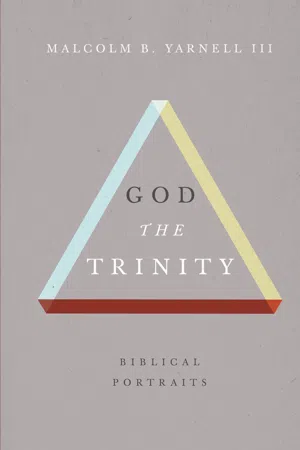
Is the Trinity biblical? Is it necessary to affirm God as three persons in one being? Despite a renewed interest in the Trinity in recent years, many Christians, including most evangelicals, either relegate the Son of God to creaturely status or repudiate the personhood of the Holy Spirit. In addition, numerous scholars affirm that the doctrine of the Trinity is not clearly revealed in Scripture. Is the Trinity merely a philosophical construction, or is it essential to orthodox Christianity? Drawing on hermeneutics and biblical and historical theology, Malcolm Yarnell crafts a careful and clear response to these issues through exegesis of pivotal texts from both testaments. He meticulously examines the foundational Hebrew confession known as the Shema, Matthew's great commission, the divine relations in the Gospel of John, Paul's Corinthian benediction, the opening hymn of Ephesians, and the throne room vision of the Apocalypse. Also considered are the relationships of language to revelation and history to metaphysics, along with recent appeals to recover patristic exegesis and the Christian imagination.He also challenges the reader to discern the implications of the Trinity for personal salvation as well as corporate worship.
- 272 pages
- English
- ePUB (mobile friendly)
- Available on iOS & Android
eBook - ePub
About this book
Information
Topic
Theology & ReligionSubtopic
Theology1
The Identity of God: Ὄνομα
Going, therefore make disciples of all the peoples, baptizing them in the name [ὄνομα] of the Father and the Son and the Holy Spirit.
Matthew 28:19
Truth through Idiom
Le plus savant physician ne pourrait rien reprocher à leurs analyses de la lumière.10 “The most learned physicist could never find a difficulty with their analyses of light.” In a moving essay written to celebrate the rise of the Impressionist movement in painting, Edmond Duranty made this startling assertion. The claim would not have been problematic to Duranty, an artist himself, but it would be and is somewhat shocking to those moderns whose primary idiom for speaking truth is found in scientific discourse rather than in art or in the more realist forms of art.11 Duranty’s challenge, written to foster appreciation for the contributions of “The New Painting” among the academic painters who elevated detail, seems intentionally blunt. The difficulty in finding the proper medium for expressing truth—on display in the modern clashes between the various arts, between the various sciences, and between science and art—is as deep as the difficulty in discerning truth.12 And the difficulty is compounded by the diverse ways human beings express the truth they perceive. Some believe truth is expressed through definitive, verifiable, and concrete propositions, as expressed in the language of fact, formula, and creed, while others express truth more readily through narrative, poetry, and hymn, or even painting, sculpture, and tapestry.
Capacities for Truth
John Ruskin, the famous proponent of natural history, political economy, and critical art, understood well the problems in bringing the arts and the sciences to a mutual understanding. From an early age Ruskin was fascinated with geometry and botany on the one hand but increasingly with engraving and poetry on the other hand. He went up from a middle-class family to read for a degree in classical greats at Oxford. Ruskin had a capaciousness of mind and spirit that is rare in any age, and from his struggles perhaps we can learn to see beyond the confines of our own limited idiom.
In lectures delivered in 1872, three years after being appointed the first Slade Professor of Art at the University of Oxford, Ruskin chided the physicist who told him that sight was “altogether mechanical.” He lamented that that particular scientist’s “physiology had never taught him the difference between eyes and telescopes.” Ruskin believed human science was a wonderful and necessary human effort because it helped humanity discern order in nature. However, one must not limit human understanding to that which is merely physical. “You do not see with the lens of the eye. You see through that, and by means of that, but you see with the soul of the eye.”13 Ruskin then appealed to Matthew 6:22–23 as a biblical basis for bringing together physical and spiritual perception: “The light of the body is the eye. If therefore, thine eye be evil . . .”14
Ruskin, who was reputed to have “the most analytic mind in Europe,”15 recognized that “analytic power” was an intellectual faculty available to people who exercised “patience in looking,” “precision in feeling,” and “due industry,” with only an average “memory” required.16 His social politics were geared toward educating the common man to develop this faculty beyond the constrictive conventions of the modern age’s dominant commercialism and industrialism, even as he recognized that some human beings were more gifted in some ways than in others. Earlier in his life, like his scientific interlocutor, he was able to see only the “hideous rocks” and a “small aspen” during his sojourn through a forest at Fontainebleau, France. However, as he began drawing the lines of a tree, he was privileged to see, if just for a moment, beyond the natural world into the beautiful, and through the beautiful into the eternal. Ecclesiastes 3:11 echoed around his mind during this epiphany.
The woods, which I had only looked on as wilderness, fulfilled I then saw, in their beauty, the same laws which guided the clouds, divided the light, and balanced the wave. “He hath made everything beautiful, in his time, [he has also set eternity in the human heart,]” became for me thenceforward the interpretation of the bond between the human mind and all visible things; and I returned along the wood-road feeling that it had led me far;—Farther than ever fancy had reached, or theodolite had measured.17
Neither Romanticism with its idiom of “fancy” nor the Enlightenment with its “theodolite” (a precision surveying tool) could ultimately obtain for Ruskin his fleeting but evocative insight into the eternal. He came to see that the laws of both art and science point toward a deeper reality, but they cannot attain it except in shadow. His was an experience in natural theology that depended on the knowledge of special revelation for its proper interpretation.
For Ruskin, who was no mere evangelical and spoke freely of his “un-conversion” from Scottish Puritanism,18 the copious reading and wholesale memorization of Scripture nevertheless provided the intellectual basis for discerning eternal verities through both art and science. Humanity may express the realities of this world through various idioms because God intends human discernment to testify to him. God provides humanity with the gift of perceiving him in sundry ways. The artist who received this grace could not conclude with mere aesthetics but must end in something more profound, which Ruskin called θεωρία, literally seeing God. The scientist could similarly receive the grace from God that would help him move beyond mere mechanics and glimpse the sublime.19 In response we are to relay what we have seen, for the “use and function” of all our analytic efforts “is to be witness to the glory of God.”20 This also means that Scripture itself is to be read ultimately not simply in a scientific manner, though that is not inappropriate, but in a more holistic way, in a typological manner.21
The Bible’s Own Idiom
In this book we hope to demonstrate that the Bible reveals the doctrine of the Trinity through its own idiom, an idiom that is conducive to typological hermeneutics responsibly deployed. Where Ruskin was fascinated to discover “patterns” as well as color and background in the world around him at an early age,22 a way of perception that made him one of the sharpest critics of both art and science in the late nineteenth century, I hope the reader will come to see the pattern of the Trinity is woven into the biblical revelation in both micro and macro forms. Indeed, the Trinity ultimately appears to be the idiom of Scripture in both Testaments. This book does not assume to speak in an artistic manner, for I am not an artist but a scientist engaged in a lifelong analysis of theological discourse. However, we do employ the idiom of art at points as a way to demonstrate that the biblical text does not restrict the theologian to a mere Aristotelian perception of the mundane. On the other hand, through regularly (and primarily) employing Aristotelian-inspired methodologies, especially evident in evangelicalism’s exegetical practices, we also demonstrate a necessary limitation to the flights of fantasy to which earlier Platonic-inspired methodologies may tend.
After reading the last paragraph, my family reminds me that my literary ventures become opaque through the use of demanding allusions and compressed vocabulary. For this I ask your patience and beg you to stick with my book as eventually I typically get around to speaking in an idiom that may suit the reader. So perhaps I must state what I mean more clearly at certain points, and this is a good point to do so with the general project. Let me use the analogy of a three-way conversation between scientists, artists, and theologians: The idiom of art may seem pointless to the scientist because the scientist speaks through a more prop...
Table of contents
- Prologue
- Chapter 1: The Identity of God
- Chapter 2: The God We Worship
- Chapter 3: The Only God
- Chapter 4: God Interpreting God
- Chapter 5: The God Who Is
- Chapter 6: Even as God
- Chapter 7: The God Who Acts
- Chapter 8: The God Who Is Coming
- Epilogue
- Appendix: Three Primary Trinitarian Creeds
Trusted by 375,005 students
Access to over 1.5 million titles for a fair monthly price.
Study more efficiently using our study tools.
Frequently asked questions
Yes, you can cancel anytime from the Subscription tab in your account settings on the Perlego website. Your subscription will stay active until the end of your current billing period. Learn how to cancel your subscription
No, books cannot be downloaded as external files, such as PDFs, for use outside of Perlego. However, you can download books within the Perlego app for offline reading on mobile or tablet. Learn how to download books offline
Perlego offers two plans: Essential and Complete
- Essential is ideal for learners and professionals who enjoy exploring a wide range of subjects. Access the Essential Library with 800,000+ trusted titles and best-sellers across business, personal growth, and the humanities. Includes unlimited reading time and Standard Read Aloud voice.
- Complete: Perfect for advanced learners and researchers needing full, unrestricted access. Unlock 1.5M+ books across hundreds of subjects, including academic and specialized titles. The Complete Plan also includes advanced features like Premium Read Aloud and Research Assistant.
We are an online textbook subscription service, where you can get access to an entire online library for less than the price of a single book per month. With over 1.5 million books across 990+ topics, we’ve got you covered! Learn about our mission
Look out for the read-aloud symbol on your next book to see if you can listen to it. The read-aloud tool reads text aloud for you, highlighting the text as it is being read. You can pause it, speed it up and slow it down. Learn more about Read Aloud
Yes! You can use the Perlego app on both iOS and Android devices to read anytime, anywhere — even offline. Perfect for commutes or when you’re on the go.
Please note we cannot support devices running on iOS 13 and Android 7 or earlier. Learn more about using the app
Please note we cannot support devices running on iOS 13 and Android 7 or earlier. Learn more about using the app
Yes, you can access God the Trinity by Malcolm B. Yarnell in PDF and/or ePUB format, as well as other popular books in Theology & Religion & Theology. We have over 1.5 million books available in our catalogue for you to explore.