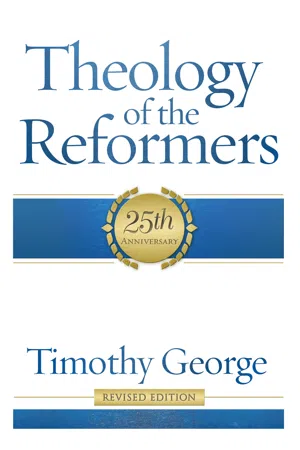
First released in 1988, this 25th Anniversary Edition of Timothy George's Theology of the Reformers includes a new chapter and bibliography on William Tyndale, the reformer who courageously stood at the headwaters of the English Reformation. Also included are expanded opening and concluding chapters and updated bibliographies on each reformer. Theology of the Reformers articulates the theological self-understanding of five principal figures from the period of the Reformation: Martin Luther, Huldrych Zwingli, John Calvin, Menno Simons, and William Tyndale. George establishes the context for their work by describing the spiritual climate of their time. Then he profiles each reformer, providing a picture of their theology that does justice to the scope of their involvement in the reforming effort. George details the valuable contributions these men made to issues historically considered pillars of the Christian faith: Scripture, Jesus Christ, salvation, the church, and last things. The intent is not just to document the theology of these reformers, but also to help the church of today better understand and more faithfully live its calling as followers of the one true God. Through and through, George's work provides a truly integrated and comprehensive picture of Christian theology at the time of the Reformation.
- 432 pages
- English
- ePUB (mobile friendly)
- Available on iOS & Android
eBook - ePub
Theology of the Reformers
About this book
Information
Topic
Theology & ReligionSubtopic
Christian Theology1
Introduction
In 1518 the Dutch scholar Desiderius Erasmus, having entered his fifty-first year and believing his death to be imminent, longed to be rejuvenated for a few years, “for this only reason that I believe I see a golden age dawning in the near future.”1 In retrospect, it seems that Erasmus was unduly pessimistic about his own end—he had nearly twenty years yet to live—and overly optimistic about his times. His heady vision of a “golden age” of peace and learning would soon vanish before renewed war between the pope and the emperor, peasants’ uprisings, the assault of the Turks in the East and, above all, a religious crisis of profound impact. This crisis, which we call the Reformation, would shake the foundations of Western Christendom, leaving the church permanently divided. Before he died in 1536, Erasmus was referring to his age as “the worst century since Jesus Christ.”2
This negative assessment, however, must be set alongside other, more positive appraisals. Thus, the Scottish Presbyterian theologian William Cunningham opened his massive study of Reformation theology with the bold claim that the Reformation of the sixteenth century “was the greatest event, or series of events, that has occurred since the close of the canon of Scripture.”3 In a similar vein, the philosopher Hegel, a Protestant of a different sort, referred to the Reformation as “the all-illuminating sun, which follows that day-break at the end of the Middle Ages.”4
Until recent years one’s interpretation of the Reformation depended, almost invariably, upon prior confessional or ideological commitments. Roman Catholic partisans, beginning with Johannes Cochlaeus in the sixteenth century and continuing to Heinrich Denifle and Hartmann Grisar in the twentieth, have not been slack in their insistence that the Reformation was—to put it mildly—a mistake. What were its causes? Luther, a mad monk driven by narcissism and sexual compulsion; the German princes, greedy, self-serving autocrats; the Protestant preachers, renegade priests ready to sell their souls to become womanizers. And its consequences? Equally obvious: the rending of the seamless robe of medieval civilization, the splitting apart of faith and reason, nature and grace (so perfectly harmonized by Thomas Aquinas), and the unleashing of the forces of absolutism, nationalism, and secularism.
Protestant polemicists, for their part, responded to the Catholic caricatures in kind. In 1564 the Protestant court chaplain, Jerome Rauscher, published a treatise entitled One Hundred Select, >Great, Shameless, Fat, Well-Swilled, Stinking>, Papistical >Lies. The leaders of the Protestant movement—Luther, Zwingli, and Calvin—were depicted as heroes of the faith. Their words and deeds took on cosmic significance in the unfolding of salvation history.5
In the tradition of liberal Protestantism, the reformers were frequently extolled not because of, but in spite of, their actual reformatory doctrines. For Hegel, and especially Luther, the Reformation constituted a crucial moment in the history of thought because at this juncture the concept of human freedom came to the fore. He thus reduced Reformation theology to the dictum: “Man is destined through himself to be free.”6 In this view the Reformation was merely the first phase of the Enlightenment; Luther and Calvin, the precursors of Rousseau and Voltaire!
The German historian Leopold von Ranke inaugurated a new era in Reformation historiography when he published his monumental German History in the Age of the Reformation (1839).7 Although a Lutheran by confession, Ranke sought to rise above denominational prejudice. (He also wrote a history of the popes, in order to prove his evenhandedness!) He stressed the interaction of religion and politics in the period of the Reformation and insisted on extensive and critical use of the primary sources. The proper aim of the historian, as Ranke put it, is to know and reconstruct the actual past wie es eigentlich gewesen (“as it actually happened”).
Ranke’s influence on subsequent Reformation historiography, and indeed on the study of history in general, has been immense. His emphasis on the scrupulous use of sources has raised critical study of the Reformation to a new level. The writings of Luther, Zwingli, and Calvin, as well as those of many Catholic and radical reformers, have since been published in modern critical editions. Much more is known today about the complex combination of political, social, and cultural factors that characterized the Reformation. At the same time, Ranke’s desire for an utterly objective history has not been fulfilled. Nor indeed can it be. History is never the simple recounting of the past as it really was. It is inevitably an interpretation of the past, a retrospective vision of the past, which is limited both by the sources themselves and by the historian who selects and interprets them.
Perspectives in Reformation Studies
Reformation studies today embrace a variety of competing approaches. Before setting forth the aim and perspective of this book, let us look at three general areas of concern in contemporary Reformation scholarship.8
The Problem of Periodization
Lord Acton, who was a keen student of the Reformation, once declared that historians should be more concerned with problems than with periods. The attempt to situate the Reformation between the medieval civilization that preceded it on the one hand and modern culture that followed it on the other has proved to be exceedingly awkward. Early in the twentieth century, Ernst Troeltsch argued that the Reformation, in its seminal tendencies, belonged to the “authoritarian” worldview of the Middle Ages. The breakthrough to modern times came not in the sixteenth century with the Reformation but in the eighteenth with the Enlightenment. The famous church historian and Luther scholar Karl Holl rebutted Troeltsch and claimed that Luther and the reformers had presaged many positive developments in modern culture, notably in the concepts of personality and community.9
Closely related to this debate is the issue of the relationship of the Renaissance to the Reformation. The word Renaissance, which was originally only a term in the history of art, has come to represent a period of cultural flourishing—intellectual, literary, artistic—that swept through Italy and then northern Europe from the fourteenth through the sixteenth centuries. The link between Renaissance and Reformation is often said to be humanism, which refers not to an anthropocentric philosophy of life but rather to a pattern of education and activism modeled upon a quasi-religious reverence for classical precedence. Humanism deeply affected every branch of the Reformation. Luther developed his insight into Pauline theology while using Erasmus’s edition of the Greek New Testament. Zwingli, Calvin, Melanchthon, and Beza, among many others, were steeped in humanistic studies before embracing the Protestant message. Still, we cannot simply equate humanism and the Reformation; for in the wake of the Lutheran schism, humanist was divided from humanist as deeply as Protestant was from Catholic.
Was the Reformation the fulfillment or the antithesis of the Renaissance? Enno van Gelder argued the latter, claiming that the Reformation was basically at odds with positive elements of the Renaissance carried forth by such scholars as Erasmus and Montaigne.10 On the other hand, William Bouwsma pointed to important affinities between the deep tensions in Renaissance culture and the solutions offered by the Protestant reformers. Thus, he described the Reformation as “the theological fulfillment of the Renaissance.”11
The problem of periodization has defied an easy consensus. It is clear that the Reformation was ambiguously and eclectically related to both medieval and modern impulses. Heiko A. Oberman, whose research on the late medieval context of the Reformation would seem to validate Troeltsch’s thesis, has nonetheless found “the birthpangs of the Modern Era” in three characteristics of the later Middle Ages: (1) ;the discovery of the inductive method in scientific research, (2) a new view of human dignity based on a covenantal understanding of the relationship between God and the human, and (3) the closing of the gap between sacred and secular.12 Without overdefining our terms, it is best to see the Reformation as an era of transition, characterized by the emergence of a new kind of culture that was struggling to be born even as the old one was still passing away.
Political, Social, and Economic Interpretations
Clearly the Reformation lends itself to an examination of these factors. In the political sphere it witnessed the rise of the modern nation-state, the last serious attempt to make the Holy Roman Empire a viable force in European politics, and the beginning of dynastic religious wars. Why the Reformation succeeded in Germany, failed in France, and never took root in Spain can only be understood in the light of the distinct political histories of these nations. Economically, the influx of gold from the New World, together with the breakup of feudal land economies, created runaway inflation and economic dislocation. The relationship between the Reformation and the rise of capitalism has been studied extensively and continues to generate controversy. Likewise, the social forces operative in the Reformation have been investigated in great detail. We now have a much fuller picture of the social realities of the sixteenth century: the resurgence of witchcraft, the impact of printing, the ethos of urban life, changing family structures—all of which impinged directly upon the religious impulses of the age.13 Some of the most creative interpretations of the Reformation have been set forth by Marxist historians who, from Friedrich Engels to Gerhard Zschabitz, have interpreted the class struggles of the sixteenth century as a prototype of revolutions in the twentieth.
Ecumenical Historiography
Perhaps no scholar has had more influence on contemporary Roman Catholic interpretations of the Reformation than Joseph Lortz. His two-volume study of The Reformation in Germany (1939–40) broke decisively with earlier Catholic polemics against the Reformation and offered a basically positive, if still critical, appraisal of Luther. An entire “school” of ecumenical Catholic historians has followed in Lortz’s footsteps. This tradition of irenic scholarship has received a further impetus since the Second Vatican Council. On the Protestant side, we may mention the new interest in the reformers generated by Emil Brunner, Paul Tillich, and especially Karl Barth. While this emphasis has been decidedly confessional in part (cf. the “Luther renaissance” associated with Karl Holl), it has also contributed to a wider appreciation of the reformers as servants of the entire church.
The Reformation as Religious Initiative
While the foregoing approaches to Reformation history provide valuable insights for understanding such a complex period, we must recognize that the Reformation was essentially a religious event; its deepest concerns, theological. In this study we are not concerned to tell the “whole story” of the Reformation. Our primary focus is neither the political, social, nor the strictly historical dimensions. Rather we are concerned with the theological self-understanding of five major reformers. Although we shall have occasion for critical assessment, we must not prejudge the validity of the reformers’ thought. If F. ;M. Powicke’s dictum, “A vision or an idea is not to be judged by its value for us, but by its value to the man who had it,”14 is not the whole truth, it at least reminds us that we cannot begin to evaluate the significance of earlier Christians, especially the reformers, until we have asked ourselves their questions and listened well to their answers.
Such an approach requires an appreciation for what John T. McNeill has called the “religious initiative” in Reformation history.15 Impressed by the secular context of current events, we are tempted to interpret the past in terms of contemporary standards, rather than those of the age we are studying. It is easy to assume that princes and reformers, like modern statesmen and diplomats, were motivated primarily by ...
Table of contents
- Preface to the Second Edition
- Preface to the First Edition
- Abbreviations
- 1. Introduction
- 2. The Thirst for God: Theology and Spiritual Life in the Late Middle Ages
- 3. Yearning for Grace: Martin Luther
- 4. Something Bold for God: Huldrych Zwingli
- 5. Glory unto God: John Calvin
- 6. No Other Foundation: Menno Simons
- 7. This One Thing I Do: William Tyndale
- 8. The Abiding Validity of Reformation Theology
- Glossary of Reformation Theology
Trusted by 375,005 students
Access to over 1.5 million titles for a fair monthly price.
Study more efficiently using our study tools.
Frequently asked questions
Yes, you can cancel anytime from the Subscription tab in your account settings on the Perlego website. Your subscription will stay active until the end of your current billing period. Learn how to cancel your subscription
No, books cannot be downloaded as external files, such as PDFs, for use outside of Perlego. However, you can download books within the Perlego app for offline reading on mobile or tablet. Learn how to download books offline
Perlego offers two plans: Essential and Complete
- Essential is ideal for learners and professionals who enjoy exploring a wide range of subjects. Access the Essential Library with 800,000+ trusted titles and best-sellers across business, personal growth, and the humanities. Includes unlimited reading time and Standard Read Aloud voice.
- Complete: Perfect for advanced learners and researchers needing full, unrestricted access. Unlock 1.5M+ books across hundreds of subjects, including academic and specialized titles. The Complete Plan also includes advanced features like Premium Read Aloud and Research Assistant.
We are an online textbook subscription service, where you can get access to an entire online library for less than the price of a single book per month. With over 1.5 million books across 990+ topics, we’ve got you covered! Learn about our mission
Look out for the read-aloud symbol on your next book to see if you can listen to it. The read-aloud tool reads text aloud for you, highlighting the text as it is being read. You can pause it, speed it up and slow it down. Learn more about Read Aloud
Yes! You can use the Perlego app on both iOS and Android devices to read anytime, anywhere — even offline. Perfect for commutes or when you’re on the go.
Please note we cannot support devices running on iOS 13 and Android 7 or earlier. Learn more about using the app
Please note we cannot support devices running on iOS 13 and Android 7 or earlier. Learn more about using the app
Yes, you can access Theology of the Reformers by Timothy George in PDF and/or ePUB format, as well as other popular books in Theology & Religion & Christian Theology. We have over 1.5 million books available in our catalogue for you to explore.