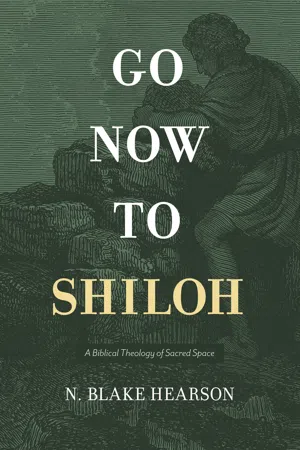
In the Old Testament, God revealed himself to people in particular places so they might communicate with him and worship him. Unlike pagan deities, who were connected to the created world, God's worshipers had to rely on him to reveal himself. Communication could be difficult, but God made it possible through places such as Bethel, Shiloh, and the tabernacle. In the New Testament, Jesus takes these categories and applies them to himself, showing that he alone is the access to God. Subsequently, the Holy Spirit comes and gives believers unprecedented access to God, making them connecting points between God and the world. Go Now to Shiloh by Old Testament scholar and professor Blake Hearson explores the challenges believers have faced over the centuries when communicating with God and shows what an immense gift we have as New Testament believers.
- 192 pages
- English
- ePUB (mobile friendly)
- Available on iOS & Android
eBook - ePub
About this book
Information
Topic
Theology & ReligionSubtopic
Biblical StudiesCHAPTER 1
IN THE BEGINNING
Communicating with God in the Bible
On November 19, 1863, Abraham Lincoln gave a few short remarks at the dedication of the battlefield at Gettysburg. His remarks, while brief, pointed to bloodshed as the cause that sanctified this ordinary field. Somehow, the loss of so many lives in that epic struggle changed the grass and soil, turning these elements and this place into a national monument that is honored to this day. After the intense three-day conflict, the area would never be the same. Add to this the dedication of the area as a final resting place for those who died in the fight, and the result is sacred ground. An ordinary space became extraordinary and off-limits to most everyday activities. Today, this site is visited by thousands annually, even after 150 years.
Fast-forward now to September 11, 2001. Early in the morning, on an ordinary Tuesday, several acres of land became sacrosanct, once again through the shedding of blood. Terrorists hijacked four passenger jets and used them as bombs against the United States. The two planes that flew into the Twin Towers of the World Trade Center in Lower Manhattan created the most death and destruction. After the attack was over, the debris of the towers was cleared away, and the human remains interred, discussions began as to what to do with “ground zero” where the buildings had stood. As with Gettysburg, the sheer number of lives lost changed the nature of the space where the Twin Towers once stood.
Strangely, American Christians generally do not see their church buildings as sacred spaces. We have some sense of things that we may not do in a church, but these boundaries more reflect ideas of politeness than beliefs as to what mysterious happenings occur there. If a church burns down, whether by accident or by an act of hatred, we view it as a tragedy for the congregation. The community that met in that church is deeply saddened by the loss. But no one in that congregation considers himself cut off from God. After all, the church is a body of believers, not a building. If anything, the loss of the building may bring the congregation closer as they pray together and seek to rebuild. We do not view the loss as a curse on a sacred place that makes it unfit for another church building. On the contrary, we depend upon the fact that contact with God remains unbroken.
Similarly, when a congregation dwindles and they sell their property, there is no caveat on how that property may be used. I have personally seen churches become bookstores, pubs, coffee shops, and even furniture outlets. While Christians may experience a sense of sadness to see their former churches used in these ways, they do not sense that sacred space has been violated. Neither the building nor the location contributed to the ability of people to communicate with God in that place.
Yet, our beliefs about sacred spaces were not always the norm. In fact, the Israelite of the Old Testament and the Jew of the New Testament would have found our notions strange—even perverse. God had revealed himself to them at particular places, and proper worship of and contact with him had to happen there. Part of this idea was linked to the need for sacrifices, but it was also ingrained in the theology of the entire Bible, with analogies found in other religions.1 As we will see below, even the Garden of Eden was such a place; it was the meeting ground between Adam, Eve, and God.
A metaphor is useful here. When I was growing up, the primary means of communication with anyone at a distance was a landline phone. If you were away from home and were in public space, you would look for a phone booth. You would step into the little cubicle, close the door, put in some change, and make a call. Even when Commissioner Gordon had to reach Batman, he used either the Bat Signal or a special phone. Cell phones, email, and texting were not options at that point.
Sacred spaces in the Old Testament tended to function in much the same way. If a worshiper wanted assurance of contact with God, he had to find a “phone booth” to reach him. God was everywhere, of course, but because of the fall, he was not everywhere reachable. Although communication remained difficult, God had set up access points or, in our analogy, phone booths, where his worshipers could have assurance of reaching him. It is important to note that these sacred places did not come about by some catastrophe like 9/11. Rather, God revealed himself at the sometimes-surprising locations. Much like phone booths, the connection could also be lost. Just as our phone companies might remove pay phones, so God might remove our means to connect with him and replace it with another.
To use a second analogy, it may be helpful to think of these connection points between heaven and earth as “stargates.”2 Science fiction fans will know that some worlds contain stargates linking one place (or time) to another far away. In the movie Stargate, a gate is discovered that allows humans to travel vast distances through space to another planet.3 The story reveals that parasitic aliens built these gates to glean cheap labor and human hosts on earth. The gate was ultimately buried long ago, so that the aliens could no longer reach earth, but it is discovered again in modern times. In this case, the analogy of a stargate illustrates that there is a special connection that overcomes an otherwise insurmountable barrier to communication.
Naturally, all analogies have limits and fail at some points. We are limited, and so are our analogies. However, the analogy of phones as a means of communication remains helpful, and it will serve as our primary metaphor moving forward. As such, the reader will see the development of communication with God in the Bible following the analogy of landlines through the early stages of cell phones and up to their current widespread use. As a result, we will see just how amazing our level of access to God really is and appreciate it in a new way.
Defining Sacred Space in the Bible
How does the Bible depict sacred space? At the bare-bones level, sacred space is a place where God has declared himself accessible to the worshiper. It is thus set in contrast to all other places. Among biblical scholars who study sacred places in the Bible, the focus is often on worship at the temple in Jerusalem; this comes from the view that the authors of Scripture sought to isolate Jerusalem as the only holy place acceptable to God. While this assumption is partially accurate, it also invites the question: Why did Jerusalem become so important in the first place? The history of contact between heaven and earth shows that Jerusalem became important to the degree that other points of contact with God were lost (e.g., Num 33:52; Deut 7:5; 12:1–7; 1 Kgs 3:2–3; 8:5–11; 11:1–10). In other words, given this attrition in the number of communication points with God, the temple in Jerusalem became the last site standing, the last holdover phone booth. Attempts to reach God via other places were met with the message, “This number is no longer in service.” Yet the focus on Jerusalem as the sole connection between God and his people causes us to miss the development of communication with a holy God in a fallen world. Furthermore, failing to observe the dynamics of fellowship and communion through sacred places causes us to miss the full effect of Jerusalem’s destruction in the Old and New Testaments.
In order to understand how biblical sacred space developed and functioned, we must go back to creation itself. When looking at the idea of sacred space in the Bible, it is apparent that the created world in its entirety has some level of sacredness, simply as the handiwork of God. However, this is only one aspect of the biblical perspective. As noted above, the Bible also depicts specific sites as holy, given their use by God to meet with selected people. These places became holy because God revealed himself there; they were places where God was accessible to his people.
As with most things, the story of God’s communication with mankind starts in the garden of Eden. Most Christians are familiar with this story and focus on the goodness of creation, subsequently marred by the sin of Adam and Eve. While this emphasis is fitting, it should not overshadow other important truths. For example, we often miss the actual purpose of the garden itself. My students are always surprised to learn that Adam and Eve were not created in the garden; they were placed there after their creation (read carefully Gen 2:7–8).
The garden was a special place with a special purpose. Adam and Eve were given tasks in Eden that would mirror the work of God in creating the world, while meeting their practical needs. Still, the primary function of Eden was as a site for fellowship with God.4 It was a place for God to commune and have harmonious relationship with beings made in his image. Thus, when Adam and Eve were banished from the garden, they were not just deprived of easy food and shelter; they also lost their interaction with God.
This loss became evident when they ate the forbidden fruit. Their place of fellowship became a place of fear, and its plants were used for cover and concealment. When their sin became apparent, God stated that they could not continue in such a state; they had to suffer the loss of sustenance and ready access to him. Creation would now resist their efforts to communicate with him, so it is more than ironic that Adam and Eve hid from him as he sought them. They were afraid. Their communication with God had already been disrupted. By consciously avoiding him, they revealed that his presence was now too difficult for them to take. God’s nearness inspired guilt and fear.
When God cast Adam and Eve out of the garden, he was giving them what their actions demanded: separation from God. Anyone who has had a falling out with a friend or spouse knows how difficult it is to be in the same room with that person. At the very least, it is awkward, and at worst, it is intolerable. Nothing can be enjoyed without resolution of the conflict or removal from the shared location. Thus, we can see how much greater the friction was between a holy God and his rebellious creatures. The initial solution was a change of venue for those creatures.
Yet this change of location, and resulting limitation of communication, did not really fix anything. The same awkwardness and pain remained. In human society, it is possible to escape our problems geographically. There are other places available to us and other people with whom to build positive relationships; not so with the Creator. Our relationship with him is inescapable. We will either seek restoration or spend a lifetime consciously or subconsciously avoiding him. There are no other options, and we know from the full revelation of Scripture that God desires restoration of both relationship and communication.
When Adam and Eve were ejected from the garden, they were removed from the discernable presence of God, but this loss does not imply that all communication with him was cut off. Rather, much like their relationship with the earth, interaction with each other, and ease of reproduction, communication only became much more difficult. Adam and Eve failed to submit to the authority of God, and that jeopardized their relationship with him. They lost the dedicated line to God and were forced into submission to his self-revelation in order to have fellowship with him.
As the Bible’s story progresses, we see that particular places in the Bible would come to serve as stopgap measures for humanity’s lost connection. No longer would God and mankind live under the same roof. Rather, the Creator would choose to communicate at exact times and places with no open-door policy. Meetings would occur by appointment and invitation only. Ultimately, Jesus would change things with his advent on earth, but the full restoration of what was lost in the garden remains to be fulfilled. In the time between the loss of fellowship in the garden in Genesis and the ultimate redemption of creation in Revelation, communication with God is a difficult process.
The Tower of Babel illustrates the sin of do-it-yourself phone repair, which God cannot abide. At its core, the story is about mankind’s desire to reach God physically and on equal terms. With respect to the latter, which preoccupies many interpreters, the sin of the builders parallels the sin of Adam and Eve. The builders wished to be independent of God and to throw off the bonds of humility. To have access to God that was not dependent on God’s self-revelation meant reaching equality with him. Humanity would not be bound by God’s will, if they could reach him at any time. However, the modern interpreter often dismisses the importance of the tower’s design.
The whole idea seems ludicrous to us. After all, in our world of skyscrapers, who would consider building a tower that could reach God? The desire to build such a tower should alert the modern reader to the fundamentally different way that ancient peoples viewed the universe. In their minds, God really could be physically reached; and if he could be reached, he could be controlled or weakened. Of course, the story ends with God foiling the plan of the people by making communication and fellowship among themselves as difficult as communication with God had become. The curse of the fall increased via greater difficulty in fellowship among mankind. Communion with God was difficult because of the fall; communion between people became difficult because of the Tower of Babel.
To be sure, God did not desire for all communication between himself and mankind to cease. By revealing himself at different times and places, he created access points where people might still connect with him. For example, in Exod 20:24, God stated in relation to sacrifice, “In every place where I cause My name to be remembered, I will come to you and bless you.” In other words, God chose the places where an interaction with him could occur. In terms of our analogy, God set up phone booths from which he would receive calls. The presence of these places implied, to the biblical authors, that all other places would not be app...
Table of contents
- Acknowledgments
- Abbreviations
- Introduction
- Chapter 1 In the Beginning: Communicating with God in the Bible
- Chapter 2 “Wherever I Reveal Myself”: Defining Sacred Space in the Hebrew Bible
- Chapter 3 Sacred Space: One-Time Revelations
- Chapter 4 A Stairway to Heaven: Places with Ongoing Sanctity
- Chapter 5 “Go Now to Shiloh”: Divine Rejection of Sacred Space
- Chapter 6 From Space to Person: The New Testament
- Epilogue
- Selected Bibliography
- Name and Subject Index
- Scripture Index
Trusted by 375,005 students
Access to over 1.5 million titles for a fair monthly price.
Study more efficiently using our study tools.
Frequently asked questions
Yes, you can cancel anytime from the Subscription tab in your account settings on the Perlego website. Your subscription will stay active until the end of your current billing period. Learn how to cancel your subscription
No, books cannot be downloaded as external files, such as PDFs, for use outside of Perlego. However, you can download books within the Perlego app for offline reading on mobile or tablet. Learn how to download books offline
Perlego offers two plans: Essential and Complete
- Essential is ideal for learners and professionals who enjoy exploring a wide range of subjects. Access the Essential Library with 800,000+ trusted titles and best-sellers across business, personal growth, and the humanities. Includes unlimited reading time and Standard Read Aloud voice.
- Complete: Perfect for advanced learners and researchers needing full, unrestricted access. Unlock 1.5M+ books across hundreds of subjects, including academic and specialized titles. The Complete Plan also includes advanced features like Premium Read Aloud and Research Assistant.
We are an online textbook subscription service, where you can get access to an entire online library for less than the price of a single book per month. With over 1.5 million books across 990+ topics, we’ve got you covered! Learn about our mission
Look out for the read-aloud symbol on your next book to see if you can listen to it. The read-aloud tool reads text aloud for you, highlighting the text as it is being read. You can pause it, speed it up and slow it down. Learn more about Read Aloud
Yes! You can use the Perlego app on both iOS and Android devices to read anytime, anywhere — even offline. Perfect for commutes or when you’re on the go.
Please note we cannot support devices running on iOS 13 and Android 7 or earlier. Learn more about using the app
Please note we cannot support devices running on iOS 13 and Android 7 or earlier. Learn more about using the app
Yes, you can access Go Now to Shiloh by Blake Hearson in PDF and/or ePUB format, as well as other popular books in Theology & Religion & Biblical Studies. We have over 1.5 million books available in our catalogue for you to explore.