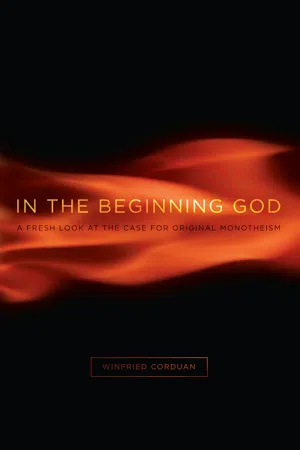
Christians believe that religion began when God created human beings and revealed himself to them. But is there scholarly evidence for this belief? In the nineteenth century academic world a stormy debate took shape over the origin of religion. Scholars explored the ancient languages of mythology and then considered evolutionary anthropology. A dominant view emerged that religion began with animism -- the reverent honoring of spirits -- and from there evolved into higher forms, from polytheism on to monotheism. However, scholars Andrew Lang and Wilhem Schmidt contended there were cultures throughout the world -- pygmy people in Africa and Asia, certain Australian Aboriginal groups and Native American tribes -- that originated as monotheistic, acknowledging the existence of one supreme God who created the world and holds people accountable for living morally upright lives. The debate wore on, and Schmidt, a member of the Catholic order and a priest, was accused (without evidence) of letting his faith interpret the facts. By the mid-twentieth century a silent consensus formed among scholars not to discuss the origin and evolution of religion any further. The discoveries of Lang and Schmidt have since been largely ignored. However, the evidence on which these scholars based their conclusion of monotheism is still out there. In the Beginning God attempts to educate Christians about the debate on this topic, the facts that were accepted and those that were ignored, and the use to which Christians can put all of this material in making a case for the truth of Christianity.
- 400 pages
- English
- ePUB (mobile friendly)
- Available on iOS & Android
eBook - ePub
About this book
Information
Topic
Teologia e religioneSubtopic
Teologia cristianaChapter 1
Origins and Beginnings: Confusion in the Making
A good story is worth telling well, and to tell it well, one may have to bring in a lot of detailed information, even if we would prefer to get to the action right away. This is one of those stories where many details are inevitable.
Our story’s plot concerns a number of scholars attempting to find an answer to the question, How did religion come about? and, sad to say, how their theories on the topic simply did not work. The story continues with a handful of men who came up with a scholarly answer to this question; it made sense and fit all of the data provided by various sciences. But then we learn about how these good ideas were discarded for nonscholarly reasons. Finally, we will conclude by showing that these supposedly discarded answers are still valid today and that they can make a difference to us.
A Straightforward Question
I think you and I would agree that the two questions, When did religion first become a part of the life of human beings? and, What form did the first religion take? are straightforward and objective questions that deserve straightforward and objective answers. Whether we have the answers is a different matter, but the nature of the questions does not change.
However, we need to be clear from the outset that straightforward is not synonymous with easy. A question such as, What is the cube root of 343? is straightforward but may not be easy to answer, depending on your skill in math. Of course, it would be wrong just to make up an answer or to say it is not a valid question just because you cannot answer it.
The question of the origin of religion strikes me as a straightforward one, inquiring after some information concerning the history of human beings. It is safe to say there was a time when no human on the earth held any beliefs or carried out any practices we would consider to be religious. One of the easiest explanations for such a religionless period could be that at that time there were no human beings; consequently, no one would have been around to practice any religion. Then—continuing that easy explanation—as soon as human beings were created, they were aware of their Creator and thus held to a religious belief. This is the biblical view.
If one wanted to become a little bit more precise within this framework, one could say that Adam and Eve really did not practice “religion” because they had an immediate relationship with God; further, perhaps religion in a more formal sense did not begin until the time of Enosh, the son of Seth, of whom the Bible tells us, “At that time people began to call on the name of the Lord” (Gen 4:26 NIV).
This response seeks to base itself on the Bible, and the reader is entitled to know that this author holds fast to it. However, I want to do more in this book than simply declare my belief, to which other people could then respond by declaring their beliefs. I also want to show why my belief is plausible. Most of the scholars with whom we will occupy ourselves in this discussion subscribed to the theory that human beings are the products of nature, not a Creator, and that religious awareness emerged alongside the process of human cultural evolution. Even scholars who did not buy into Darwinian evolution still said that religion came about as a part of human development. Without believing in a personal Creator, the question of the origin of religion becomes a difficult one.
Sticking to the Right Question
We must make sure we do not allow ourselves to get sidetracked into trying to answer a question we did not mean to ask. What is the origin of human beings? and, What is the origin of religion? are two different questions, even if for many people the answer to the second question is virtually identical with the answer to the first. My contention is that Regardless of how one explains the origin of human beings, one cannot get around the fact that the first religion of human beings was monotheism, the recognition and worship of one God. Obviously, world views make a lot of difference, and questions such as whether we accept the truth of the Bible, whether the Genesis account is factual, whether humans were created by God in his image, or whether they are the product of a currently ongoing process of adaptation and development, are extremely important ones. But we need not answer every possible question every time we consider a related topic. For our purpose, we are assuming the presence of human beings on the earth, and we want to know what they believed and practiced as their religion. The point is that even without believing in creation or revelation, the answer still comes out the same.
Ambiguity Arises
What makes this story complex is that after a time of debate in the late nineteenth and early twentieth centuries, neither the question nor the answers were considered to be straightforward in academic circles. Due to the manner in which scholars treated this topic, the theories became increasingly complicated and—dare I say—evasive. One change was that the word origin took on an equivocal meaning.
Imagine a fantasy novel that begins with a hero looking for a long-lost magical sword called “Victor.” It is clear that what everyone means by Victor in the first part of the book is the traditional weapon made of metal with a two-edged blade coming to a sharp point, mounted on a grip. However, unbeknownst to the reader, somewhere toward the middle of the novel, the author changes the meaning of the word; suddenly Victor is no longer a weapon but the name of the hero’s younger brother, who has disappeared! While the readers are still thinking about the weapon as the novel progresses, it stops making sense to them because they do not realize that for some unknown reason the author changed the object to which the word Victor referred from a weapon to a person. This story has become incoherent, and the reader will presumably toss it to the side and find something more consistent to read.
However, if the reader is a budding scholar in the academic world, maybe as a graduate student or as a beginning teacher, and if he discovers that the ambiguity (or really, incoherence) concerning the word Victor is an essential principle in his discipline, he may decide it must be profound, assent to it without necessarily understanding it, and defend it in his writings so that a doctorate, a professorship, tenure, and promotion will all be in his reach.
A large part of the upcoming story revolves around the fact that scholars have allowed themselves to redefine the word origin in new and novel ways. What precisely does origin mean? It may be difficult for you, just as much as for me, to understand the word to mean anything other than some kind of a beginning in time, the first appearance of something, the particular moment when something new came into existence. However, in the discussion on the origin of religion, for many scholars the word origin can also refer to something else less clearly defined.
Let me quickly cite one example in the context of our topic. Joseph Kitagawa, a leading scholar of religions in the twentieth century, affirmed with confidence: “The question of the origin of religions is not a historical one, but a metaphysical one.”1
What does this statement mean? I do not blame you if you cannot make sense of this assertion because surely the one making it seems to be redefining words. How can an “origin” not be an event in time and space, and, therefore, historical? At a minimum the statement may strike you as a gesture of misdirection, as when a stage magician tries to get you to look the wrong way.
So it could be possible to write off Kitagawa’s pronouncement, and others like it, as evasive double-talk. Perhaps it is. Still, many people accept what he said, whether they understand it or not. It sounds “deep,” and people love “deep” sayings, even if they are unintelligible or maybe especially if they are so.
We can counter such profound-sounding declarations with plain biblical ones. But there is no good reason to ignore the other resources at our disposal. We can go a step further and show that the biblical version is true not only because we say it is divine revelation but because it is also based on scholarly criteria. The information others have tried to use to debunk the biblical account will actually support the Bible. If someone who makes a statement inconsistent with the Bible is wrong on scientific grounds, then we should be able to show on scientific grounds where he is wrong because God did not create a world in which the facts contradict his Word. If the person is wrong because he is allowing his predispositions to dictate his answers, we should be able to expose such sleight of hand. If the person is talking gibberish, we should be able to expose it as such. And if someone should claim it is neither possible nor even permissible to demonstrate the nature of the origin of religion, we should be able to counter by saying, “We just did.”
Mircea Eliade: The Sky Becomes God
We are getting far ahead of ourselves here, and we should start traveling back in time, about 150 years, to the beginning of the debate. But, as we travel back, let me pull the “stop” switch at a place about half a century ago for a quick look at an example of the outcome of the discussion after about 100 years. I am inserting this example for two reasons: (1) because it illustrates how persuasive, almost hypnotic, some theories on the origin of religion can be, and (2) because it illustrates the manner in which the overall academic mind-set had shifted by then, preparing us to look through the prism with which contemporary scholars view the discussions that began 150 years ago.
Here is a summary based on the speculations of the well-known scholar of religion, Mircea Eliade:2 Once upon a time, when the economic level of human beings could only be described in terms of mere subsistence, people were highly aware of their natural environment. Among the many things that intrigued them was the splendor of the sky. They realized the sky with its brilliant light, which illuminated every part of the world, was different from anything else they encountered. They were aware of the many items that populated the universe such as trees, mountains, and rivers, as well as people and their implements. But those were all different from the sky. When the people saw a rock, they simply saw a rock; when they beheld the sky, they saw something so vast and so beyond anything that they could touch or understand that they were simultaneously fascinated and intimidated by it. In many ways they feared the sky, but they also saw the sky as friendly to them, at least most of the time. The sky brought sunshine, it brought rain, and it was their constant companion, whether they were hunting or fishing or collecting edible vegetation. The sky was always present.
Sometimes the sky would be angry, and it might send thunder and lightning and possibly even downpours so harsh they resulted in harmful floods. But after the sky had worked off its temper, the rain and the cool its tantrum had produced contributed to making further life possible and bearable.
The sky, people said, is great. We cannot conceive of anything greater than the sky; and, what’s more, if we pray to it, it often fulfills our desires. It knows and understands us. Because it is so great, nothing is beyond its capability. Understanding these amazing qualities of the sky, it seemed that it was more than just an object: it was a great being, who was not just a thing up there, but who in some ways resembled a human person, except that its powers exceeded anything we humans are capable of. The people began to think of the sky as the home of a super person and considered him to be “god.” They thought they could call him by his name and approach him if they were careful. Having come to think of him as a supreme god now, they recognized that he was still the Great Shining One, who is beyond our understanding, and they continued to be in total awe of him.
Thus, according to Eliade, the sky had become one of the important manifestations of what is sacred in the world. He called such disclosures “hierophanies,” which means literally, “manifestations of the Holy.” The little narration above is based on his exposition of the sacredness of the sky, which he says “symbolizes transcendence, power and changelessness simply by being there. It exists because it is high, infinite, immovable, powerful.”3
As we saw above, in the perception of the people, the sky then underwent a transformation from being a disclosure of sacredness itself to becoming the residence of a Supreme Being. Eliade explains, “When this hierophany became personified, when the divinities of the sky showed themselves, or took the place of the holiness of the sky as such is difficult to say precisely.”4
Let us look carefully at this declaration of a lack of precise knowledge. It seems to imply that we are looking at an event or a period in time during which this transition occurred. What else could one possibly mean by asking “when” something took place? There can hardly be any doubt that this event is the “origin” of belief in gods of the sky or of a single supreme God of the sky. Thus, Eliade seems to have committed himself here to the idea that we can reconstruc...
Table of contents
- In the Beginning God
- Preface
- Chapter 1: Origins and Beginnings: Confusion in the Making
- Chapter 2: Max Müller: Mythology as a Disease of Language
- Chapter 3: E. B. Tylor: Religion from a Darwinian Perspective
- Chapter 4: Andrew Lang: Turnabout Is Fair Play
- Chapter 5: Andrew Lang: Interactions and Totemism
- Chapter 6: Wilhelm Schmidt and Culture Circles
- Chapter 7: Wilhelm Schmidt: The Results
- Chapter 8: Wilhelm Schmidt: Reactions and Critiques
- Chapter 9: Eliade, Otto, and Durkheim: Escape into the Irrational
- Chapter 10: Monotheism Around the Globe
- Chapter 11: Original Monotheism and Christian Apologetics
- Appendix A
- Appendix B
Trusted by 375,005 students
Access to over 1.5 million titles for a fair monthly price.
Study more efficiently using our study tools.
Frequently asked questions
Yes, you can cancel anytime from the Subscription tab in your account settings on the Perlego website. Your subscription will stay active until the end of your current billing period. Learn how to cancel your subscription
No, books cannot be downloaded as external files, such as PDFs, for use outside of Perlego. However, you can download books within the Perlego app for offline reading on mobile or tablet. Learn how to download books offline
Perlego offers two plans: Essential and Complete
- Essential is ideal for learners and professionals who enjoy exploring a wide range of subjects. Access the Essential Library with 800,000+ trusted titles and best-sellers across business, personal growth, and the humanities. Includes unlimited reading time and Standard Read Aloud voice.
- Complete: Perfect for advanced learners and researchers needing full, unrestricted access. Unlock 1.5M+ books across hundreds of subjects, including academic and specialized titles. The Complete Plan also includes advanced features like Premium Read Aloud and Research Assistant.
We are an online textbook subscription service, where you can get access to an entire online library for less than the price of a single book per month. With over 1.5 million books across 990+ topics, we’ve got you covered! Learn about our mission
Look out for the read-aloud symbol on your next book to see if you can listen to it. The read-aloud tool reads text aloud for you, highlighting the text as it is being read. You can pause it, speed it up and slow it down. Learn more about Read Aloud
Yes! You can use the Perlego app on both iOS and Android devices to read anytime, anywhere — even offline. Perfect for commutes or when you’re on the go.
Please note we cannot support devices running on iOS 13 and Android 7 or earlier. Learn more about using the app
Please note we cannot support devices running on iOS 13 and Android 7 or earlier. Learn more about using the app
Yes, you can access In the Beginning God by Winfried Corduan in PDF and/or ePUB format, as well as other popular books in Teologia e religione & Teologia cristiana. We have over 1.5 million books available in our catalogue for you to explore.