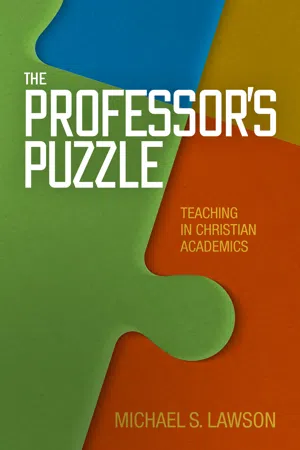
The Professor's Puzzle is designed as a handbook for new and aspiring professors to help them transition from the independent research of their doctoral program to classroom teaching. Unfortunately, acquiring a Ph.D. often does not involve real preparation for teaching. One cannot assume that mastering content necessarily means one is qualified to teach it. Drawing from years of experience training young faculty members, professor Michael S. Lawson gathers together the best of educational research and practices, leavened with the yeast of Christian theology, so that readers are equipped to put the "teaching puzzle" together. Ideal for aspiring professors in Christian higher education, as well as all who enter the teaching profession, so they may learn artful teaching and careful administration.
The following translations are available from the publisher: Chinese, German, French, Russian, and Spanish.
- 320 pages
- English
- ePUB (mobile friendly)
- Available on iOS & Android
eBook - ePub
About this book
Information
Topic
Theology & ReligionSubtopic
Religion
A Philosophy for Christian Academic Education
“The fear of the Lord is the beginning of wisdom.”
Psalm 111:10
Introduction
Plato did not invent philosophy (the love of wisdom), although his name has become synonymous with it. When we consider his teacher, Socrates, and his student, Aristotle, we find the Greek foundation stones of Western philosophy. In the East, thinkers like Guatama Buddha and Confucius also took leading roles in the search for wisdom, but they have not affected Western educational philosophies. A love of wisdom (philosophy) did not originate with philosophers or thinkers. The Bible traces an earlier and significantly different history for wisdom and those who love “her.”
In the opening book of the Bible, Eve took the first misguided step in her pursuit of wisdom. But eating the fruit brought only the knowledge of good and evil, not the wisdom she sought. Obviously they are not the same thing. In contrast, Job traces the source of wisdom directly to God, not a particular fruit. In the New Testament, James echoes that thought and announces God’s open promise to generously bestow wisdom on any who ask him in faith. Solomon sought wisdom above wealth, power, or vengeance, and Proverbs extols her virtues in chapter after chapter. The Old Testament encompasses a whole genre of material called “Wisdom literature,” verifying her significance. Ultimately the apostle Paul painted a bold contrast between God’s wisdom and Greek wisdom in the opening chapter of his Corinthian correspondence.
Fundamentally, Greek philosophers and the Bible differ in their starting places for wisdom. The great Greek thinkers struggled to explain the nature of reality as best they could in their search for wisdom. They used reason and logic, which they assumed existed to test ideas and perceptions. They questioned any notion that failed their rational tests. Their formulations attempted to account for both the visible (tangible) world and the invisible (intangible) world around them.4 However, Greek philosophy ended where it began, with a search. Ultimately, the Greeks and those who followed after them could not escape the confines of their own logic.
On the other hand, the Bible begins with the source of wisdom, the Creator himself. He blessed the tabernacle craftsmen with wisdom. God’s wisdom guided both Moses and Daniel. Solomon’s unprecedented wisdom came as a gift from God. Ultimately, all the treasures of wisdom are bound up in Christ, the exact representation of the Father. And God grants generous portions of wisdom without criticism to those who ask in faith. Furthermore, God’s wisdom doesn’t only explain life; God’s wisdom produces a life that “is first pure, then peace-loving, gentle, compliant, full of mercy and good fruits, without favoritism and hypocrisy” ( Jas 3:17). Those who embrace God’s wisdom live such lives.
Given the disparity between the Greek’s search and the Bible’s source, why do Christian scholars bother with Greek philosophers? Let me suggest four answers. First, Greeks set the philosophical agenda for Western thinkers. No one interacting with philosophy can ignore their questions. Second, Western theology organized itself to answer Greek philosophical questions.5 Third, Augustine and Aquinas brought Christian thought to bear on Platonic and Aristotelian ideas respectively. The writings of these two ecclesiastical giants continue to influence Christian theology in the West. Fourth, many “modern” practices of education have roots deeply buried in Greek soil. For instance, Plato thought education ought to sort people into proper social positions. Education still tends to establish social status, even in Christian circles.
This chapter is not designed to provide a Christian philosophy. Instead, I hope to provide basic categories, questions, and comments to guide your construction of a personal philosophy of Christian education applied specifically to an academic setting. In order for us to think together, you need to know how I am using some key words. Of course, Christian refers to all Christ’s teaching and character. I am particularly interested in his core values, which should permeate anything that bears his name. Theology refers to a comprehensive understanding of God based on both Scripture and creation. For clarity, I use the capitalized term Philosophy to refer to the Greeks and those who followed them, while the lower-case philosophy describes the wisest approach or best practice. Education encompasses the broadest scope of human learning and should be distinguished from academic schooling. Schooling only provides a portion of any person’s overall education.6 Therefore, a general philosophy of Christian education fits a wide variety of contexts totally, many of which are unrelated to schooling. But, Christian should modify everything associated with both education and schooling.
In the ancient world, education and religion were inseparable. Religion provided oxygen for the culturally rich structures in a society’s general education. A son normally learned a trade at his father’s side and there watched his father offer sacrifices designed to increase the family’s success. The visible and invisible worlds intertwined. This understanding of reality in the West began to change as the Enlightenment’s effects took hold. Eventually, educators separated general (scientific) education from religious (unverifiable by science) education. The university curriculum, once unified under theology, split into physical studies and metaphysical studies—with the latter deemed to have little practical value.
Today, children of the Enlightenment who come to faith in Christ need restructured thinking at the most basic level because Christian education stands in stark contrast to this dichotomy. Christian education offers a unified system. A genuinely Christian school recognizes the Creator in every subject and applies Christian values to every practice or policy.7 I freely admit this is easier said than done. We do tend to “sprinkle” a little Christianity on inherited structures and practices rather than giving them a thorough cleansing with biblical theology. I am confident we can and must do better.
In addition, Christian education must account for two features never mentioned in the public sector. Western Philosophy has largely abandoned the search for moral absolutes. Public education in a pluralistic society mainly focuses on information. The Sa...
Table of contents
- Preface: Putting the Professor’s Puzzle Together
- Chapter 1: A Philosophy for Christian Academic Education
- Appendix A: BEGE-1710 Christian Life and Thought: Syllabus
- Appendix B: Teacher Behaviors Inventory
Trusted by 375,005 students
Access to over 1.5 million titles for a fair monthly price.
Study more efficiently using our study tools.
Frequently asked questions
Yes, you can cancel anytime from the Subscription tab in your account settings on the Perlego website. Your subscription will stay active until the end of your current billing period. Learn how to cancel your subscription
No, books cannot be downloaded as external files, such as PDFs, for use outside of Perlego. However, you can download books within the Perlego app for offline reading on mobile or tablet. Learn how to download books offline
Perlego offers two plans: Essential and Complete
- Essential is ideal for learners and professionals who enjoy exploring a wide range of subjects. Access the Essential Library with 800,000+ trusted titles and best-sellers across business, personal growth, and the humanities. Includes unlimited reading time and Standard Read Aloud voice.
- Complete: Perfect for advanced learners and researchers needing full, unrestricted access. Unlock 1.5M+ books across hundreds of subjects, including academic and specialized titles. The Complete Plan also includes advanced features like Premium Read Aloud and Research Assistant.
We are an online textbook subscription service, where you can get access to an entire online library for less than the price of a single book per month. With over 1.5 million books across 990+ topics, we’ve got you covered! Learn about our mission
Look out for the read-aloud symbol on your next book to see if you can listen to it. The read-aloud tool reads text aloud for you, highlighting the text as it is being read. You can pause it, speed it up and slow it down. Learn more about Read Aloud
Yes! You can use the Perlego app on both iOS and Android devices to read anytime, anywhere — even offline. Perfect for commutes or when you’re on the go.
Please note we cannot support devices running on iOS 13 and Android 7 or earlier. Learn more about using the app
Please note we cannot support devices running on iOS 13 and Android 7 or earlier. Learn more about using the app
Yes, you can access The Professor's Puzzle by Michael S. Lawson in PDF and/or ePUB format, as well as other popular books in Theology & Religion & Religion. We have over 1.5 million books available in our catalogue for you to explore.