Preaching occurs when a holy man of God opens the Word of God and says to the people of God,
"Come and experience God with me in this text."
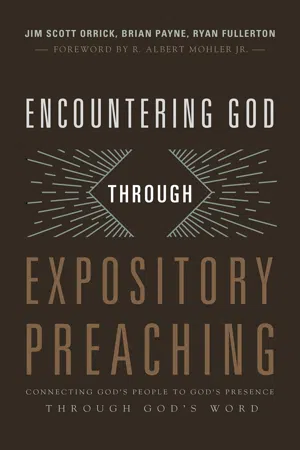
EncounteringGod through Expository Preaching ushers preachers of all levels of experience through the practical steps necessary to preach with power. The authors not only cover the exegetical skills and homiletical techniques necessary for sound preaching, but they also dive deeper to emphasize how a pastor's character and reliance upon the Holy Spirit are essential to preaching God's word effectively. As the preacher encounters God in preaching, he will preach with spiritual power and see lives transformed and churches strengthened.
eBook - ePub
Encountering God through Expository Preaching
Connecting God's People to God's Presence through God's Word
- 208 pages
- English
- ePUB (mobile friendly)
- Available on iOS & Android
eBook - ePub
Encountering God through Expository Preaching
Connecting God's People to God's Presence through God's Word
About this book
Information
Topic
Theology & ReligionSubtopic
Christian MinistryPART ONE
The Holy Man, the Holy Text, and the Holy Spirit

THE MAN MATTERS
God Shoots Out His Word with Crooked Arrows, But . . .
It is a sweet and comforting thought that God is willing to use imperfect preachers. James, the brother of Jesus, is a prime example of this. God used him to lead the church in Jerusalem and to author a book of the Bible; but in the book that bears his name, James confessed, “We all stumble in many ways” (Jas 3:1). We all sin, and even preachers are stumblers. No preacher is perfect. The apostles James and John could be overly concerned about their status (Mark 10:37). Peter could be a coward (Gal 2:11–14). Despite these stumblings, God our Father used these men, and others like them, to lead thousands to the Lord and to convey to us the “faith that was once for all delivered to the saints” (Jude 3).
While it is sweet and comforting to know that God uses imperfect men to preach his Word, this sweet truth will turn sour if we use it to excuse our sin and to slacken in our fight for Christlikeness. We must be clear: God’s grace will never encourage us to be less concerned about our sin. In fact, according to James, the reality that “we all stumble in many ways” should make us pursue preaching not with a complacent presumption but rather with greater fear and trembling. He writes, “Not many of you should become teachers, my brothers, for you know that we who teach will be judged with greater strictness. For we all stumble in many ways” (Jas 3:1–2). Since we stumble, we should be cautious about entering into a teaching ministry. We should be cautious because great stumbling will incur greater judgment, and it will undermine the goal of great teaching.
Bad men undermine good sermons. Paul knew this, and it is one of the reasons he wrote to the Romans, “You then who teach others, do you not teach yourself? While you preach against stealing, do you steal? You who say that one must not commit adultery, do you commit adultery? You who abhor idols, do you rob temples? You who boast in the law dishonor God by breaking the law. For, as it is written, ‘The name of God is blasphemed among the Gentiles because of you’” (2:21–14). When people who talk about God live godless lives they put a bad taste in the mouths of their listeners. They make unbelievers want to spit and swear. Bad men preaching good sermons produces blasphemy. A preacher may proclaim the grace of God with glorious orthodoxy, but if his life contradicts his doctrine he will disgrace the gospel of Christ (1 Tim 3:7).
The Man Matters
These considerations underscore one vital point: when it comes to preaching, the man matters. Our definition of preaching specifies that it is a holy man of God who says to the congregation, “Come and experience God with me in this text.” Good preaching is more than the sum total of rigorous exegesis, orthodox theology, and engaging homiletics. Good preaching is not simply a skilled act that can be done by any man. No, God desires that preaching be a skilled act that is done by a certain kind of man. So what kind of man must the preacher be? The aim of this chapter is to sketch out the kind of man God wants to use in the pulpit. God desires the ministry of preaching and teaching to be done by men who are holy, qualified, and progressing.
A Holy Man
The godly Scottish pastor Robert Murray M’Cheyne famously said, “A holy man is an awful weapon in the hands of God.” That sentiment is backed up by Paul’s words in 2 Timothy, where he clearly teaches that if a man cleanses himself from sin, he becomes useful to God. Paul wrote, “Now in a great house there are not only vessels of gold and silver but also of wood and clay, some for honorable use, some for dishonorable. Therefore, if anyone cleanses himself from what is dishonorable, he will be a vessel for honorable use, set apart as holy, useful to the master of the house, ready for every good work” (2 Tim 2:20–21). We will benefit from briefly unpacking this passage.
In this passage Paul compares Timothy’s local church to a great house. Like every house, this one had some honorable vessels and some dishonorable vessels. Our houses today have both cheap plastic plates (which we usually use for the kids) and nicer ceramic plates (which we bring out to honor guests). Great houses in Paul’s day would have had both dishonorable plates made of wood and clay and honorable plates made of silver and gold. From the context, we can tell that the two types of vessels are meant to represent two different kinds of church leaders. Honorable vessels are those who cleanse themselves by fleeing youthful passions and pursuing righteousness (2 Tim 2:22). A dishonorable vessel would be one of the false teachers Timothy was dealing with. They were men who “quarrel about words,” “irreverent babblers,” and those who do not flee “youthful passions” (2 Tim 2:14, 16, 22). Such men are dishonorable vessels whom the master of the church will not use.
Notice this: those who will be used are clean, and they are cleansed from sin. That is why they are called “holy” in verse 21, and it is why Paul explains what it looks like to cleanse oneself by commanding Timothy to “flee youthful passions and pursue righteousness, faith, love, and peace, along with those who call on the Lord from a pure heart” (2 Tim 2:22).
See what the Lord says about the person who is holy: such a man is “set apart,” “useful,” and “ready for every good work.” Like the articles of the temple, the preacher who fights sin and flees sin is set apart, holy, devoted unto God. He is also useful. He can speak to others about sin and our Savior because he deals in these realities constantly. Like a chef knows knives, and a professor knows books, godly preachers know the ins and outs of what it looks like to fight sin and to apply Christ’s saving grace. Like a guide familiar with a path he has walked a thousand times, the preacher is useful to those he guides because he knows well the pathway to holiness. He can help others since he has himself been helped along the path. Finally, he is ready for every good work. A man who is indulging in sin is grieving the Spirit, and when the frown of the Spirit is on a man he is not ready to preach the smile of heaven that comes to us through the cross of Christ. I (Fullerton) have the privilege of pastoring near an excellent seminary, and many students are under my pastoral care. That means I have the privilege of meeting and shepherding many men who aspire to be good preachers, and most of them are men who are following hard after God and pursuing godly character. Sadly, a few seem more eager to conquer the original languages than to conquer their carnal lusts. Some seem more eager to master homiletics than to manage their own homes. The result of their distorted values is that they will never be used mightily by God. They might be used occasionally in spite of themselves, like Balaam’s donkey, but they will never know what it is to feel the abiding blessing of God on their ministries. The blessing of God is reserved for those who cleanse themselves and pursue holiness.
Because God blesses holiness, the preacher of God’s Word must adopt certain vital community habits. He must stay close to God’s people. Paul tells Timothy to “flee youthful passions and pursue righteousness, faith, love and peace, along with those who call on the name of the Lord from a pure heart” (emphasis added). Notice that Timothy is to stay close to other believers (those who call on the Lord from a pure heart). Preachers must not be distant from the communities they teach; rather, through friendships, accountability relationships, and small groups, they must be actively fighting sin along with the people. Too many preachers convince themselves they must hide their struggles from their people. This sometimes leads to preachers who hide their sin behind a veneer of holiness. But God does not bless veneers of holiness. He blesses men actively seeking holiness in all of life’s struggles right alongside God’s people.
Over the years, I have found that this commitment to holiness calls for costly decisions. Many times on Saturday evening, when I felt I needed every minute to prepare for Sunday, I have laid my studies aside to make a phone call, pay a visit, or write an e-mail to someone I may have sinned against. I have always felt that if I were going to be used of God, I would be better off having a more holy life than a more highly polished sermon. And I have been right; God has never disappointed. I can testify that He has always made up for any lack of polish in my sermon by the blessing He adds to the preaching as I imperfectly seek to be a pure vessel ready for every good work. Brother preacher, we eagerly want to help your preaching! The rest of this book is aimed to help you prepare your preaching, pray for your preaching, and then to preach in the power of the Holy Spirit. But, ultimately your preaching will need God’s smile upon it if it will be successful, and that blessing comes as we pursue holiness.
And do not fear confessing your sin to your people. Unless your sin is disqualifying and scandalous, your confessions to them individually and corporately will not undermine your ability to minister the Word to them; rather, honest, humble confession will help your ministry to them.
A Qualified Man
God not only desires holy men, but he also desires qualified men. What do I mean by qualified men? I mean that the preaching ministry is ordinarily done by elders who meet the qualifications laid out for pastors in 1 Timothy 3:1–7 and Titus 1:1–9. I realize that not everyone reading this book will be a pastor in a local church. And I am not saying that only ordained pastors can ever preach. But I will say that qualified men are responsible for the preaching ministry of the church, and that those who aspire to preach God’s Word regularly should also aspire to be qualified leaders in the local church. If you are not yet qualified to lead God’s church, you should be working toward becoming qualified if you hope to exercise a fruitful preaching ministry.
So what are these qualifications? What lifestyle does God desire for preachers? We will survey the qualifications laid out in Titus 1. My goal in doing this is not to say all that could be said about the qualifications for ministry, but to notice specifically how these qualifications (or lack thereof) will affect your preaching ministry. I think the qualifications Paul lays out for the elder in Titus 1 remind us that the man matters.
God, in his wisdom, has commanded that His Word be preached, and He has told us by whom it should be preached so that it will be the most powerful. The seventeenth-century poet George Herbert said that when the Word of God is preached by a holy man of God it is like the light of the sun shining through a beautiful stained glass window:
Doctrine and life, colours and light, in one
When they combine and mingle, bring
A strong regard and awe: but speech alone
Doth vanish like a flaring thing.
And in the ear, not conscience ring.1
When they combine and mingle, bring
A strong regard and awe: but speech alone
Doth vanish like a flaring thing.
And in the ear, not conscience ring.1
Herbert is making an astounding assertion: just as the beauty of the light of the sun is enhanced by passing through a stained glass window, so the beauty and effectiveness of God’s Word is enhanced when it is preached by a holy man. If you would have your preaching bring “strong regard and awe,” you must be a man of good doctrine and a qualified life. Otherwise, your words will hit people’s ears only to immediately “vanish like a flaring thing.” So, what qualifications does God want to characterize your life?
First, an elder must be “above reproach” (Titus 1:1). To be above reproach does not mean you are perfect, but it does mean that there is no charge of persistent sin and especially of scandalous sin that can legitimately be charged against you. This call to be above reproach really sums up the thrust of all the other qualifications that follow. If the charge of being a drunkard or a greedy man can stick to you then your preaching will not stick to people’s consciences. Instead, every time you call people to holiness, they will merely dismiss your words since you do not practice what you preach. On the other hand, I know of a preacher who, after he preached a sermon, was serving the Lord’s Supper. As one of the members of the church filed up to him to take the bread, he whispered in the preacher’s ear, “I have a love/hate relationship with your preaching.” The man meant that he loved the preacher’s presentation of the gospel but he also felt pinched, convicted, and called to change by the preacher’s stand for righteousness. This is what we want our preaching to do: simultaneously to wound and to heal, to pinch in a way that points to Christ. But it will not do any of this if every time we speak against sin our people can merely dismiss us as hypocrites.
The elder must be “the husband of one wife” (Titus 1:6). If he is married, an elder must be faithfully committed to his own wife in a monogamous marriage.2 As preachers, our goal is to cultivate godly marriages among those we shepherd (Eph 5:22–32). How can we possibly do this if our own marriages are in shambles? I once heard of a church where the pastor and his wife divorced, and within two years, six more couples in the church also divorced. When the pastor’s marriage fell apart, so did much of the fruit of his preaching ministry. On the other hand, when a preacher continually cleaves to his bride, his example joins with his preaching to declare God’s faithfulness to His bride. As the pastor commits himself to his wife in marriage, he is providing his people a clear picture of Christ’s commitment to the church. Our marriages matter to our preaching.
Paul’s next qualification involves how a pastor manages his home. He writes, “His children are believers and not open to the charge of debauchery or insubordination” (Titus 1:6). The word translated “believers” can also be translated “dutiful,” or “faithful.” I think it should be translated “faithful” here, since that accords more with the parallel passage in 1 Timothy 3, and it also harmonizes more clearly with the theological reality that no elder has the power to make his children believers.3 So here the elder is called to have a well-managed home where his children are submissive to him and not living scandalously and riotously.
Many godly men have fallen into the fault of not calling their children to the same standards to which they call others. Eli honored his sons above the Lord (1 Sam 2:29). David would not displease his son by asking him hard questions and calling his actions to account (1 Kgs 1:6). When we fail in the way that these good men did, we undermine our ministries and disqualify ourselves from New Covenant service. If we would have a church to trust our preaching, they must see that we are calling our children to the same standards to which we are calling the church. In our preaching we are called to “Declare these things; exhort and rebuke with all authority. Let no one disregard you” (Titus 3:15). If we do this to those in the pew while letting our children get away with murder (or maybe just immodesty), we will undermine our preaching.
He must not be “arrogant” (Titus 1:7). Hypersensitivity about your preaching is an indication of arrogance. If you cannot handle having your sermons critiqued and questioned, get out of the ministry. If you cannot handle having your imperfections exposed, do not pursue the pastorate. Furthermore, impatience is also often an indication of arrogance. The ministry of preaching is not for men who want everyone around them to “get it the first time.”...
Table of contents
- Foreword by R. Albert Mohler Jr.
- What Is Preaching?
- Part One: The Holy Man, the Holy Text, and the Holy Spirit
- Part Two: Preparing to Lead the People of God to Experience God: Early Preparation
- Part Three: “Come and Experience God with Me in This Text”: Final Preparation
- Conclusion: It is not what you expected. It is better.
- Scripture Index
- Name Index
- Subject Index
Trusted by 375,005 students
Access to over 1.5 million titles for a fair monthly price.
Study more efficiently using our study tools.
Frequently asked questions
Yes, you can cancel anytime from the Subscription tab in your account settings on the Perlego website. Your subscription will stay active until the end of your current billing period. Learn how to cancel your subscription
No, books cannot be downloaded as external files, such as PDFs, for use outside of Perlego. However, you can download books within the Perlego app for offline reading on mobile or tablet. Learn how to download books offline
Perlego offers two plans: Essential and Complete
- Essential is ideal for learners and professionals who enjoy exploring a wide range of subjects. Access the Essential Library with 800,000+ trusted titles and best-sellers across business, personal growth, and the humanities. Includes unlimited reading time and Standard Read Aloud voice.
- Complete: Perfect for advanced learners and researchers needing full, unrestricted access. Unlock 1.5M+ books across hundreds of subjects, including academic and specialized titles. The Complete Plan also includes advanced features like Premium Read Aloud and Research Assistant.
We are an online textbook subscription service, where you can get access to an entire online library for less than the price of a single book per month. With over 1.5 million books across 990+ topics, we’ve got you covered! Learn about our mission
Look out for the read-aloud symbol on your next book to see if you can listen to it. The read-aloud tool reads text aloud for you, highlighting the text as it is being read. You can pause it, speed it up and slow it down. Learn more about Read Aloud
Yes! You can use the Perlego app on both iOS and Android devices to read anytime, anywhere — even offline. Perfect for commutes or when you’re on the go.
Please note we cannot support devices running on iOS 13 and Android 7 or earlier. Learn more about using the app
Please note we cannot support devices running on iOS 13 and Android 7 or earlier. Learn more about using the app
Yes, you can access Encountering God through Expository Preaching by Ryan Fullerton,Jim Orrick,Brian Payne in PDF and/or ePUB format, as well as other popular books in Theology & Religion & Christian Ministry. We have over 1.5 million books available in our catalogue for you to explore.