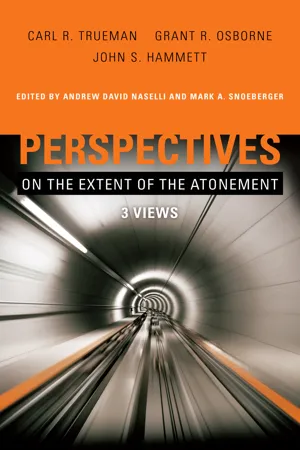
Perspectives on the Extent of the Atonement presents a point-counterpoint exchange concerning God's intention in sending Christ to die on the cross. All three contributors recognize a substitutionary element in the atoning work of Christ, but disagree over the nature and objects of that substitution. Carl Trueman (Westminster Theological Seminary) argues that Christ's atoning work secured the redemption of his elect alone. While infinite in value, Christ's death was intended for and applied strictly to those whom the Father had elected unconditionally in eternity past. John Hammett (Southeastern Baptist Theological Seminary) argues that Christ's atoning work had multiple intentions. Of these intentions two rise to the fore: (1) the intention to accomplish atonement for God's elect and (2) the intention to provide atonement for all mankind. Grant Osborne (Trinity Evangelical Divinity School) argues that Christ's atoning work provided atonement generally for all mankind. The application of that atoning work is conditioned, however, on each person's willingness to receive it.
eBook - ePub
Perspectives on the Extent of the Atonement
3 Views
- 256 pages
- English
- ePUB (mobile friendly)
- Available on iOS & Android
eBook - ePub
Perspectives on the Extent of the Atonement
3 Views
About this book
Information
Topic
Theology & ReligionSubtopic
Christian TheologyChapter 1
Definite Atonement View
Carl R. Trueman
The doctrine of definite atonement is one of those doctrines that might appear at first glance both counterintuitive and something of an imposition upon Scripture that distorts its plain meaning. Is it not obvious that God loves everybody? Should that not be reflected in the extent of the atonement? It seems basic that, in the words of John 3:16, God loves the world and that therefore a universal aspect to that love should surely lie at the heart of Christ’s most significant action as Savior: his death on the cross. To talk of limitation in such context would seem to undercut biblical teaching and to attenuate the love of God.1
Of course, other, far less controversial church teachings are susceptible to the criticism that, on the surface, Scripture does not at first glance seem to teach them, at least if one focuses on only certain biblical passages. For example, the coequality of the Father and Son would seem to contradict Jesus’ statements in the Gospels about the Father being greater than he. Every Christian knows—or should know—that such texts need to be set within the context of the overall teaching of Scripture and also within the history of the church’s reflection on the nature of the Father and Son. Only then can one truly understand why Trinitarian theology affirms that the persons in the Godhead are equal. Thus it is with definite atonement: it is important that we do not dismiss the doctrine out of hand because it seems to stand at odds with the “plain meaning” of verses such as John 3:16. In order to do this, we need to understand exactly what questions the church asked that led to the formulation as we have it.
The term definite atonement actually covers a variety of views of the atonement. Some of those who hold to definite atonement, for example, are comfortable with the medieval formula that declares Christ’s death is sufficient for all but efficient only for the elect; others have little or no use for the phrase. Yet all fit into the range of theories of atonement that can be considered “limited” based on their understandings of its extent. I raise this point because I want to establish at the start that my purpose is to outline the doctrine in terms of the broader confessional consensus and not in any narrow, intra-confessional manner. Thus, issues that might differentiate those within one confessional community, such as the nature and utility of the “sufficient for all, efficient only for the elect” distinction, will not be points of major discussion.2
I should also note at the outset that to pose the question in terms of the atonement’s extent is not the most appropriate way to approach the topic. Couched in such a loaded form, it immediately generates obvious questions: How can the atonement be preached other than to those who know (by some mystical experience?) that they are already elect? Does it not thereby kill evangelism? In fact, it is better to think of the question of the atonement’s extent as an inference drawn from its nature and efficacy. This, as I will argue, casts the kerygmatic problems in a somewhat different light: does the preacher proclaim a finished, efficacious work of Christ on the cross, or does he preach a work that merely lays the groundwork for salvation?
Historically, treatments of this issue have often carefully discussed the value of Christ’s sacrifice relative to classic christological formulations, with debates about whether this means that Christ’s death, as God-man, has infinite value.3 The Anselmic theory of atonement helped establish much of the framework for this type of discussion. Such debates often connected to the medieval distinction between Christ’s death as sufficient for all but efficient only for some. In general I will not be adopting this kind of framework for my argument. Most, if not all, Christian theologians would have no problem with the idea that Christ’s death could have sufficed for the sins of the whole world if that was in fact God’s intention. Arminians and hypothetical universalists agree with five-point Calvinists on that issue.4 My approach will be rather to look at the biblical nature of Christ’s mediation, specifically as it relates to the unity of intention that undergirds his priestly work of sacrifice and intercession. The question of the atonement’s extent is thus not merely a logical deduction of the kind that simply places the atonement under the umbrella of the decree of election; it is intimately connected to a number of aspects of the atonement. One cannot deal with the question of extent isolated from the doctrinal matrix in which the atonement is to be understood. Thus, the question of the atonement’s extent is a part—or perhaps better, a necessary inference—of the atonement’s nature.
I need to stress one final preliminary point: the mere presence of universal language in a biblical text does not require that we read it in an unequivocally universal way. Context and intention always determine sense. One obvious example is John 12:19: “So the Pharisees said to one another, ‘You see that you are gaining nothing. Look, the world has gone after him.’”5 It is obvious from this context that the word “world” does not mean every single human has gone after Jesus but simply that a significant number of them have done so. It is also clear that the speaker is not using “world” in the same way John uses it in John 1:9–10, where it clearly means something different. This really needs no elaborate explanation: we are all familiar with the ordinary use of language that uses such universal terms for a somewhat more limited number. Anyone who has ever stopped their teenage child from doing something or going somewhere will have heard the response, “But everyone else will be there,” and know that we are talking here of only a subset of the child’s social circle. We might also speak of someone who is well liked as being popular “with everyone” yet automatically understand that “everyone” cannot here mean the whole of the human race. Thus, we must understand verses of Scripture with an apparent universal reference in context—both the immediate context and that of the Bible’s teaching as a whole—rather than assume they can simply function as unanswerable proof texts.6
The case for particular redemption, like that for the Trinity, does not depend on the understanding of any single text, nor does any single text explicitly teach it. Instead, it is the result of the cumulative force and implications of a series of strands of biblical teaching. We can summarize these as (1) the particularity of intention in Christ’s saving mission and (2) the objective efficacy of Christ’s work. These two should then be set against the background of general biblical teaching on intention, efficacy, and atonement in the Bible. Once this is done, it is possible to address those texts that seem on the surface to militate against definite atonement.
The Particularity of Intention in Christ’s Saving Mission
For anti-Pelagian views of predestination, the focus of Christ’s mission as it relates to the decree is inevitably going to be understood in a focused, particular way. However, this particularity does not rest solely on a theological construct; it finds numerous resonances within the text of Scripture.
Texts
Matthew 1:21; 20:28; 26:28. When the angel visits Joseph, he declares that Christ “will save his people from their sins” (Matt 1:21), a sentiment Zechariah echoes in Luke 1:68. Later, in Matt 20:28 and 26:28, Christ specifically speaks of his work as intended for the salvation of many, not everyone. Thus, these texts support the notion that the origin of Christ’s mission lies in a saving intention that has particular and limited reference.
John 6:37–40. John’s Gospel is an even more fruitful place for such references. John 6:37–40 strikingly places the Son’s mission under the will of the Father but in such a way that the Son is willing to do what the Father has prescribed and promised. Even though certain people have seen Jesus but have not believed, this does not indicate that his mission has failed or been frustrated in any way (v. 37). He is clear: all whom the Father has given to him will come to him. D. A. Carson persuasively argues that the second half of verse 37 strongly underscores this, to be understood as “I will certainly keep in.”7 The passage then proceeds to indicate the foundation on which this is built: Christ has come to do the will of the Father (v. 38). Christ then defines his Father’s will as losing none whom the Father has given him but rather raising them up on the last day (v. 39). The particular and predestinarian thrust of ...
Table of contents
- Perspectives Series Abbreviations List
- Chapter 1: Definite Atonement View
- Chapter 2: General Atonement View
- Chapter 3: Multiple-Intentions View of the Atonement
- Chapter 4: Conclusion
- Name Index
Trusted by 375,005 students
Access to over 1.5 million titles for a fair monthly price.
Study more efficiently using our study tools.
Frequently asked questions
Yes, you can cancel anytime from the Subscription tab in your account settings on the Perlego website. Your subscription will stay active until the end of your current billing period. Learn how to cancel your subscription
No, books cannot be downloaded as external files, such as PDFs, for use outside of Perlego. However, you can download books within the Perlego app for offline reading on mobile or tablet. Learn how to download books offline
Perlego offers two plans: Essential and Complete
- Essential is ideal for learners and professionals who enjoy exploring a wide range of subjects. Access the Essential Library with 800,000+ trusted titles and best-sellers across business, personal growth, and the humanities. Includes unlimited reading time and Standard Read Aloud voice.
- Complete: Perfect for advanced learners and researchers needing full, unrestricted access. Unlock 1.5M+ books across hundreds of subjects, including academic and specialized titles. The Complete Plan also includes advanced features like Premium Read Aloud and Research Assistant.
We are an online textbook subscription service, where you can get access to an entire online library for less than the price of a single book per month. With over 1.5 million books across 990+ topics, we’ve got you covered! Learn about our mission
Look out for the read-aloud symbol on your next book to see if you can listen to it. The read-aloud tool reads text aloud for you, highlighting the text as it is being read. You can pause it, speed it up and slow it down. Learn more about Read Aloud
Yes! You can use the Perlego app on both iOS and Android devices to read anytime, anywhere — even offline. Perfect for commutes or when you’re on the go.
Please note we cannot support devices running on iOS 13 and Android 7 or earlier. Learn more about using the app
Please note we cannot support devices running on iOS 13 and Android 7 or earlier. Learn more about using the app
Yes, you can access Perspectives on the Extent of the Atonement by Andrew David Naselli, Mark A. Snoeberger, Andrew David Naselli,Mark A. Snoeberger in PDF and/or ePUB format, as well as other popular books in Theology & Religion & Christian Theology. We have over 1.5 million books available in our catalogue for you to explore.