Pastoral Ministry brings together the mandate of God, the needs of the sheep, and the model of the good Shepherd to uniquely inspire and equip you to fulfill your ministry as a shepherd.
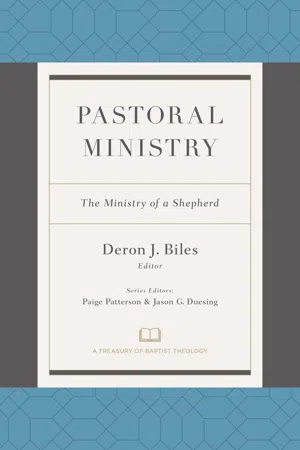
eBook - ePub
Pastoral Ministry
The Ministry of a Shepherd
- 224 pages
- English
- ePUB (mobile friendly)
- Available on iOS & Android
eBook - ePub
Pastoral Ministry
The Ministry of a Shepherd
About this book
Information
Topic
Theology & ReligionSubtopic
Christian MinistryCHAPTER 1
Introduction: The Ministry of a Shepherd
Deron J. Biles
God, in His grace, called me to be a pastor. It is a calling from which I have never recovered. I remember when God first called me as a 12-year-old boy. I recall walking down the aisle and taking the hand of my pastor, who was also my father, and sharing with him that God had called me to full-time ministry.
Not until a few years later as a 19-year-old pastor of a small church in central Texas did I begin to realize that, despite having been reared in the home of a pastor, I did not really know what a pastor was supposed to do. Three decades later, I am still learning. During that time, I have had the privilege of serving as a pastor, working with pastors at a state convention, and now training pastors at a seminary.
Being a pastor is an audacious calling. It is at once a remarkable privilege and an unaccomplishable task. Imagine the grace of God to call men to be His servants. What a wonderful privilege we have been given! Yet, the task is so great, who can be worthy? Just as the Lamb alone is worthy to loose the seals of the scroll (Rev 5:1–5), ultimately He alone is qualified to shepherd His people. Nevertheless, the ministries of the men God calls to be His shepherds must be consumed by His purpose for their lives. God’s Word supplies clarity for this high calling.
The Shepherd God
In general, the Bible talks more about who a shepherd is than what a shepherd does. Yet, both are vital in ministry. They are combined in Asaph’s tribute to David, “So he shepherded them according to the integrity of his heart, / And guided them by the skillfulness of his hands” (Ps 78:72).1 This verse expresses the faithful integration of being and doing that completes the ideal shepherd.
Passages that are typically used to describe the role of the pastor (i.e., 1 Tim 3:1–7; Titus 1:5–9) address more of the character attributes required of pastors than they do actual functions. However, a few passages in Scripture speak to the tasks of pastoral ministry; among these are Jer 23:1–4; Ezek 34:1–10; Acts 20:17–36; Eph 4:11–12; and 1 Pet 5:1–4.
In Scripture the clearest picture of the functions of a shepherd is found in Ezekiel 34. In this chapter God outlines the responsibilities of shepherds, the accountability of the shepherds, the consequences of a lack of shepherds, and the anticipation of the good Shepherd. The responsibilities of a shepherd become clear as we examine those areas for which God holds His shepherd servants accountable. Thus, we understand what shepherds should do by paying attention to what God indicts them for not doing.
The potency of Ezekiel 34 is the clarity of God’s instructions (i.e., what God expects of His servants)—not someone’s idea of what God wants. God says what He demands—the “oughtness” of tending sheep. So, we should huddle in close and sit up straight at the anticipation of His instruction and, in sincere faith, say, “Speak, for your servant is listening.”
What Shepherds Do
Being a pastor is hard work. The responsibilities seem endless. Some time ago, I put together a list of all the things that a pastor is expected to do. The list is still growing, but here is what I have so far. A pastor is expected to
| preach, teach, pray, equip, cast vision, counsel, lead the staff, lead his family, study, conduct weddings and funerals, | dedicate babies, baptize, serve the Lord’s Supper, moderate business meetings, attend denominational functions, advise committees, manage the public relations of the church, | lead the community in social reform, visit the sick and the bereaved and the lost and the prospects and the problematic, provide leadership, and give direction. |
But that is not all. In addition to what pastors are expected to do, there is also an unwritten list of expectations regarding what they should know. They are expected to be knowledgeable (maybe even an expert) in
| theology, hermeneutics, rhetoric, logic, music, architecture, administration, leadership, management, finance, education, | conflict resolution, worship, counseling, medicine, legal matters, ethics, politics, secular culture, engineering, acoustics, aesthetics, | gerontology, child-rearing, apologetics, evangelism, etiquette, prayer, the Bible, current events, history, religions, and denominations. |
To be fair, some of the expectations under which pastors operate are self-imposed; others are prescribed by the congregation. These tasks may be necessary or even good. But, they must not be the highest priorities. The church may employ you, but God is the One who called you. So, you must focus first on His instructions and filter all other expectations through the template of His Word.
Ezekiel 34 is God’s message to pastors: “This is what I expect from you.” He delivers these expectations in the context of His performance review of some shepherds who scored very low on their evaluations.
The indictment of the shepherds in Ezekiel 34 recalls God’s search for a faithful leader in Ezek 22:30, “So I sought for a man among them who would make a wall and stand in the gap before Me on behalf of the land, that I should not destroy it; but I found no one.”2 It also highlights the fact that God will not leave His sheep unattended simply because His shepherds have not proven worthy of their calling.
Imagery of Shepherds and Sheep
Imagery of shepherd and sheep is common in Scripture and rich in significance.3 The frequency of its use in the Pentateuch, in the history of the monarchy, in the book of Psalms, and in the Prophets demands careful exegetical attention.
The Bible uses shepherds and sheep as metaphors.4 Metaphors do not define; they compare.5 They explain what is unknown by comparing it to something that is known. Thus, when Jesus used metaphors to explain what “the kingdom of heaven is like,” His intention was not to give us full comprehension of the kingdom. Instead, by comparison, we learn something about one aspect of His kingdom.
We must be careful not to press the image too far. There are obvious limitations to the images of sheep and shepherd. The portrayal of sheep as weak, sickly, and ignorant is not necessarily indicative of all church members. In addition, that sheep are often bred to be eaten might not sit well in a new members class.
Yet, the comforting assurance of a shepherd who leads his sheep to lush pastures and streams of refreshing water, protects them from impending dangers, cares for their needs, knows them individually, and seeks to find them when they are lost resonates in the church as much as in the pasture. That is the picture in Scripture of a God-honoring shepherd.
Who Were the Shepherds of Israel?
The term “shepherd” can mean a number of things in Scripture. It is used as both a noun and a verb. In addition to actual keepers of sheep, the term is used for kings and leaders in the Old Testament.6 This is consistent with how the term was used in ancient Near Eastern literature.7 In Ezekiel 34, given the context and the obvious connection with Jeremiah 23, the term clearly references the kings of Judah and other leaders entrusted with special care of God’s people.8 Moreover, the terms used to describe the intended functions of the shepherds convey the personal care expected of them by God.9
In the Old Testament, David is portrayed as the ultimate shepherd, even as Christ is portrayed as the true Shepherd in the New Testament. David served two shepherding functions in the Old Testament. He was an actual shepherd (1 Sam 16:11); and, as king, he was the shepherd-leader of his people (Ps 78:70–72). Thus, as David’s early role as a shepherd of his father’s sheep foreshadowed his later role as shepherd of Israel, so his life became a type of the true Shepherd of God’s people ultimately fulfilled in Christ.10
God as Shepherd
The imagery of a shepherd is not limited to mankind. In Scripture, God is both called11 and portrayed as a shepherd.12 Moreover, the Bible frequently refers to God’s people as His sheep.13 So, if God is the true Shepherd, then the role of His under-shepherd must find its meaning in Him. Thus, the essential question of Ezekiel 34 is: What does it mean to be a shepherd?
Jesus as the Good Shepherd
The conscious expectation of the Shepherd-Messiah in the Old Testament finds its fulfillment in Christ.14 He is also described as “the good shepherd” (John 10:11, 14); the “one shepherd” (John 10:16), the “great Shepherd” (Heb 13:20), and “the Chief Shepherd” (1 Pet 5:4).15 In the New Testament, Jesus completes the Messianic promise of Ezekiel 34.16 Jesus stands in antithetical relationship to the false shepherds (John 10:1, 5, 8, 10, 12–13):
•He knows the sheep, and the sheep know Him (John 10:3, 14, 27).
•He leads the sheep (John 10:4).
•He protects the sheep (John 10:10).
•He is a good shepherd (John 10:11, 14).
•He sacrifices Himself for the sheep (John 10:11, 15).
•He feeds the sheep (Isa 40:11; John 21:15–17).
•He holds the shepherds accountable (1 Pet 5:4).
•He is “the Chief Shepherd...
Table of contents
- Dedication
- Acknowledgments
- Abbreviations
- Contributors
- A Treasury of Baptist Theology
- 1. Introduction: The Ministry of a Shepherd: Deron J. Biles
- 2. Feed the Flock: David Allen
- 3. Strengthen the Weak: Deron J. Biles
- 4. Healing: The Forgotten Art of the Church: Paige Patterson
- 5. Shepherds Must Bind Up the Broken: Dale Johnson
- 6. The Shepherd Who Protects the Sheep: Malcolm Yarnell
- 7. Bring Back Those Driven Away: Tommy Kiker
- 8. Seeking the Lost and Perishing: Matt Queen
- 9. Leading the Flock: Fred Luter
- 10. Trusting the True Shepherd: Stephen Rummage
- Name Index
- Subject Index
- Scripture Index
Trusted by 375,005 students
Access to over 1.5 million titles for a fair monthly price.
Study more efficiently using our study tools.
Frequently asked questions
Yes, you can cancel anytime from the Subscription tab in your account settings on the Perlego website. Your subscription will stay active until the end of your current billing period. Learn how to cancel your subscription
No, books cannot be downloaded as external files, such as PDFs, for use outside of Perlego. However, you can download books within the Perlego app for offline reading on mobile or tablet. Learn how to download books offline
Perlego offers two plans: Essential and Complete
- Essential is ideal for learners and professionals who enjoy exploring a wide range of subjects. Access the Essential Library with 800,000+ trusted titles and best-sellers across business, personal growth, and the humanities. Includes unlimited reading time and Standard Read Aloud voice.
- Complete: Perfect for advanced learners and researchers needing full, unrestricted access. Unlock 1.5M+ books across hundreds of subjects, including academic and specialized titles. The Complete Plan also includes advanced features like Premium Read Aloud and Research Assistant.
We are an online textbook subscription service, where you can get access to an entire online library for less than the price of a single book per month. With over 1.5 million books across 990+ topics, we’ve got you covered! Learn about our mission
Look out for the read-aloud symbol on your next book to see if you can listen to it. The read-aloud tool reads text aloud for you, highlighting the text as it is being read. You can pause it, speed it up and slow it down. Learn more about Read Aloud
Yes! You can use the Perlego app on both iOS and Android devices to read anytime, anywhere — even offline. Perfect for commutes or when you’re on the go.
Please note we cannot support devices running on iOS 13 and Android 7 or earlier. Learn more about using the app
Please note we cannot support devices running on iOS 13 and Android 7 or earlier. Learn more about using the app
Yes, you can access Pastoral Ministry by Deron J. Biles,Paige Patterson,Jason G. Duesing, Deron J. Biles, Paige Patterson, Jason G. Duesing in PDF and/or ePUB format, as well as other popular books in Theology & Religion & Christian Ministry. We have over 1.5 million books available in our catalogue for you to explore.