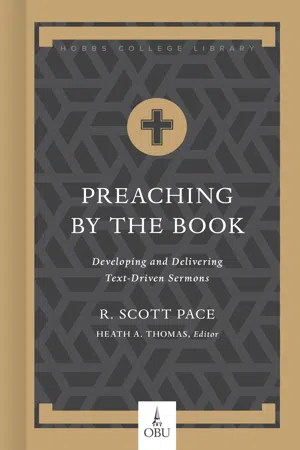
Preachers communicate God's word by fully considering their context and their congregation. Preaching by the Book is a practical handbook offering fundamental guidance for preachers beginning to explore their gifts, and fresh insights for seasoned veterans desiring to refine their craft. R. Scott Pace challenges preachers to develop their style and their substance by considering their unique personality and gifts, the work of the Spirit, and the particular audience on a given occasion.
eBook - ePub
Preaching by the Book
Developing and Delivering Text-Driven Sermons
- 144 pages
- English
- ePUB (mobile friendly)
- Available on iOS & Android
eBook - ePub
Preaching by the Book
Developing and Delivering Text-Driven Sermons
About this book
Information
Topic
Theology & ReligionSubtopic
Christian MinistryPART I
THE FOUNDATION
CHAPTER 1
Inspiration
Speaking the Truth
We all have favorite preachers whom we admire. Whether because of their dynamic delivery, spiritual passion, or clear explanation of the biblical text, certain preachers inspire us. But we may not be able to pinpoint a specific attribute that resonates most with us because good preaching involves a combination of essential factors, both human and divine.
Phillips Brooks captured this blend in his famous description of preaching as “truth through personality.”1 This succinct definition of the sacred task characterizes a sermon as the communication of divine and eternal “truth.” But it also conveys the significance of the messenger’s part in God’s plan as he graciously communicates eternal truth through the unique gifts, individual character, and speaking style of willing servants “through personality.”2
Although there are more precise and prescriptive definitions of Christian preaching,3 this basic explanation provides a foundational perspective that reverently considers God’s role and our responsibility. We cannot escape the gravity of the immense obligation we bear as God’s chosen instruments to preach his word (1 Cor 9:16). God has mysteriously and marvelously selected us to participate in his divine work. And yet the success of the sermon, its eternal and life-changing impact, does not ultimately depend on us. Instead, it lies in the assurance of God’s unfailing Word to accomplish his divine will (Isa 55:10–11). This underscores the reality that preaching is fundamentally a theological endeavor. Therefore, we must begin our exploration of the preaching task by laying the doctrinal foundation for sermon preparation and delivery.4
A Theology of Preaching
The theological nature of preaching begins with our convictions about God and his divine self-disclosure. Scripture declares that there is one true and living God (Deut 6:4; Isa 46:9) who exists in three persons—the Father, the Son, and the Holy Spirit (Matt 28:19; 2 Cor 13:14). The Bible also teaches that God has revealed himself to us, generally through his creation (Rom 1:20; Ps 19:1–6) and, more specifically, through his word (2 Tim 3:16) and his Son (Heb 1:1–2). God’s disclosure of his personal nature expresses his desire to be known and compels us to proclaim his eternal truth. In other words, “We speak because God has spoken.”5 Or, as pastor-theologian John Stott asserts, “It is God’s speech that makes our speech necessary.”6
By disclosing himself to us, God has not only declared his existence; he has also extended his grace and redemption through Jesus Christ. The reality of God’s holiness, man’s sinfulness, and Christ’s forgiveness is the essence of the gospel and the heart of the message God desires to be proclaimed to the ends of the earth (Mark 16:15; Acts 1:8). Personal faith in Jesus Christ is the only means of salvation (John 14:6; Acts 4:12) and God has designated preaching as the means by which he will accomplish his redemptive plan (Rom 10:14; 1 Cor 1:21).
Therefore, God’s revelation and redemption become the theological impetus for Christian preaching. Stott elaborates further and helps us see that our approach to preaching also hinges on our core convictions regarding several other related and fundamental doctrines.
•A Conviction about God—The kind of God we believe in determines what kind of sermons we preach.
•A Conviction about Scripture—We cannot handle Scripture adequately in the pulpit if our doctrine of Scripture is inadequate.
•A Conviction about the Church—The Word of God is the scepter by which Christ rules the church and the food with which he nourishes it.
•A Conviction about the Pastorate—The Chief Shepherd has delegated the pastoral care of feeding his own sheep which he has purchased with his blood.
•A Conviction about Preaching—Whenever pastors expound God’s Word with integrity, people in the church hear the voice of God.7
These doctrinal convictions unite to help formulate our theology of preaching. They also establish the spiritual mind-set necessary for us to develop into more faithful preachers. As Mohler summarizes, “A theology of preaching begins with the humble acknowledgment that preaching is not a human invention but a gracious creation of God and a central part of His revealed will of the church.”8
Because God has ordained preaching as a designated means for accomplishing his work, we can benefit from tracing the theological root of preaching to the spiritual fruit it produces. God himself, in the person of the Holy Spirit, is the divine agent that unifies all of the elements of preaching, from preparation to proclamation. Our understanding of the Spirit’s work in preaching is also a crucial theological component for us to consider.
We must first recognize that the Spirit is the divine agent of inspiration. Scripture was conceived by the work of the Spirit through the biblical writers. By the Holy Spirit human authors recorded God’s message in a supernatural way that incorporated their knowledge, skills, personality, and experience while preserving the divine nature of his written Word (2 Pet 1:19–21). Through his work of inspiration, the Scriptures reveal God (2 Tim 3:16) and are a living and powerful, two-edged sword that cuts with the precision of a surgical scalpel (Heb 4:12).
The same Holy Spirit who inspired Scripture also works in us as the divine agent of interpretation. Jesus identified him as the “Spirit of truth” who guides us into the truth and discloses God’s Word to us (John 16:13–15). He teaches us all things (John 14:26) and enables us to understand spiritual and scriptural truth (1 Cor 2:10–16). As the One who inspired the Scriptures, the Spirit is able to help us interpret them faithfully and accurately.
In addition to aiding our study of his divinely inspired Word, the Spirit also serves as the divine agent of infilling. While the Holy Spirit indwells the life of every believer (1 Cor 6:19; Eph 1:13; 1 John 4:13), we are also called continually to “be filled with the Spirit” (Eph 5:18). Particularly for the preacher, this infilling provides the divine empowerment to proclaim boldly and clearly the truth of God’s Word (Acts 4:31). Jesus characterized his own preaching as that which was anointed by the Spirit (Luke 4:18; cf. Isa 61:1) and also described this work of the Spirit when he commissioned his apostles (Matt 10:20). Likewise, our preaching must be enabled and empowered by the infilling of the Holy Spirit as we yield to him (1 Cor 2:4).
The Spirit not only works in the preacher’s preparation and delivery, but he also actively works in the lives of the listeners. The Spirit opens the hearts of the hearers as the divine agent of illumination. As we preach his Word, the Lord pierces and awakens hearts (Acts 16:14). The Spirit convicts sinners (John 16:8), offers assurance to God’s children (Rom 8:16; 1 John 3:24), and enables believers to receive God’s truth with spiritual understanding (1 Cor 2:12–13; 1 Thes 2:13).
But the Spirit is also the divine agent of implementation. Through the work of the Spirit, believers are empowered to apply the truth of God’s Word to their lives. Life-change does not simply occur in our own strength and by our best efforts but by the Spirit (2 Cor 3:18; Zech 4:6). Through the Spirit we are able to put to death the deeds of the flesh (Rom 8:13), and by the Spirit we live and are led (Gal 5:18, 25). The Spirit also enables us to worship (Phil 3:3; John 4:24), endows us with spiritual gifts (1 Cor 12:11), and produces spiritual fruit in our lives (Gal 5:22–23).
So the Spirit of God who inspired the Scriptures enables us to interpret them, fills us to proclaim them, opens the hearts of the listeners to receive them, and supernaturally applies them to their lives. Therefore, the comprehensive work of the Spirit, in conjunction with the revelation of the Father and redemption through his Son, firmly establishes a trinitarian theology of preaching that serves as the basis for our practical approach to the sacred task.
Textual Preaching
Our methodology for preaching must flow from our theology of preaching. At the core of our doctrinal beliefs and central to our philosophy of preaching is our view of Scripture. The Bible is God revealing himself to us through personal and propositional truth. While we may readily affirm this reality, we must also consider the reasons for our affirmation.
The supernatural process by which God provided the Scriptures gives us confidence in their accuracy and reliability. First, the Lord revealed his wisdom. God has made himself known through his creation and his conduct. Scripture is a manifestation and a by-product of his divine self-disclosure. Second, the Spirit guided his writers. The Holy Spirit superintended the writing process and guided more than 40 human authors over a period of more than 1600 years to compose his written revelation to man. Third, the authors recorded his Word. God selected men of faith and used their personalities, writing styles, and perspectives to accurately record his Holy Word according to his purpose and design. And, finally, the church preserved his witness. God’s people have preserved the timeless truth of his sacred testimony by faithfully proclaiming and practicing the teachings of Scripture.
Through this providential process God has provided the Scriptures in order to disclose himself to us in several ways. For example, Scripture records the works of God. The great and mighty deeds of God have been recorded for our instruction so that through the Scriptures we might find encouragement and hope (Rom 15:4). Additionally, Scripture recounts the ways of God. The Bible teaches us that God’s ways and thoughts are beyond our comprehension. But through his Word his ways are made known and his plan is accomplished (Isa 55:9–11). Scripture also reflects the will of God. The Bible expresses God’s desires and equips us to discern his will (Rom 12:2). Most importantly, Scripture reveals the “who” of God. The personal character and attributes of God are clearly revealed through his Word (Ps 19:7–9). Our view of Scripture is rooted in the conviction that God has revealed himself to us through these facets of his Word.
As a result of the supernatural process and the nature of biblical revelation, we can affirm that the Scriptures are the inspired, inerrant, and infallible Word of God. Therefore, the Bible is both sure and sufficient. This doctrinal conviction has significant implications for our preaching philosophy. The divine and authoritative nature of Scripture influences how we select a passage, how we study the text, how we structure our sermon, and how we share the message.
Selecting a Passage. Text selection is the first step of sermon preparation. Many pastors exhaust themselves trying to discern the biblical passage God wants them to preach each Sunday. This is typically considered a “topical approach” where a particular topic determines the preaching text. While in some special occasions, unique circumstances that require our attention, or a personal conviction that leads us to a specific passage, our primary approach should be a “textual approach” that allows the text to determine the topic.9
A preaching passage consists of a complete subject, thought, or concept expressed by the biblical author with consideration of the immediate context. Expositional series walk through books of the Bible or extended passages in order to teach faithfully the whole counsel of God (Acts 20:27). This approach honors the entire biblical text as God’s Word, protects us from “cherry picking” easy or familiar passages, teaches biblical truth within its context, keeps our messages fresh, helps our people prepare for our sermons, and models for them how to study God’s Word.
Studying the Text. Our interpretation of a passage in sermon preparation also flows from our convictions regarding Scripture. We must come before God’s word humbly, seeking wisdom to understand his divine truth and acknowledging our inability apart from his help. Our investigation and interpretation must be faithful to the text and preserve its intended meaning. As teachers of God’s Word, we are held to a higher level of accountability because of the significant influence we have on others (Jas 3:1). His elevated expectations for us are measured by one standard, our fidelity to the Scriptures. Our handling of the biblical text is how God ultimately evaluates our preaching ministry (2 Tim 2:15). Therefore, ...
Table of contents
- Acknowledgments
- About the Library
- Part I. The Foundation
- 2. Investigation: Surveying the Truth
- Part II. The Framework
- 4. Implementation: Synthesizing the Truth
- Part III. The Finishing Touches
- 6. Illustrations: Drawing Them Pictures
- 7. Invitations: Drawing the Net
- 8. Conclusion: Final Thoughts
- Name and Subject Index
- Scripture Index
Trusted by 375,005 students
Access to over 1.5 million titles for a fair monthly price.
Study more efficiently using our study tools.
Frequently asked questions
Yes, you can cancel anytime from the Subscription tab in your account settings on the Perlego website. Your subscription will stay active until the end of your current billing period. Learn how to cancel your subscription
No, books cannot be downloaded as external files, such as PDFs, for use outside of Perlego. However, you can download books within the Perlego app for offline reading on mobile or tablet. Learn how to download books offline
Perlego offers two plans: Essential and Complete
- Essential is ideal for learners and professionals who enjoy exploring a wide range of subjects. Access the Essential Library with 800,000+ trusted titles and best-sellers across business, personal growth, and the humanities. Includes unlimited reading time and Standard Read Aloud voice.
- Complete: Perfect for advanced learners and researchers needing full, unrestricted access. Unlock 1.5M+ books across hundreds of subjects, including academic and specialized titles. The Complete Plan also includes advanced features like Premium Read Aloud and Research Assistant.
We are an online textbook subscription service, where you can get access to an entire online library for less than the price of a single book per month. With over 1.5 million books across 990+ topics, we’ve got you covered! Learn about our mission
Look out for the read-aloud symbol on your next book to see if you can listen to it. The read-aloud tool reads text aloud for you, highlighting the text as it is being read. You can pause it, speed it up and slow it down. Learn more about Read Aloud
Yes! You can use the Perlego app on both iOS and Android devices to read anytime, anywhere — even offline. Perfect for commutes or when you’re on the go.
Please note we cannot support devices running on iOS 13 and Android 7 or earlier. Learn more about using the app
Please note we cannot support devices running on iOS 13 and Android 7 or earlier. Learn more about using the app
Yes, you can access Preaching by the Book by Dr. R. Scott Pace, Heath A. Thomas in PDF and/or ePUB format, as well as other popular books in Theology & Religion & Christian Ministry. We have over 1.5 million books available in our catalogue for you to explore.