When was the last time you shared your faith?
If we’re being honest, it’s an awkward, challenging conversation. Christians know that we’re supposed to be sharing the gospel with the lost. Jesus gave us the Great Commission before he left, telling us to go and make disciples of all nations. But we still just . . . don’t do it. Why?
Is evangelism dead?
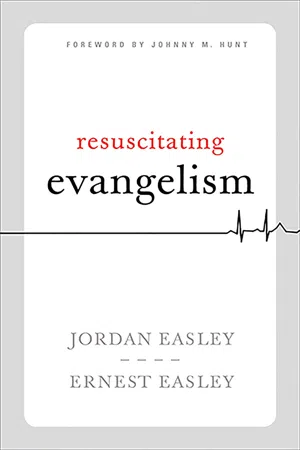
Here’s the good news: evangelism is the means by which Jesus promised to build his church, and Jesus will make good on his promises. In Resuscitating Evangelism father-son duo Jordan and Ernest Easley—both pastors and evangelists—share a biblical strategy for obeying Jesus and bringing new life to evangelism. As we bring new life to evangelism, we’ll see God bring new life to the lost all around us.
- 192 pages
- English
- ePUB (mobile friendly)
- Available on iOS & Android
eBook - ePub
Resuscitating Evangelism
About this book
Information
Topic
Theology & ReligionSubtopic
Christian ChurchChapter 1
Checking Our Pulse
The old saying Take two aspirins and call me in the morning doesn’t really apply if you have a fast-growing cancer in your body. You need something far more drastic. But if you don’t know the cancer exists, you’ll never take the necessary steps to address it. You’ll just continue self-medicating, hoping it will eventually go away or fix itself.
To address a problem, we must first become aware of the problem. In order for that to happen, we must intentionally look internally and recognize any warning signs or symptoms that may provide indications that something is wrong. When we as disciples of Jesus Christ take an honest look internally at our hearts, our passions, and our priorities as Christ followers, we’ll discover certain things we naturally emphasize and certain things we don’t prioritize at all.
What Do We Truly Prioritize?
As a pastor, I will attest—we will never go a week without singing. Nor will we ever go a Sunday without preaching God’s Word or passing the offering plate. At our church, we will always have small groups, and we will always have an emphasis on teaching our children about Jesus. We prioritize these things, and as a result, we are consistent in doing them.
Don’t get me wrong—all of these things are good. We hold them high because that’s what Jesus told us to do. But Jesus told us to do much more than just meet, eat, worship, and teach. Choosing to do a handful of these good things doesn’t make you a disciple of Jesus Christ; knowing Jesus, being the person Jesus calls you to be, and living in obedience to His commands are what make you a disciple of Christ. Therefore, if we’re going to live the life Jesus called us to live, we must begin prioritizing the things Jesus told us to prioritize.
What Did Jesus Tell Us to Prioritize?
In Mark 16:15, Jesus said, “Go into all the world and preach the gospel to all creation.” That is a mandate to the church and therefore should be a priority in our lives. But for many of us, we’d have to admit, who we are and what we do in real life doesn’t necessarily match up with who we’ve been called to be.
When we begin peeling back the layers of our heart and take an honest look internally, we will most likely discover that the pulse of our personal evangelism and even the pulse of our corporate evangelism is pretty faint and seems to beat at a slower and slower pace.
Warning Signs and Symptoms
The initial problem is that our personal evangelism pulse doesn’t match what Jesus has called us to do. But perhaps the more immediate problem is that the church seems to be in denial. We’re like the person who knows something is wrong with his body but refuses to go to the doctor. He continues to live as normal, and all the while the sickness gets worse and worse. The reasons for this may be many, but most likely the attributing factors boil down to two things: complacency and fear.
Complacency and Fear
People who have poor hygiene or don’t take care of their body most likely will not prioritize regular visits to the doctor. I recently read a stat that said, “80 percent of Americans avoid preventative care. Further, 9 out of 10 millennials avoid seeing the doctor annually.”1 At first these statistics shocked me, but then it hit me—the reason they don’t take care of themselves or prioritize doctors visits is because at this point in their life, they simply don’t care enough or see the benefits of taking care of their body.
This is a great example of a complacent attitude. Unfortunately, in this day and time, those who call themselves Christians seem to be more and more complacent. Followers of Christ who do not share their faith may avoid doing so because at their core, they really don’t care about other people. I know that sounds harsh, but why else would we keep our mouths shut about Jesus when people around us are dying and going to hell? Maybe it’s because at this point in our life, we truly don’t care. We’re complacent.
Followers of Christ who do not share their faith may avoid doing so because at their core, they really don’t care about other people.
Or perhaps it has less to do with our apathy and more to do with our fear. Some of us avoid gospel conversations because we’re afraid. We’re afraid of what it might cost us, or we’re afraid of what the outcome might be. We’re afraid it won’t work, that we won’t know all the answers, that we’ll lose a friend, or that the whole thing will be embarrassing.
These are the people who avoid going to the doctor because they’re afraid of what the doctor might find. We think, If I avoid going to the doctor, he can’t tell me I’m dying. He can’t tell me to make adjustments. He can’t tell me what I’m doing wrong. But that doesn’t change the fact that on the inside, there’s something wrong! For us as believers, we think, If I simply avoid sharing the gospel with this person, they won’t be able to shut me down, or think I’m weird, or ask me a question I’m unprepared to answer. Many times we keep our mouths shut because we’re afraid. We’re afraid because we treasure our own comfort and identity more than our obedience to God.
In Ezekiel 16, we see the results of complacency firsthand with God’s children. “Now this was the iniquity of your sister Sodom: She and her daughters had pride, plenty of food, and comfortable security, but didn’t support the poor and needy. They were haughty and did detestable acts before me, so I removed them when I saw this” (vv. 49–50).
This passage of Scripture is part of an analogy describing Israel’s relationship with God. God had rescued them from their enemies, but in response they turned to other gods. They were too prideful, prosperous, and prone to sin; and as a result, they were “removed” because of their disobedience.
The underlying principle in this passage implies that comfort often leads to apathy and complacency. Israel ignored the poor and needy because they knew that providing aid to these people would have caused them to be inconvenienced in a great way. In short, their inaction was a sin God detested.
I believe this too should be a warning for the church today. The Western church is prosperous and, in many ways, prideful. We have large buildings, big budgets, well-trained church staff members, and countless evangelism and discipleship tools at our disposal. In fact, we have more tools to aid us in fulfilling the Great Commission than ever before, and yet we continue to make excuses for why we don’t share Jesus. The poor and needy in today’s context not only include those who are physically or monetarily so but also those who are spiritually poor and needy. When we forsake these people and forgo sharing the hope we have in Jesus Christ with them, we are as disobedient to God today as the Israelites were in that day.
When you consider your own pulse for personal evangelism, what do you see? Are you maximizing the moments God gives you and making much of Him, or have you been missing opportunities to share of your salvation? What are the reasons you don’t share more often? What are the reasons you may be prone to neglect opportunities to sow seeds of hope in the lost people around you? Is it because you’re complacent? Is it because you’re afraid?
We’ve got to look at the answers to these questions as if they are warning signs from the Lord. It’s almost as if He’s saying, “The complacency you’re living with was never a part of My plan for your life! That fear you’re experiencing didn’t come from Me, but it’s keeping you from obeying Me. It’s keeping you from living in My will!”
What do the warning signs show you? How will you respond?
Pay Attention to the Warning Signs
A recent study published in the Harvard Business Review revealed that the U.S. warning-label system is not accomplishing what it needs to accomplish.2 The researchers concluded that the label system doesn’t do a good job of distinguishing between small risks and large risks. Thus, it becomes easy for the warning labels to cry “wolf” and, as a result, the people that ignore the smaller risks are more likely to ignore the larger risks. That’s dangerous because sometimes what may seem like a little problem or a trivial warning is actually something much more significant than we may believe.
When it comes to a lack of evangelism, we tend to disregard it as a real problem most of the time. We miss opportunities to share Christ, and then we justify our disobedience with thoughts like, Someone else will share with them someday, or The timing just wasn’t right. Some may even try to use their theology as an excuse for their disobedience in sharing Christ. Once again, these are all excuses we make that emphasize our underlying belief that my lack of personal evangelism really isn’t that big of a deal. Before you read another word of this book, you’ve got to get this: A lack of evangelism is always a big deal that always leads to an even bigger problem! Therefore, we should heed these warnings from the Lord and move forward toward faithfulness.
A lack of evangelism is always a big deal that always leads to an even bigger problem!
People who continue to drive their car when their check engine light comes on do so at their own peril. They may not be able to hear or feel that something is wrong, but under the hood a whole lot may be going wrong. The instruction manual to most cars warns the driver to discontinue driving once the check engine light turns on. Unfortunately, when it does, we usually just keep on driving. In much the same way, many believers today complain that their church isn’t working or growing, and yet these same people continue to ignore the clear commands in the Bible that tell us we are called by God to fulfill the Great Commission today and share the hope of Jesus with the lost world around us.
Jesus said in Matthew 28:19–20, “Go, therefore, and make disciples of all nations, baptizing them in the name of the Father and of the Son and of the Holy Spirit, teaching them to observe everything I have commanded you.” He was clear in His commission to the church. He told us we are to tell everyone in the world about Him, and then we are to baptize those who are saved. He then gave us the responsibility of teaching them God’s Word so that they too can do the work of ministry (Eph. 4:11–12), which means we are to equip new disciples not only to walk with Christ but also to share Christ themselves, taking on their place in the mission.
What happens when Jesus’ disciples fail to share Jesus? This one truth has been consistent since the book of Acts: churches break down when they disregard God’s instructions. Today we see thousands of churches closing their doors every year. Right now we’re seeing fewer and fewer people make decisions for Christ and following through with believer’s baptism and active church membership. We are living in a world where Christians are looking more and more like the culture around us. These are the real symptoms we’re dealing with. So the question is: What are we supposed to do?
David Jeremiah said, “If we have left something or someone, the first step is to remember where we started.”3 If the church would get back to the basics and do what Jesus commanded us to do, I believe we would see a harvest only He could bring.
Current State of Evangelism
On February 21, 2018, the world came to a standstill and watched the funeral of Reverend Billy Graham, who died at the age of ninety-nine. As we watched this beautiful service on the grounds of the Billy Graham Library in Charlotte, North Carolina, we reflected on a life well lived, and we celebrated a job well done. But as I viewed the service, I couldn’...
Table of contents
- Foreword
- Introduction
- Chapter 1: Checking Our Pulse
- Chapter 2: Our Source of Strength and Power
- Chapter 3: Addressing Malnourishment
- Chapter 4: Do Your Job!
- Interlude: The Pastor’s Role in Leadingan Evangelistic Church
- Chapter 5: Overcoming Obstacles That Prevent Health
- Chapter 6: What’s in Your Family History?
- Chapter 7: What Works Today?
- Chapter 8: Getting the Church Back on Her Feet
- Conclusion
- Notes
Trusted by 375,005 students
Access to over 1.5 million titles for a fair monthly price.
Study more efficiently using our study tools.
Frequently asked questions
Yes, you can cancel anytime from the Subscription tab in your account settings on the Perlego website. Your subscription will stay active until the end of your current billing period. Learn how to cancel your subscription
No, books cannot be downloaded as external files, such as PDFs, for use outside of Perlego. However, you can download books within the Perlego app for offline reading on mobile or tablet. Learn how to download books offline
Perlego offers two plans: Essential and Complete
- Essential is ideal for learners and professionals who enjoy exploring a wide range of subjects. Access the Essential Library with 800,000+ trusted titles and best-sellers across business, personal growth, and the humanities. Includes unlimited reading time and Standard Read Aloud voice.
- Complete: Perfect for advanced learners and researchers needing full, unrestricted access. Unlock 1.5M+ books across hundreds of subjects, including academic and specialized titles. The Complete Plan also includes advanced features like Premium Read Aloud and Research Assistant.
We are an online textbook subscription service, where you can get access to an entire online library for less than the price of a single book per month. With over 1.5 million books across 990+ topics, we’ve got you covered! Learn about our mission
Look out for the read-aloud symbol on your next book to see if you can listen to it. The read-aloud tool reads text aloud for you, highlighting the text as it is being read. You can pause it, speed it up and slow it down. Learn more about Read Aloud
Yes! You can use the Perlego app on both iOS and Android devices to read anytime, anywhere — even offline. Perfect for commutes or when you’re on the go.
Please note we cannot support devices running on iOS 13 and Android 7 or earlier. Learn more about using the app
Please note we cannot support devices running on iOS 13 and Android 7 or earlier. Learn more about using the app
Yes, you can access Resuscitating Evangelism by Ernest L. Easley,Jordan Easley in PDF and/or ePUB format, as well as other popular books in Theology & Religion & Christian Church. We have over 1.5 million books available in our catalogue for you to explore.