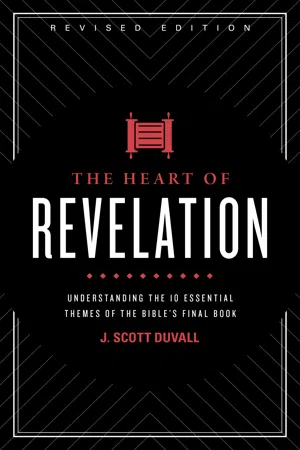
"Let anyone who has ears to hear listen to what the Spirit says to the churches." The book of Revelation speaks powerfully to every aspect of the Christian life, and the modern church desperately needs the vision of hope that it provides. In this thematic approach to the Bible's final book, author J. Scott Duvall identifies ten major themes, including: God and his people, worship, enemies, the mission, and the new creation. In The Heart of Revelation, readers will understand how to read Revelation in context, asking, "What are the main truths and realities of Revelation that we can know for certain?" and learning how these truths are relevant to our lives as modern-day believers.
eBook - ePub
The Heart of Revelation
Understanding the 10 Essential Themes of the Bible's Final Book
- 240 pages
- English
- ePUB (mobile friendly)
- Available on iOS & Android
eBook - ePub
The Heart of Revelation
Understanding the 10 Essential Themes of the Bible's Final Book
About this book
Information
Topic
Theology & ReligionSubtopic
Biblical Studies1
GOD
“The Almighty”
Everyone I know wants their life to work. I’ve never met a person who has set out to be a miserable failure. A failed life starts when a person believes the lie that it’s all about him. George MacDonald—a Scottish minister, English professor, and author who had a tremendous influence over C. S. Lewis, J. R. R. Tolkien, G. K. Chesterton, and others—once said that “the one principle of hell is—I am my own!”1 Revelation says we are not our own and it’s not all about us. We are not the center of the universe, and when we try to put ourselves (or anything else) in that place, life inevitably falls apart. You can prolong the crash with more money or power, but it will happen eventually.
Revelation tells us loudly and clearly that God is the true center! He alone can bear the weight of the world. He alone can bear the weight of your world, of your life. He alone can give us meaning and purpose and significance. Isn’t it unbelievably stressful to try to be our own center or to try to make someone or something into that center? I’m not only talking about bad stuff, but I’m also referring to good things or people, such as a spouse or a ministry or a job or a hobby. There is no center other than God that can bear the heavy weight of our trust and hold our lives together.
Revelation is the most God-centered book in the whole Bible. It reminds us that God is the only true center when it shows us that God is in control, that he is more powerful than all competing gods, that he loves and cares about us, that he has a plan to fix this broken world, and that in the end he will rid the universe of every trace of evil. Revelation presents God as the Almighty, the only true center we can count on.
God Is in Control!
From the very start, John reassures us that God is in control: “John, To the seven churches in the province of Asia: Grace and peace to you from him who is, and who was, and who is to come. . . . ‘I am the Alpha and the Omega,’ says the Lord God, ‘who is, and who was, and who is to come, the Almighty’” (1:4, 8). God is the one “who is, and who was, and who is to come,” an expression that reflects God’s description of himself to Moses as “I AM WHO I AM” (Exod 3:14). In that famous burning-bush conversation, God was basically telling Moses that he is the eternally self-existent. In other words, God has always been God, he is God, and he always will be God. Just as he has been in control of the past, so he will be in control of what is happening now and what will happen in the future. Even when it doesn’t seem like it, he is eternally sovereign (Rev 4:9–11; 10:6; 15:7). We serve a God who is in control!
What is fascinating about the “was, and is, and is to come” statement is that the “is to come” part has dropped off in the last two places it is mentioned in Revelation (11:17; 16:5; cf. 1:4, 8; 4:8). In those places in Revelation, the future has already arrived. When we come into God’s presence one day, the “is to come” will become our “is.” The future will become the present for us, which reminds me of the section of Handel’s “Hallelujah” chorus drawn from 11:15: “The kingdom of the world has become the kingdom of our Lord and of his Messiah, and he will reign for ever and ever.”
Perhaps surprisingly, God speaks directly in Revelation only twice—1:8 and 21:5–6—and in both places he identifies himself as “the Alpha and the Omega” (the first and last letters of the Greek alphabet). It’s synonymous with “the Beginning and the End” (21:6; 22:13), or “the First and the Last” (1:17; 22:13). Revelation is telling us that God bookends all of human history. He is both the starting line and the finish line, and the whole race in between. The one who controls both ends of history also stands sovereign over everything in the middle. Again, God is in control.
Revelation affirms God’s sovereignty in subtle ways through the use of the term “was given” (Gk. edothē). This is known as a theological or divine passive and occurs throughout the book to highlight God’s control of events. When the text says that something “was given” but doesn’t mention who gave it, often God is the implied subject. God is doing the giving. For example, those carrying out God’s judgments are “given” the judgments, and while God is not mentioned directly, he stands behind those judgments (e.g., 6:2; 9:1). Evil powers like the two beasts are “given” permission to act so that God stands sovereign even over the forces of evil (e.g., 13:7, 14). And God also stands behind the protection of his people (e.g., the woman “was given” the wings of an eagle in 12:14).
It’s comforting to say, “God is in control,” but what does this really mean? We can easily misunderstand this expression. Revelation isn’t saying that God causes everything that happens. People sin in Revelation (read about the sins of the seven churches in chaps. 2–3), but God doesn’t cause sin. In Revelation, God’s people suffer, even die, but God doesn’t delight in the murdering of his own people. God’s being in control doesn’t mean that he is the source of sin and evil. God’s sovereign control means that while Satan and sin and death may win some battles, God wins the war.
The Almighty King
On April 18, 2007, in the eastern Turkish city of Malatya, three Christians were brutally tortured and murdered: Necati Aydin, Uğur Yüksel, and Tilmann Geske. Revelation scholar Mark Wilson, who lives in Turkey and knew these men, writes:
Before this, my understanding of martyrdom had been an academic one. I had read about [the early Christian martyrs] Ignatius . . . and Polycarp. . . . I had shared the story of their deaths with many visitors who came to Izmir. But suddenly the suffering of these early Christians was no longer abstract; we were part of the community that was mourning the tragic loss of brothers in Christ.2
Christians living in the West don’t experience much persecution, and many of us are ignorant of the sufferings of our fellow believers around the world.3 Thankfully, through books like Eric Metaxas’s Bonhoeffer and Paul Marshall, Lela Gilbert, and Nina Shea’s Persecuted, and organizations such as Open Doors and the Voice of the Martyrs, we are learning more about how Christians are suffering today worldwide.4
The Christians who first read (or heard) Revelation were much more familiar with persecution. Some were experiencing persecution, even death, for remaining faithful to Christ, but most were actually compromising with the prevailing culture. In the Roman Empire, Rome considered itself the center of the universe, and the emperor claimed to be Lord of all.
The original readers would have been deeply encouraged to hear John’s favorite title for God: the “Almighty.” In Greek, the Roman emperor was called by a similar name: autokratōr, or “one who rules by himself.” No one on earth could compare to an emperor like Nero or Domitian. Temples and statues and coins constantly reminded the people of the emperor’s enormous reach and power.
But Revelation uses an even more powerful title for God: the “Almighty” (Gk. pantokratōr), a term meaning “ruler over all” (the term pan is the Greek word for “all,” and kratōr means “mighty”).5 What is a measly earthly empire to God, who is in charge of the whole universe? Revelation is telling us that God is more powerful than all competing rulers—all of them, everywhere. There is no emperor or king or president who can compare to the one who rules the world. Our God is indeed “King of the nations” (15:3).
Revelation doesn’t just tell us that God is in charge; it shows us. Of all the book’s symbols, there is one that pulls together all the others: the throne of God. John is getting a personalized angelic tour of the cosmos by receiving a series of visions. In his first vision (chaps. 2–3), he is shown the circumstances of the churches on earth, where some are remaining faithful and others are compromising. It’s natural to ask, “If Christians within the Roman Empire are struggling to stay faithful, has God lost control?” or “If the goddess Roma (symbolizing Rome and her empire) can murder and seduce God’s people, is God still in charge?” The throne image helps answer these kinds of questions.
After hearing about the situation of the seven churches, John is shown a vision of heaven so that he can see what’s really real (4:1–11; cf. Isa 6:1–5). He’s blown away by what he sees. He immediately lays eyes on the center of all reality: the majestic, glorious throne. God and the Lamb occupy the throne, and the Spirit of God blazes in brilliant light in front of the throne. Multitudes of angels surround the throne in concentric circles of never-ending worship. Kingdoms come and go, but God on his throne remains forever. The center of all reality is the triune God on his throne.
To say that God is seated on his throne doesn’t mean that God is literally sitting in heaven in a giant chair, any more than saying Jesus is the Lamb of God means he is a four-legged animal. Rather, Revelation shows us through picture language that God is King over all competing kings and that he is the Ruler over all rival rulers. The throne image centers and anchors and grounds everything else. All of creation revolves around the throne, as the rim and spokes rotate around the hub of a bicycle wheel. All the subsequent visions in the book originate from the throne of God, the ultimate and true center of reality.
You probably recall that the first part of the Lord’s Prayer from Matthew 6 is all about God—may we recognize your name as holy; may your kingdom come and your will be done, on earth as it is in heaven. Well, Revelation 4 shows us the “as in heaven” part of that prayer as we see worship happening now. What is happening in heaven now will one day spill over onto the new earth as God’s will becomes the universal norm of the new creation.6 What a day that will be!
The throne-room vision of Revelation 4 also helps us adopt a kingdom perspective for our lives now. We need a heavenly view of things to stay faithful in this world. While it appears that the powers of this world—whether they be political, religious, military, or economic—are having their way now, this is not the whole (or even the real) picture. These pretend gods are on a very short leash. Their kingdoms will not last. One day their royal charade will come crashing down as the kingdom of this world becomes the kingdom of our God.
Our Faithful Father
In Revelation, God is not just sitting on his throne, ruling the universe. God is high and lifted up for sure. He is transcendent, but he is not distant. He is closer to us than we are to ourselves.7 He is also our faithful Father, who loves and cares for us, his beloved children.
I don’t know all the reasons why, but it’s been a struggle for me to believe that God really loves me. Some of you might have the same struggle. As it turns out, this is nothing new. From the very beginning, the evil one has been trying to convince us that God is withholding something from us, that he doesn’t really want what is best for us. Adam and Eve fell for this lie back in Genesis 3. If we come to believe that God is less loving and less gracious than he truly is, we will turn elsewhere to get our needs met. When we decide that God doesn’t have our best interest at heart, that he isn’t really good (for us), then our picture of God becomes distorted, and we will struggle to trust him to give us life.
Revelation sends the clear message that God is for us, that he loves us, and that he will protect us from spiritual harm and bring us safely into his eternal kingdom. Do we get God’s love like the apostle John got it? If the same John wrote both Revelation and the Gospel of John (as many evangelical scholars believe), then how cool is it to remember that he refers to himself as “the disciple whom Jesus loved” (John 13:23; cf. 20:2; 21:7, 20)? This doesn’t mean ...
Table of contents
- Acknowledgments
- Introduction
- Cast of Characters in the Divine Drama of Revelation
- 1. God: “The Almighty”
- 2. Worship: “You Are Worthy”
- 3. The People of God: “His Called, Chosen and Faithful Followers”
- 4. The Holy Spirit: “The Seven Spirits before His Throne”
- 5. Our Enemies: “The Dragon Stood on the Shore of the Sea”
- 6. The Mission: “My Two Witnesses”
- 7. Jesus Christ: “The Lamb, Who Was Slain”
- 8. Judgment: “How Long, Sovereign Lord?”
- 9. The New Creation: “I Saw ‘a New Heaven and a New Earth’”
- 10. Perseverance: “To the One Who Is Victorious”
- Notes
- Subject Index
- Scripture Index
Trusted by 375,005 students
Access to over 1.5 million titles for a fair monthly price.
Study more efficiently using our study tools.
Frequently asked questions
Yes, you can cancel anytime from the Subscription tab in your account settings on the Perlego website. Your subscription will stay active until the end of your current billing period. Learn how to cancel your subscription
No, books cannot be downloaded as external files, such as PDFs, for use outside of Perlego. However, you can download books within the Perlego app for offline reading on mobile or tablet. Learn how to download books offline
Perlego offers two plans: Essential and Complete
- Essential is ideal for learners and professionals who enjoy exploring a wide range of subjects. Access the Essential Library with 800,000+ trusted titles and best-sellers across business, personal growth, and the humanities. Includes unlimited reading time and Standard Read Aloud voice.
- Complete: Perfect for advanced learners and researchers needing full, unrestricted access. Unlock 1.5M+ books across hundreds of subjects, including academic and specialized titles. The Complete Plan also includes advanced features like Premium Read Aloud and Research Assistant.
We are an online textbook subscription service, where you can get access to an entire online library for less than the price of a single book per month. With over 1.5 million books across 990+ topics, we’ve got you covered! Learn about our mission
Look out for the read-aloud symbol on your next book to see if you can listen to it. The read-aloud tool reads text aloud for you, highlighting the text as it is being read. You can pause it, speed it up and slow it down. Learn more about Read Aloud
Yes! You can use the Perlego app on both iOS and Android devices to read anytime, anywhere — even offline. Perfect for commutes or when you’re on the go.
Please note we cannot support devices running on iOS 13 and Android 7 or earlier. Learn more about using the app
Please note we cannot support devices running on iOS 13 and Android 7 or earlier. Learn more about using the app
Yes, you can access The Heart of Revelation by J. Scott Duvall in PDF and/or ePUB format, as well as other popular books in Theology & Religion & Biblical Studies. We have over 1.5 million books available in our catalogue for you to explore.