In We Showed Baltimore, Christian Swezey tells the dramatic story of how a brash coach from Long Island and a group of players unlike any in the sport helped unseat lacrosse's establishment.
From 1976 to 1978, the Cornell men's lacrosse team went on a tear. Winning two national championships and posting an overall record of 42–1, the Big Red, coached by Richie Moran, were the class of the NCAA game. Swezey tells the story of the rise of this dominant lacrosse program and reveals how Cornell's success coincided with and sometimes fueled radical changes in what was once a minor prep school game centered in the Baltimore suburbs.
Led on the field by the likes of Mike French and Eamon McEneaney, in the mid-1970s Cornell was an offensive powerhouse. Moran coached the players to be in fast, constant movement. That technique, paired with the advent of synthetic stick heads and the introduction of artificial turf fields, made the Cornell offensive game swift and lethal. It is no surprise that the first NCAA championship game covered by ABC Television was Cornell vs. Maryland in 1976. The 16–13 Cornell win, in overtime, was exactly the exciting game that Moran encouraged and that newcomers to the sport wanted to see.
Swezey recounts Cornell's dramatic games against traditional powers such as Maryland, Navy, and Johns Hopkins, and gets into the strategy and psychology that Moran brought to the team. We Showed Baltimore describes how the game of lacrosse was changing—its style of play, equipment, demographics, and geography. Pulling from interviews with more than ninety former coaches and players from Cornell and its rivals, We Showed Baltimore paints a vivid picture of lacrosse in the 1970s and how Moran and the Big Red helped create the game of today.
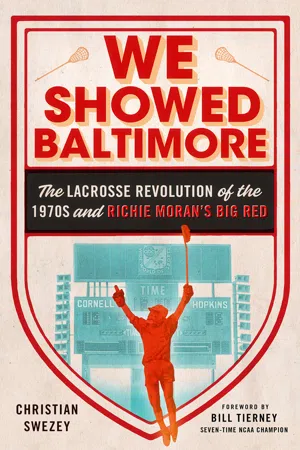
eBook - ePub
We Showed Baltimore
The Lacrosse Revolution of the 1970s and Richie Moran's Big Red
- 374 pages
- English
- ePUB (mobile friendly)
- Available on iOS & Android
eBook - ePub
About this book
1
June 13, 1970
That Saturday in Lexington, Virginia, dawned bright and blazingly hot. It did not take long for shirts to become damp with sweat, for ice cream to melt onto the napkins of adults and the fingers of children. Still, the small town of seven thousand people, nestled in the Shenandoah Valley, was busier than usual on June 13, 1970. That afternoon Lexington was hosting the twenty-ninth annual North–South College All-Star lacrosse game. And in 1970 the game was as important an event as lacrosse, a sport older than baseball, could muster. It was the culmination of four days that included the unveiling of the all-American teams and the naming of the national champion. “The showplace for lacrosse,” says then-Cornell coach Richie Moran, “was the North–South game.”1
The annual exhibition ostensibly featured the top fifty-two seniors from around the country, though in 1970, as in previous years, nearly two-thirds listed their hometowns as either Maryland or New York, primarily Long Island. (The next-best represented state in 1970 was New Jersey, with four participants.) It was of this period that Paul Attner wrote, in 1976 in the Washington Post, “Lacrosse once had an image of being a prep-school, rich-boy’s sport, a label it deserved… . [Although lacrosse] has been adopted by public schools in the Baltimore and Long Island areas, and is growing steadily in other eastern regions, the old preppie tag still lingers.”2
Maryland and New York had also combined to host almost every previous North–South game since the inception of the contest in 1940.3 For the 1970 contest, however, the US Intercollegiate Lacrosse Association, the sport’s governing body, sent the talent showcase for the first time to a location south of Maryland. The USILA liked to send its premier event every so often to an area where lacrosse was either unknown—in 1952 the game was played in New York’s famed Polo Grounds—or just starting to grow, such as the 1949 contest at Rensselaer Polytechnic Institute in Troy, New York.4
Lexington was in the latter category. Washington and Lee is one of the oldest colleges in the nation, established in 1749; the school had fielded lacrosse teams since the late 1930s. In 1970 the sport’s main publication, the NCAA annual Official Lacrosse Guide, featured on its cover Washington and Lee senior defenseman Ned Coslett. That spring, the Generals enjoyed their best season to date, with eight victories in eleven games. Senior attackman Tom Groton, the team’s leader with twenty-five goals, was selected to play in the North–South game on his home field.5 The sport was generally on the upswing west of the Blue Ridge Mountains: That spring Virginia Military Institute, which shares Lexington in a grudging coexistence with Washington and Lee, for the first time fielded a club team.6
And for the North–South game Lexington rolled out the red carpet with festivities including a garden party, a golf outing, an “old-fashioned Virginia barbeque dinner” and a parade down Main Street.7 Welcoming banners were hung, and some of the stores maintained window displays honoring specific players.8 The players themselves were given free passes to the Fairfield Pool, ten miles from campus, and free rein of the school’s student union building, complete with ping-pong, arcade games, pool tables, payphones, and foosball tables with small ashtrays behind each goal, ashtrays that, when students were on campus, filled up quickly with small, white, crushed cigarette butts.9 Quietly, during breaks in the festivities, the six-person NCAA Lacrosse Tournament and Rules Committee, charged with shepherding in the first playoffs that the college sports governing body had approved for the following season, held its inaugural meetings in Lexington.
Virginia Governor Linwood Holton, Republican and W&L alum, bought the first ticket—$2.50 for him and any company he would bring with him, half-price for his children—in a ceremony photographed by the school.10 “To my knowledge,” said W&L coach Dick Szlasa in the lead-up, “this will be the biggest athletic attraction ever held in Lexington.”11 Lexington’s rolling hills certainly were unfamiliar to lacrosse players and coaches. One attendee recalls being told that a North–South player from the Midwest had missed the first day of practice because he had gone to Lexington, Kentucky.12
Lacrosse was not well known in Lexington, Virginia. The town certainly knew the concept of North against South. In 1859 it was cadets from VMI who provided security for the hanging death of antislavery activist John Brown in Harpers Ferry, West Virginia, at the conflux of the Potomac and Shenandoah rivers. One of VMI’s professors in the late 1850s was Stonewall Jackson, later a Confederate general in the Civil War. He is buried in Lexington, as is a better-known Confederate general, Robert E. Lee, whose name in 1970 in Lexington alone was affixed to the university, a hotel, a street, the historic Lee-Jackson House near campus, and an Episcopalian church.13 Both the North–South game and the preliminary contest—pitting the top high-school seniors from Baltimore County against their counterparts from New Jersey and played hours before the college game—offered uncanny reminders. The North–South game included a midfielder from Syracuse University named Jeff Davis. The preliminary game featured a Baltimore County goalie named Jeb Stewart.14 And fans walking to the game from Main Street in the historic downtown area would have passed the venerable hotel named for Lee, a six-story, red-brick building with a white lobby jutting into the sidewalk. A neon sign on the roof advertised “HOTEL” in giant capital letters and below and smaller, “Robert E. Lee”; individual air-conditioning units stuck halfway out many windows.
On the opposite side of the street was the Southern Inn restaurant with its distinctive T-shaped neon sign. A few doors down was McCrum’s Drug Store, complete with a pharmacy and a large selection of magazines and newspapers, including the Wednesday-only Lexington News-Gazette. The lead editorial that week, titled “Welcome, All-Stars,” urged the townspeople to attend the game even if they had never seen lacrosse. As if to reinforce the point, an adjoining story, nearly a full page in length, was titled “LACROSSE—Here’s How It’s Played.”15
Closer to the campus was the State Theater, one of two movie theaters in town, and the Dutch Inn, popular among students a little worse for wear from a night of drinking because, as one W&L alum of the era recalls, it produced hamburgers within two minutes, day or night. Attendees walking along Main Street then arrived on campus, the scene dotted with red-brick buildings with translucent white trim set on lush, well-manicured lawns. To reach Wilson Field attendees crossed a narrow footbridge. The stadium held seating for seven thousand people—the town’s entire population could fit inside.
Spectators who arrived early would have seen the warm-up, a blur of colors at once mystifying to the uninitiated. The North, practicing in the end zone at the southern end of the stadium, wore red jerseys with white numerals and white shorts. The South, sequestered at the other end, wore white jerseys with blue numerals and the same white shorts. The wood of both teams’ lacrosse sticks seemed as if burnished with a deep suntan. The wide, webbed opening at the top from which the ball was caught and passed resembled a child’s snowshoe. Locals more versed in warmer outdoor endeavors may have likened the sticks to fishnets affixed to the end of extra-long handles; the players themselves, throwing and catching with the heavy, odd-looking instruments, looked as if they were using brooms to shoo away a bird.
The heavy sticks had almost no pocket; the strings were taut catgut and leather—almost like an oversized tennis racket—and even the slightest of touches to the stick from an opponent could dislodge the ball. It was also hard to generate velocity on passes or shots because the ball so easily slipped out of the webbing. In that era fans often stood within a few yards of the action, even behind the goals, with little to no fear of being struck by a shot traveling at excessive speed. The ball traveled slowly enough for spectators, if needed, to simply duck out of the way.
Indeed, the lacrosse sticks in use in 1970 were essentially older than Washington and Lee University itself. In the early 1970s “the sticks we were using were basically the same as the [Native Americans] used in the 16th or 17th century,” said former Syracuse coach Roy Simmons, Jr., in 1986. “All of them hand-carved—mostly by [Native Americans]—and there were too few sticks to go around… . Kids couldn’t just walk into a sporting goods store and buy a lacrosse stick. And even if they could, the sticks were expensive and broke easily.”16
The wooden stick was one piece. The entire apparatus would have to be replaced if there were damage to either the head or shaft. The webbing could be repaired, a laborious process best handled by an expert. Players of the era recall blocking off several hours to purchase a stick, in order to find one perfectly weighted and balanced in their hands. There was primarily one retailer selling them—Bacharach Rasin with its giant warehouse on 802 Gleneagles Court in Towson, Maryland, outside Baltimore. The sticks were made by hand on Native American reserves in Canada and arrived in batches every year in early spring, with Baltimore-area players receiving the word and racing to Towson to select the best possible stick and thus the pick of the litter. Once the sticks were gone, usually by April, there was no more inventory until the following year.
The one-piece sticks were also made specifically for right-handers and left-handers. In fact, it was this predicament that changed the sport forever. In the late 1960s four men in Baltimore—one of them a left-hander who could not find a left-handed stick—began working on a prototype for a plastic lacrosse stick. They started with the stick head and decided on a utilitarian design that would be the same for lefties and righties. The novel design was not yet in circulation. An attackman at the University of Virginia recalls the early attempt at a plastic head, one he used briefly in a game in 1969. “It was a piece of crap,” Tom Duquette says now. All of the players in the 1970 North–South game used wooden sticks.17
If any players of the era could twirl the heavy one-piece wooden sticks with a measure of aplomb they could be found at Johns Hopkins. (The Baltimore school was such a power that the US Lacrosse Hall of Fame, initiated in 1957 and dedicated in 1966, was hosted on its campus.18) Between 1956 and 1970 Johns Hopkins shot better than 28 percent once, and averaged more than eleven goals per game nine times in fifteen seasons.19 Between 1960 and the recently completed 1970 season, the Blue Jays had three times scored more than twenty goals in a game. These offensive stats put the Blue Jays at the top of the college game, at a time when the “fastest game on two feet” was a bit slow and favored defenses.
On the grass of Wilson Field, the players completed their North (red) and South (white) uniforms with their college helmets, making the game look a little ragtag, like a summer pickup game. The helmets themselves were hard plastic and resembled a version of the winter hats with earflaps that are popular among hunters in cold climes. The lacrosse helmet adds one flourish, a full facemask similar to what offensive and defensive linemen wear in football. In later years players would refer to the model, also made by Bacharach Rasin, as “bucket helmets.” The Cornell Daily Sun, the student paper, often referred to the team as “the guys walking around with birdcages on their heads.” The most distinctive bucket on the field in Lexington belonged to number 13 in white. Warren Galvin, a graduate from Ohio State but a native of Long Island, wore the Buckeyes’ helmet featuring a red top half and bill and a white bottom half. He looked like a woodpecker and stood out on the field. He also stood out because he was one of seven players from schools west of the Allegheny Mountains.
The South player wearing a white jersey with a blue “11” and some additional protective gear stood in front of what looked like a small guardhouse with a loose white net around the back. When asked, the curious were told that he was the goalie and he was in front of the goal. Number 11’s name was Len Supko, from Brooklyn Park, Maryland, near Annapolis. On this day, he may have drawn stares. In his final college game, Supko continued his tradition of beginning his warm-up routine by stopping shots not with the head of his stick but with the shaft.20 (Supko also continued a tradition of Navy goalies refusing to wear a chest protector, another sign of the low speeds at which the ball traveled.) However unorthodox—goalies used the same webbing to throw and catch and save shots as the other players—Supko believed the unusual routine improved his hand-eye coordination. There was method to the madness: At the all-American banquet in Washington and Lee’s Evans Hall dining room the previous night, Supko, roughly a week removed from his graduation from the Naval Academy, had been named the best goalie in college lacrosse.
The sport’s matrix became a little clearer as players moved through their warm-up routines and the spectators flipped through the game program, which cost fifty cents. Two other players on the South side of the field wore the s...
Table of contents
- Foreword
- Prologue: 1978, 2001, 1970
- 1. June 13, 1970
- 2. The Climb Begins
- 3. Barbarians at the Gate
- 4. The First NCAA Tournament
- 5. Falling Short
- 6. The Establishment Strikes Back
- 7. Assembling the Pieces
- 8. The French Connection
- 9. Start of a Streak
- 10. From Brown Stadium
- 11. Flamin’ Eamon
- 12. That-a-Way in Piscataway
- Epilogue: End of an Era
- Acknowledgments
- Notes
- Bibliographic Note
- Index
Trusted by 375,005 students
Access to over 1.5 million titles for a fair monthly price.
Study more efficiently using our study tools.
Information
Publisher
Three HillsYear
2022Print ISBN
9781501762826
9781501762826
Subtopic
North American HistoryeBook ISBN
9781501762840
Frequently asked questions
Yes, you can cancel anytime from the Subscription tab in your account settings on the Perlego website. Your subscription will stay active until the end of your current billing period. Learn how to cancel your subscription
No, books cannot be downloaded as external files, such as PDFs, for use outside of Perlego. However, you can download books within the Perlego app for offline reading on mobile or tablet. Learn how to download books offline
Perlego offers two plans: Essential and Complete
- Essential is ideal for learners and professionals who enjoy exploring a wide range of subjects. Access the Essential Library with 800,000+ trusted titles and best-sellers across business, personal growth, and the humanities. Includes unlimited reading time and Standard Read Aloud voice.
- Complete: Perfect for advanced learners and researchers needing full, unrestricted access. Unlock 1.5M+ books across hundreds of subjects, including academic and specialized titles. The Complete Plan also includes advanced features like Premium Read Aloud and Research Assistant.
We are an online textbook subscription service, where you can get access to an entire online library for less than the price of a single book per month. With over 1.5 million books across 990+ topics, we’ve got you covered! Learn about our mission
Look out for the read-aloud symbol on your next book to see if you can listen to it. The read-aloud tool reads text aloud for you, highlighting the text as it is being read. You can pause it, speed it up and slow it down. Learn more about Read Aloud
Yes! You can use the Perlego app on both iOS and Android devices to read anytime, anywhere — even offline. Perfect for commutes or when you’re on the go.
Please note we cannot support devices running on iOS 13 and Android 7 or earlier. Learn more about using the app
Please note we cannot support devices running on iOS 13 and Android 7 or earlier. Learn more about using the app
Yes, you can access We Showed Baltimore by Christian Swezey in PDF and/or ePUB format. We have over 1.5 million books available in our catalogue for you to explore.