The most important work by a key figure in German thought, Helmuth Plessner's Levels of Organic Life and the Human, originally published in 1928, appears here for the first time in English, accompanied by a substantial Introduction by J. M. Bernstein, after having served for decades as an influence on thinkers as diverse as Merleau-Ponty, Peter Berger, Habermas, and the new naturalists.
The Levels, as it has long been known, draws on phenomenological, biological, and social scientific sources as part of a systematic account of nature, life, and human existence. The book considers non-living nature, plants, non-human animals, and human beings in turn as a sequence of increasingly complex modes of boundary dynamics—simply put, interactions between a thing's insides and surrounding world. On Plessner's unique account, living things are classed and analyzed by their "positionality," or orientation to and within an environment. "Life" is thereby phenomenologically defined, and its universal yet internally variable features such as metabolism, reproduction, and death are explained.
The approach provides a foundation not only for philosophical biology but philosophical anthropology as well. According to Plessner's radical view, the human form of life is excentric—that is, the relation between body and environment is something to which humans themselves are positioned and can take a position. This "excentric positionality" enables human beings to take a stand outside the boundaries of their own body, a possibility with significant implications for knowledge, culture, religion, and technology.
Plessner studied zoology and philosophy with Hans Driesch in the 1910s before embarking on a highly productive philosophical career. His work was initially obscured by the superficially similar views of Max Scheler and Martin Heidegger and by his forced exile during World War II. Only in recent decades, as scholarship has moved more squarely into engagement with issues like animality, embodiment, human dignity, social theory, the philosophy of technology, and the philosophy of nature, has the originality and depth of Plessner's vision been appreciated.
A powerful and sophisticated account of embodiment, the Levels shows, with reference both to science and to philosophy, how life can be seen on its own terms to establish its own boundaries, and how, from the standpoint of life, the human establishes itself in relation to the nonhuman. As such, the book is not merely a historical monument but a source for invigorating a range of vital current conversations around the animal, posthumanism, the material turn, and the biology and sociology of cognition.
This modern philosophical classic, long-awaited in English translation, is a key book both historically and for today's interest in understanding philosophy and social theory together with science, without reducing the former to the latter.
eBook - PDF
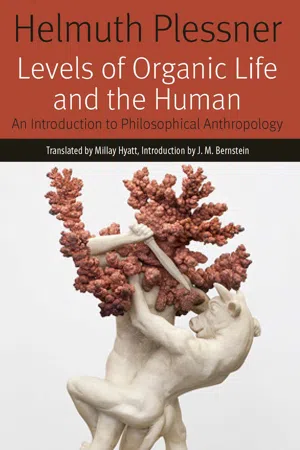
Levels of Organic Life and the Human
An Introduction to Philosophical Anthropology
- 449 pages
- English
- PDF
- Available on iOS & Android
eBook - PDF
Levels of Organic Life and the Human
An Introduction to Philosophical Anthropology
About this book
Information
Publisher
Fordham University PressYear
2019Print ISBN
9780823283989
9780823283996
eBook ISBN
9780823284016
Table of contents
- Cover
- Levels of Organic Life and the Human
- Title
- Copyright
- CONTENTS
- Foreword from the Helmuth Plessner Society
- Translator’s Preface and Acknowledgments
- Preface to the First Edition (1928)
- Preface to the Second Edition (1965)
- Introduction
- 1. Aim and Scope of the Study
- 2. The Cartesian Objection and the Nature of the Problem
- 3. The Thesis
- 4. The Modes of Being of Vitality
- 5. The Organizational Plants and Animals
- 6. The Sphere of the Animal
- 7. The Sphere of the Human
- Appendix
- Glossary
- Notes
- Index
Trusted by 375,005 students
Access to over 1.5 million titles for a fair monthly price.
Study more efficiently using our study tools.
Frequently asked questions
Yes, you can cancel anytime from the Subscription tab in your account settings on the Perlego website. Your subscription will stay active until the end of your current billing period. Learn how to cancel your subscription
No, books cannot be downloaded as external files, such as PDFs, for use outside of Perlego. However, you can download books within the Perlego app for offline reading on mobile or tablet. Learn how to download books offline
Perlego offers two plans: Essential and Complete
- Essential is ideal for learners and professionals who enjoy exploring a wide range of subjects. Access the Essential Library with 800,000+ trusted titles and best-sellers across business, personal growth, and the humanities. Includes unlimited reading time and Standard Read Aloud voice.
- Complete: Perfect for advanced learners and researchers needing full, unrestricted access. Unlock 1.5M+ books across hundreds of subjects, including academic and specialized titles. The Complete Plan also includes advanced features like Premium Read Aloud and Research Assistant.
We are an online textbook subscription service, where you can get access to an entire online library for less than the price of a single book per month. With over 1.5 million books across 990+ topics, we’ve got you covered! Learn about our mission
Look out for the read-aloud symbol on your next book to see if you can listen to it. The read-aloud tool reads text aloud for you, highlighting the text as it is being read. You can pause it, speed it up and slow it down. Learn more about Read Aloud
Yes! You can use the Perlego app on both iOS and Android devices to read anytime, anywhere — even offline. Perfect for commutes or when you’re on the go.
Please note we cannot support devices running on iOS 13 and Android 7 or earlier. Learn more about using the app
Please note we cannot support devices running on iOS 13 and Android 7 or earlier. Learn more about using the app
Yes, you can access Levels of Organic Life and the Human by Helmuth Plessner, Millay Hyatt in PDF and/or ePUB format, as well as other popular books in Philosophy & Mind & Body in Philosophy. We have over 1.5 million books available in our catalogue for you to explore.