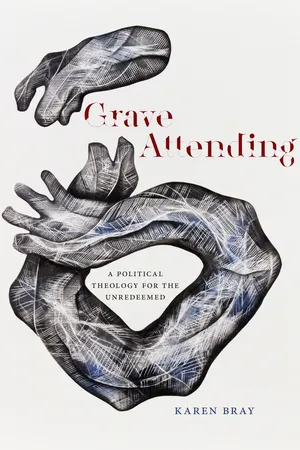
"This is a book about what it would mean to be a bit moody in the midst of being theological and political. Its framing assumption is that neoliberal economics relies on narratives in which not being in the right mood means a cursed existence." So begins Grave Attending: A Political Theology for the Unredeemed, which mounts a challenge to neoliberal narratives of redemption. Mapping the contemporary state of political theology, Karen Bray brings it to bear upon secularism, Marxist thought, affect theory, queer temporality, and other critical modes as a way to refuse separating one's personal mood from the political or philosophical. Introducing the concept of bipolar time, she offers a critique of neoliberal temporality by countering capitalist priorities of efficiency through the experiences of mania and depression. And it is here Bray makes her crucial critical turn, one that values the power of those who are unredeemed in the eyes of liberal democracy—those too slow, too mad, too depressed to be of productive worth—suggesting forms of utopia in the poetics of crip theory and ordinary habit. Through performances of what she calls grave attending—being brought down by the gravity of what is and listening to the ghosts of what might have been—Bray asks readers to choose collective care over individual overcoming.
Grave Attending brings critical questions of embodiment, history, and power to the fields of political theology, radical theology, secular theology, and the continental philosophy of religion. Scholars interested in addressing the lack of intersectional engagement within these fields will find this work invaluable. As the forces of neoliberalism demand we be productive, efficient, happy, and flexible in order to be deemed worthy subjects, Grave Attending offers another model for living politically, emotionally, and theologically. Instead of submitting to such a market-driven concept of salvation, this book insists that we remain mad, moody, and unredeemed. Drawing on theories of affect, temporality, disability, queerness, work, and race, Bray persuades us that embodying more just forms of sociality comes not in spite of irredeemable moods, but through them.
- 273 pages
- English
- PDF
- Available on iOS & Android
eBook - PDF
About this book
Information
Publisher
Fordham University PressYear
2019Print ISBN
9780823286867
9780823286850
eBook ISBN
9780823286881
Table of contents
- Cover
- GRAVE ATTENDING
- Title
- Copyright
- Dedication
- CONTENTS
- 1. Unbegun Introductions
- 2. Unsaved Time
- 3. Unproductive Worth
- 4. Unwilling Feeling
- 5. Unreasoned Care
- 6. Unattended Affect
- Acknowledgments
- Notes
- Bibliography
- Index
Trusted by 375,005 students
Access to over 1.5 million titles for a fair monthly price.
Study more efficiently using our study tools.
Frequently asked questions
Yes, you can cancel anytime from the Subscription tab in your account settings on the Perlego website. Your subscription will stay active until the end of your current billing period. Learn how to cancel your subscription
No, books cannot be downloaded as external files, such as PDFs, for use outside of Perlego. However, you can download books within the Perlego app for offline reading on mobile or tablet. Learn how to download books offline
Perlego offers two plans: Essential and Complete
- Essential is ideal for learners and professionals who enjoy exploring a wide range of subjects. Access the Essential Library with 800,000+ trusted titles and best-sellers across business, personal growth, and the humanities. Includes unlimited reading time and Standard Read Aloud voice.
- Complete: Perfect for advanced learners and researchers needing full, unrestricted access. Unlock 1.5M+ books across hundreds of subjects, including academic and specialized titles. The Complete Plan also includes advanced features like Premium Read Aloud and Research Assistant.
We are an online textbook subscription service, where you can get access to an entire online library for less than the price of a single book per month. With over 1.5 million books across 990+ topics, we’ve got you covered! Learn about our mission
Look out for the read-aloud symbol on your next book to see if you can listen to it. The read-aloud tool reads text aloud for you, highlighting the text as it is being read. You can pause it, speed it up and slow it down. Learn more about Read Aloud
Yes! You can use the Perlego app on both iOS and Android devices to read anytime, anywhere — even offline. Perfect for commutes or when you’re on the go.
Please note we cannot support devices running on iOS 13 and Android 7 or earlier. Learn more about using the app
Please note we cannot support devices running on iOS 13 and Android 7 or earlier. Learn more about using the app
Yes, you can access Grave Attending by Karen Bray in PDF and/or ePUB format, as well as other popular books in Theology & Religion & Critical Theory. We have over 1.5 million books available in our catalogue for you to explore.