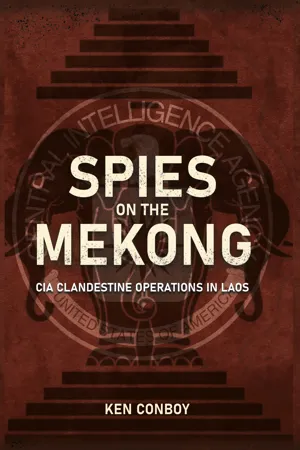
During the Cold War, the Central Intelligence Agency's biggest and longest paramilitary operation was in the tiny kingdom of Laos. Hundreds of advisors and support personnel trained and led guerrilla formations across the mountainous Laotian countryside, as well as running smaller road-watch and agent teams that stretched from the Ho Chi Minh Trail to the Chinese frontier. Added to this number were hundreds of contract personnel providing covert aviation services. It was dangerous work. On the Memorial Wall at the CIA headquarters in Langley, Virginia, nine stars are dedicated to officers who perished in Laos. On top of this are more than one hundred from propriety airlines killed in aviation mishaps between 1961 and 1973. Combined, this grim casualty figure is orders of magnitude larger than any other CIA paramilitary operation. But for the Foreign Intelligence officers at Langley, Laos was more than a paramilitary battleground. Because of its geographic location as a buffer state, as well as its trifurcated political structure, Laos was a unique Cold War melting pot. All three of the Lao political factions, including the communist Pathet Lao, had representation in Vientiane. The Soviet Union had an extremely active embassy in the capital, while the People's Republic of China—though in the throes of the Cultural Revolution—had multiple diplomatic outposts across the kingdom. So, too, did both North and South Vietnam. All of this made Laos fertile ground for clandestine operations. This book comprehensively details the cloak-and-dagger side of the war in Laos for the first time, from agent recruitments to servicing dead-drops in Vientiane.
- 256 pages
- English
- ePUB (mobile friendly)
- Available on iOS & Android
eBook - ePub
About this book
Information
CHAPTER 1
Growing Pains
Laos was a most improbable nation to transfix the superpowers of the mid-20th century. A landlocked patch of mountainous territory roughly the size of Great Britain, it had its heyday six hundred years earlier when local royalty rose to prominence under what was called Lan Xang, the Kingdom of a Million Elephants. Back then it had flourished as a center for the arts and Buddhist theology. Equally impressive was Lan Xang’s military prowess, its warriors extending the kingdom’s reach over most of current-day Laos, northern and central Thailand, and northern Cambodia.
By the 16th century, however, Lan Xang’s fortunes began to wane as it was weakened in a series of wars with the Burmese. Three centuries later, continued foreign pressure, compounded by palace intrigue, split the kingdom in three.
Thus broken, the once-formidable Lan Xang was a sparsely populated backwater when the French traveled up the Mekong River in the latter half of the 19th century. Though the fractured principalities had few economic benefits to offer, France needed a buffer to shield its lucrative Vietnamese holdings from the expansionist Thai and the British in Burma. The French, then, fused the landlocked realms back together into a single protectorate and created Laos. As its titular leader, the king in Luang Prabang was elevated as the unified Lao monarch.
Under French rule, Laos barely developed beyond its frontier status. A handful of dirt roads, passable only in the dry season, were cut on an east–west axis to the Vietnamese coast. A single north–south road, Route 13, was not completed until 1943. While Vietnamese laborers were imported to mine tin, and coffee and corn were grown on the Bolovens Plateau, products from Laos never represented more than 1 percent of total French exports from its Southeast Asian colonies.
With few resources to exploit, the Lao population was all but ignored by the French. And while the king of Laos was allowed to retain nominal control around Luang Prabang, in practice the French ruled Laos as would a benign and indifferent absentee landlord, retaining the existing traditional village structure and introducing hundreds of educated Vietnamese to run the country on a daily basis.
As for the apolitical Lao peasantry, most of whom had little interest in events outside their village, French indifference was matched in kind. Indeed, only two disturbances of any significance—both involving hill tribes—broke the peace during nearly a half century of French rule. These relatively minor events aside, Laos was as close as the French got to a perfect protectorate. At little cost, they had a nearly trouble-free buffer—until World War II.
With the fall of France to Nazi Germany in June 1940, France’s grip on its Southeast Asian colonies quickly degenerated to a toehold. The reason was that Germany’s Axis partner, Japan, had grand plans for Asia that did not include European overlords. Accordingly, Japan’s military forced its way into French Indochina three months after Paris fell. By August 1941, some 40,000 Japanese troops were stationed in France’s Lao, Cambodian, and Vietnamese territories, giving Tokyo de facto control behind a veneer of pro-Axis French administrators.
Across Southeast Asia, the Japanese proved themselves mercurial masters. Initially brutal toward indigenous resistance, they quickly warmed to local nationalist movements when the war started going bad and the Allies looked poised to reenter Indochina. In Laos, they went so far as to kidnap Crown Prince Savang Vatthana in order to force King Sisavang Vong, a dedicated Francophile, to declare on 8 April 1945 an end to French protectorate status.
Taking a cue from the Japanese, the educated upper stratum of Lao society began to flirt with notions of nationalism and independence. Leading the pack of budding nationalists were three brothers from the junior branch of the royal family. The oldest, Prince Phetsarath, was a French-educated viceroy who had been a driving force behind establishment of the Lao civil service and judiciary before World War II; he was widely recognized as the second-most powerful man in Laos after the king. The second brother, Prince Souvanna Phouma, had earned two engineering degrees in France before returning to Vientiane as chief of the Architecture Bureau in the colonial Public Works Service. The third brother, Prince Souphanouvong, was, more correctly, the younger half brother of the other two. Ambitious, vain, and academically gifted, Souphanouvong had earned a reputation as a rebel, his resentment of authority fanned by childhood discrimination because his mother was a commoner.
With Phetsarath and Souvanna Phouma at the forefront, a young nationalist movement, the Lao Issara—or Free Lao—took shape. And with Tokyo’s strong encouragement, it was this group that declared independence in the waning days of World War II.
Not having any of it, the French cobbled together an expeditionary force and rushed it back to Laos. As the French pushed their way into the panhandle in early 1946, the Lao Issara all but melted away. After southern Laos was liberated, on 24 April the French dropped an airborne battalion along the outskirts of Vientiane; the Lao Issara offered no resistance. Fifteen days later, a similar drop put Luang Prabang under French control. Three months after that, the French reincorporated Laos—along with Cambodia and the Vietnamese territories—into an Indochinese federation.
With French authority restored, the Lao Issara leadership regrouped in Thailand. Moping in Bangkok safe houses, the dispirited nationalists began to bicker endlessly among themselves.
That the Lao Issara remained toothless was welcome news for France, which had its hands full combating the fast-growing threat from communist Vietnamese guerrillas known as the Viet Minh. To free more assets for use against the Viet Minh, France transformed Laos in May 1947 into a constitutional monarchy with sufficient autonomy to inaugurate a national assembly in six months’ time. Continuing in the same vein, a July 1949 Franco-Lao agreement granted the Royal Lao Government (RLG) the right to raise a Lao National Army (Armée Nationale Laotienne, or ANL).
As the French now had Laos speeding down the road toward de facto independence, the Lao Issara all but lost its raison d’être. Thus, when the RLG dangled a promise of amnesty, many from the Lao Issara expressed interest. Prince Phetsarath, at odds with the king, chose to sulk in Thailand. Souphanouvong, long known for his unusually close ties to the Vietnamese, had been expelled from the mainstream Lao Issara in May 1949; predictably, he made his way to Vietnam to lobby support from the Viet Minh’s revolutionary godfather, Ho Chi Minh. Alone among the brothers, Souvanna Phouma formally dissolved the Lao Issara in October and then led the bulk of his comrades across the Mekong in peace.
The RLG soon faced a threat from a different quarter. Since the opening of 1949, the Viet Minh had been quietly nurturing a sister wing composed of communist Lao guerrillas in the northeastern province of Sam Neua. Soon after creation of this movement’s first 25-man guerrilla band, Souphanouvong, ousted from the Lao Issara, offered himself up as their ally. For the ambitious Souphanouvong, this guerrilla movement offered greater personal visibility—free of competition from other senior nationalists; for the communist guerrillas, the flamboyant prince was a good publicist, adding appeal and legitimacy to an otherwise obscure, Viet Minh-backed splinter movement.
With hill tribe recruits, Souphanouvong’s imprimatur, and Viet Minh support, the movement made early gains. By August 1950, 150 of its members were on hand for a clandestine rally at Ho Chi Minh’s mountain redoubt in Tuyen Quang, Vietnam. It was there that the resistance was cosmetically reshaped into the Neo Lao Issara (Free Lao Front). The meeting also saw the first use of the term Pathet Lao (Lao Nation), in reference to the Neo Lao Issara’s armed wing; from that point forward, despite several official name changes over the years, the term Pathet Lao became synonymous with both the Lao communist military organization and its associated political front.
Meantime, the French war effort was not going well. By early 1952, the Viet Minh had seized most of the northern border region with China, leaving it free to make raids into northern Vietnam’s fertile Red River delta. Hoping to turn the tide, French forces maneuvered into blocking positions. Rising to the challenge, the Viet Minh responded with some twenty-five thousand troops and grabbed even more swaths of territory by the second week of March.
For the French, things only got worse. Near year’s end, colonial officials were convinced of an imminent Vietnamese invasion of Sam Neua. Garrisoned by two Lao battalions and three local guard companies, the province had already lost a pair of frontier outposts to encroaching elements of two Viet Minh regiments in early December.
Recognizing Sam Neua’s vulnerability, the French high command dispatched Lao paratroopers to Sam Neua town, the provincial capital, during the third week of December 1952. But rising to the challenge once more, Vietnamese forays savaged the Lao paratroopers over the next three months. Then, in a defining moment for the Viet Minh, on 12 April 1953 a massive Vietnamese task force spilled across the Sam Neua frontier. Given less than a day’s lead, the Franco-Lao garrison retreated southwest; only a fraction eventually reached safety on the Plain of Jars (Plaine des Jarres, or PDJ), a grassy plateau between Sam Neua and Vientiane.
As Sam Neua Province was being overwhelmed, a second Viet Minh invasion force massed in the Vietnamese valley of Dien Bien Phu. Composed of one regiment and Pathet Lao auxiliaries, this column crossed the border and pushed south toward Luang Prabang. As an emergency blocking force, a lone company of Lao commandos was parachuted halfway between Dien Bien Phu and Luang Prabang on 14 April. In addition, the French orchestrated a major airlift of reinforcements into the royal capital, pumping the town full of Foreign Legionnaires and Moroccan troops. Still, by 27 April the outlook for Luang Prabang looked grim as the isolated commando company was overrun in less than three hours.
From a purely military perspective, the French top brass would have been right to order a withdrawal from Luang Prabang. But greatly complicating matters, the king of Laos refused to vacate his throne, allegedly influenced by psychic premonitions of a local blind seer who said the Viet Minh would stop short of the town.
Their prestige tied to the monarch’s welfare, the French had no choice but to rush in still more reinforcements. Continuing to roll south, the Viet Minh had moved to within 30 kilometers of Luang Prabang by 10 May. The French forces waited tensely for a final confrontation. The weather, however, proved their salvation as monsoon rains began two days later. With their extended supply lines quickly mired, the Viet Minh troops retraced their steps back toward Dien Bien Phu. Luang Prabang, against long odds, was saved.
As the French were scrambling to hold northern Laos, halfway around the world the United States was paying close attention. Whereas Laos had once been relegated to a footnote in discussions of Indochina, the US government was now breathlessly equating the kingdom’s fate with that of the entire noncommunist bloc south of China. Said newly inaugurated President Dwight Eisenhower during a 28 April 1953 National Security Council meeting, if Laos is lost, we will “likely lose the rest of Southeast Asia and Indonesia. The gateway to India, Burma, and Thailand will be open.”1
Matching this sentiment with action, the United States loaned six transport planes (with civilian aircrews) to conduct supply drops as the French rushed reinforcements to the PDJ. By the end of May, the augmented garrison surged forth, beating the Viet Minh column back toward the border. At the cost of 1,569 Lao and French Union soldiers, the Viet Minh offensive had at long last been stopped.
Though the French had won a temporary reprieve, Washington remained deeply concerned. The United States already had diplomatic outposts scattered across Indochina to help keep its finger on the pulse. In 1952, the modest-size legation in the southern Vietnamese city of Saigon had been upgraded to an embassy under Ambassador Donald Heath. This embassy, in turn, oversaw tiny legations in Vientiane and the Cambodian capital of Phnom Penh, as well as a consulate in the northern Vietnamese city of Hanoi.
To that time, the Vientiane legation, founded in 1950, was almost notional. Junior diplomats from elsewhere in Indochina were rotated through one or two at a time for short stints. Aside from a Thai consulate, they were the only foreign representatives in town.
Continuing the trend, the vice consul in Hanoi, 32-year-old Lloyd “Mike” Rives, was temporarily shifted to Vientiane in June 1953. Hailing from an affluent New Jersey family, Rives was up to the task. For one thing, he had majored in French at Princeton University and was thus fluent in the lingua franca of the kingdom. For another thing, he was more than familiar with hardship after four years in the Marines, much of it island-hopping in the Pacific.
Arriving at the same time was Ted Tanen, a 27-year-old California native who had just completed a tour as administrative clerk at the embassy in Burma. Tanen’s role in Vientiane was as a proto–public affairs officer, gathering cultural material for use on Voice of America.
While the pair had prior experience in Southeast Asia—Rives in Hanoi, Tanen in Rangoon—Vientiane made those two venues look positively cosmopolitan by comparison. The Lao capital had no running water and only intermittent electricity from generators. Tropical diseases, especially amoebic dysentery, were rampant. Roads had yet to be paved.
The legation itself was located in a spacious French-style villa on the bank of the Mekong. Rives and Tanen, both bachelors, had bedrooms in the villa, setting aside another room to function as the chancery for official business and repurposing an adjacent lavatory as a code room. Electricity was provided by a generator that was used only in the evenings; gasoline was hauled across the Mekong in jerry cans. Water was hand-pumped to a tank on the roof, allowing gravity to funnel it through the shower and toilet.
Making the most of his French language skills, Rives quickly networked across Vientiane’s upper echelon of French administrators and, to a lesser extent, Lao elites. He would then take his notes back to the lavatory-cum-code-room, where he would encrypt them—old school— using one-time pads. The resultant number groups were then brought to the central post office and transmitted either to Saigon or directly to Washington. Reversing the process, each evening a messenger from the post office would arrive with the day’s incoming telegrams, which Rives would decrypt while sitting on the toilet with a one-time ...
Table of contents
- Front Cover
- Half-Title Page
- Title Page
- Copyright Page
- Contents
- Acknowledgements
- 1 Growing Pains
- 2 The Young Turks
- 3 Hell is a City
- 4 Apéritif
- 5 The Teams
- 6 The Flying Squad
- 7 The Holy Grail
- 8 Hard Target
- 9 Rock and a Hard Place
- 10 The Art of Seduction
- 11 Suspicious Minds
- 12 Writing on the Wall
- 13 Eye of the Hurricane
- 14 Surreptitious Entries
- 15 Dénouement
- 16 Cloak and Keris
- Maps
- Select Bibliography
- Endnotes
Trusted by 375,005 students
Access to over 1.5 million titles for a fair monthly price.
Study more efficiently using our study tools.
Frequently asked questions
Yes, you can cancel anytime from the Subscription tab in your account settings on the Perlego website. Your subscription will stay active until the end of your current billing period. Learn how to cancel your subscription
No, books cannot be downloaded as external files, such as PDFs, for use outside of Perlego. However, you can download books within the Perlego app for offline reading on mobile or tablet. Learn how to download books offline
Perlego offers two plans: Essential and Complete
- Essential is ideal for learners and professionals who enjoy exploring a wide range of subjects. Access the Essential Library with 800,000+ trusted titles and best-sellers across business, personal growth, and the humanities. Includes unlimited reading time and Standard Read Aloud voice.
- Complete: Perfect for advanced learners and researchers needing full, unrestricted access. Unlock 1.5M+ books across hundreds of subjects, including academic and specialized titles. The Complete Plan also includes advanced features like Premium Read Aloud and Research Assistant.
We are an online textbook subscription service, where you can get access to an entire online library for less than the price of a single book per month. With over 1.5 million books across 990+ topics, we’ve got you covered! Learn about our mission
Look out for the read-aloud symbol on your next book to see if you can listen to it. The read-aloud tool reads text aloud for you, highlighting the text as it is being read. You can pause it, speed it up and slow it down. Learn more about Read Aloud
Yes! You can use the Perlego app on both iOS and Android devices to read anytime, anywhere — even offline. Perfect for commutes or when you’re on the go.
Please note we cannot support devices running on iOS 13 and Android 7 or earlier. Learn more about using the app
Please note we cannot support devices running on iOS 13 and Android 7 or earlier. Learn more about using the app
Yes, you can access Spies on the Mekong by Ken Conboy in PDF and/or ePUB format, as well as other popular books in Politics & International Relations & 20th Century History. We have over 1.5 million books available in our catalogue for you to explore.