This book explores the question of how equitable and inclusive education can be implemented in heterogeneous classes where learners' languages and cultures reflect the social reality of mass migration and everyday plurilingualism. The book brings together researchers and practitioners working in inclusive teaching and learning in a variety of migration contexts from pre-school to university. The book opens with an exploration of the relationship between language ideologies and policies with respect to the inclusion of learners for whom the language of education is not the language spoken in the home. The following section focuses on innovative pedagogical practices which allow migrants to be socially, culturally and institutionally included at school and at university while using their plurilingual competences as resources for learning/teaching and allowing them to fully realise their potential.
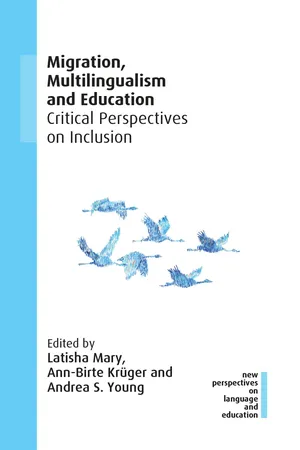
eBook - ePub
Migration, Multilingualism and Education
Critical Perspectives on Inclusion
- English
- ePUB (mobile friendly)
- Available on iOS & Android
eBook - ePub
Migration, Multilingualism and Education
Critical Perspectives on Inclusion
About this book
Information
Part 1
Ideology Drives Policy: Rethinking Inclusion
1Pushing Back Monoglossic Ideologies of Language: Towards Transformative and Inclusive Pedagogies for 21st Century Multilingual Classrooms
Christine Hélot
In a report published in 2008 by UNESCO, inclusive education is described in the following terms:
Inclusive education is central to the achievement of high quality education for all learners and the development of more inclusive societies. Inclusion is still thought of in some countries as an approach to serving children with disabilities within general educational settings. Internationally however, it is increasingly seen more broadly as a reform that supports and welcomes diversity amongst all learners. (UNESCO, 2008: 5)
Inclusion is the central notion explored in the 14 chapters that compose this engaging book – a book that takes us on an inspiring journey inside linguistically and culturally diverse classrooms across Europe, North America and Japan. The researchers and practitioners who contributed to the volume all address one crucial question: How can we achieve a more inclusive and equitable education for all learners in 21st century multilingual settings? Indeed, most education systems in the world still educate children through one dominant language, and continue to hold on to the belief that this is the best way towards social integration (Van Avermaet et al., 2018). However, in the process, learners lose their own previously acquired languages and, whether these languages are referred to as ‘heritage’ or ‘family’ or ‘languages of origin’, they end up disappearing or, worse, being forbidden. Why, in our multilingual times, should schools remain bastions of monolingualism, ignore the very resources students need to acquire in the age of a knowledge-based society and waste the opportunity to understand that social cohesion can only be born out of inclusive education?
This book is about inclusion and multilingual education and it links the research and practice of new pedagogical approaches that tackle the relationships between language education and exclusion, language use in school and discrimination (Escudé, 2018), language practices and subordination, and the disempowerment and voicelessness of children who are prevented from using their full linguistic repertoires to learn. In the face of the growing inequalities pervading our contemporary societies and affecting our education systems (see Lahire, 2019, for the latest research in France on inequality, for example), the present volume offers a wealth of examples of ‘pedagogies of the possible’ (Hélot & Ó Laoire, 2011), pedagogies that conceive of new practices of inclusion based on the following principles: acceptance of all learners, respect for their singularities and pluralities, and curricula in which they see their physical linguistic and cultural environment as well as their identity reflected.
Alongside such an understanding of inclusion, many of the chapters refer to the notion of equity. Equity is different from equality, a central principle of many education systems. Equity means a fair, inclusive and respectful treatment of all people. It is important to insist that, contrary to equality, an equitable approach to education does not imply disregard for individual differences, but that it acknowledges the individual needs of students who, as social actors, have their own learning biographies and their own plurilingual repertoires linked to their socialization and experiences of mobility. In other words, the many children growing up today in families where various languages are spoken display individual linguistic repertoires including multiple cultural experiences that play a crucial role in their learning journeys, and thus demand individual attention. This point is central for many of the educational contexts under study, where the principle of equality supersedes the notion of equity and makes it difficult for teachers to understand that the specific needs of their multilingual students are a matter of equity and not just equality.
As we have written elsewhere (Hélot et al., 2018; Mary & Young, 2018; Young, 2018), and as clearly illustrated in this volume, all classrooms today across the world are multilingual, not because multilingual education is widespread, but because many children come to school speaking a great diversity of languages. An inclusive approach to education therefore means that teachers are educated to understand what it means to grow up with several languages, and that whether these languages are allowed or forbidden in the classroom, they are an integral part of students’ learning experiences, of acquiring knowledge in all school subjects, including the language of instruction and the languages taught in schools. In other words, multilingual children should no longer be asked to censor some of their languages, because all their linguistic and cultural experiences are part of their identity, part of their understanding of the world around them and therefore part of the acquisition process of new knowledge.
All the classrooms described in this volume, whether in France, Germany, Austria, England, Cyprus, Portugal, Greece, Palestine, Japan, New York or California, and all the settings presented in the interesting personal testimonies illustrate that linguistic and cultural diversity is now the norm in 21st century classrooms. Previous publications refer to similar research in terms of ‘the multilingual turn’ (Conteh & Meier, 2014; May, 2013). The multilingual turn not only calls for a profound rethink of our pedagogies, but it demands that we challenge the conceptualization of language and language education as it was formulated in the 20th century, that is, with the main objective of serving the nation-state. Research on language education and language policy in the 21st century has questioned such ideological borders and reframed our understanding of the role of language and languages in our personal lives and for societal goals. Based on poststructuralist approaches to research, the multilingual turn in sociolinguistic and educational research focuses on the language ...
Table of contents
- Cover-Page
- Half-Title
- Series
- Title
- Copyright
- Contents
- Contributors
- Acknowledgements
- Part 1: Ideology Drives Policy: Rethinking Inclusion
- Part 2: ‘Actuality Implies Possibility’: New Practices of Inclusion
- Glossary
- Index
Trusted by 375,005 students
Access to over 1.5 million titles for a fair monthly price.
Study more efficiently using our study tools.
Frequently asked questions
Yes, you can cancel anytime from the Subscription tab in your account settings on the Perlego website. Your subscription will stay active until the end of your current billing period. Learn how to cancel your subscription
No, books cannot be downloaded as external files, such as PDFs, for use outside of Perlego. However, you can download books within the Perlego app for offline reading on mobile or tablet. Learn how to download books offline
Perlego offers two plans: Essential and Complete
- Essential is ideal for learners and professionals who enjoy exploring a wide range of subjects. Access the Essential Library with 800,000+ trusted titles and best-sellers across business, personal growth, and the humanities. Includes unlimited reading time and Standard Read Aloud voice.
- Complete: Perfect for advanced learners and researchers needing full, unrestricted access. Unlock 1.5M+ books across hundreds of subjects, including academic and specialized titles. The Complete Plan also includes advanced features like Premium Read Aloud and Research Assistant.
We are an online textbook subscription service, where you can get access to an entire online library for less than the price of a single book per month. With over 1.5 million books across 990+ topics, we’ve got you covered! Learn about our mission
Look out for the read-aloud symbol on your next book to see if you can listen to it. The read-aloud tool reads text aloud for you, highlighting the text as it is being read. You can pause it, speed it up and slow it down. Learn more about Read Aloud
Yes! You can use the Perlego app on both iOS and Android devices to read anytime, anywhere — even offline. Perfect for commutes or when you’re on the go.
Please note we cannot support devices running on iOS 13 and Android 7 or earlier. Learn more about using the app
Please note we cannot support devices running on iOS 13 and Android 7 or earlier. Learn more about using the app
Yes, you can access Migration, Multilingualism and Education by Latisha Mary, Ann-Birte Krüger, Andrea S. Young, Latisha Mary,Ann-Birte Krüger,Andrea S. Young in PDF and/or ePUB format, as well as other popular books in Languages & Linguistics & Education General. We have over 1.5 million books available in our catalogue for you to explore.