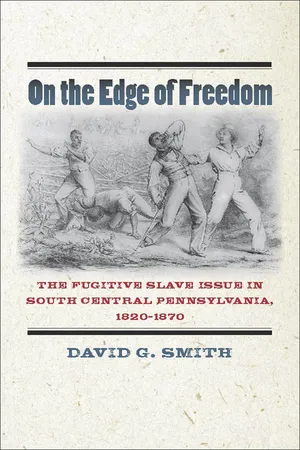
In On the Edge of Freedom, David G. Smith breaks new ground by illuminating the unique development of antislavery sentiment in south central Pennsylvania—a border region of a border state with a complicated
history of slavery, antislavery activism, and unequal freedom. During the antebellum decades every single fugitive slave escaping by land east of the Appalachian Mountains had to pass through the region, where they faced both significant opportunities and substantial risks. While the hundreds of fugitives traveling
through south central Pennsylvania (defined as Adams, Franklin, and Cumberland counties) during this period were aided by an effective Underground Railroad, they also faced slave catchers and informers. "Underground" work such as helping fugitive slaves appealed to border antislavery activists who shied away from agitating for immediate abolition in a region with social, economic, and kinship ties to the South.
And, as early antislavery protests met fierce resistance, area activists adopted a less confrontational approach, employing the more traditional political tools of the petition and legal action.
Smith traces the victories of antislavery activists in south central Pennsylvania, including the achievement of a strong personal liberty law and the aggressive prosecution of kidnappers who seized innocent African Americans as fugitives. He also documents how their success provoked Southern retaliation and the passage of a strengthened Fugitive Slave Law in 1850. The Civil War then intensified the debate over fugitive slaves, as hundreds of escaping slaves, called "contrabands," sought safety in the area, and scores were recaptured by the Confederate army during the Gettysburg campaign.
On the Edge of Freedom explores in captivating detail the fugitive slave issue through fifty years of sectional conflict, war, and reconstruction in south central Pennsylvania and provocatively questions what was gained by the activists' pragmatic approach of emphasizing fugitive slaves over immediate abolition and full equality. Smith argues that after the war, social and demographic changes in southern Pennsylvania worked against African Americans' achieving equal opportunity, and although local literature portrayed this area as a vanguard of the Underground Railroad, African Americans still lived "on the edge of freedom." By the 1920s, the Ku Klux Klan was rallying near the Gettysburg battlefield, and south central Pennsylvania became, in some ways, as segregated as the Jim Crow South. The fugitive slave issue, by reinforcing images of dependency, may have actually worked against the achievement of lasting social change.
eBook - PDF
On the Edge of Freedom
The Fugitive Slave Issue in South Central Pennsylvania, 1820-1870
- 344 pages
- English
- PDF
- Available on iOS & Android
eBook - PDF
On the Edge of Freedom
The Fugitive Slave Issue in South Central Pennsylvania, 1820-1870
About this book
Information
Publisher
Fordham University PressYear
2014Print ISBN
9780823263790
9780823240326
eBook ISBN
9780823263974
Table of contents
- Cover
- Contents
- List of Tables
- Acknowledgments
- Introduction: The Fugitive Slave Issue on the Edge of Freedom
- 1 South Central Pennsylvania, Fugitive Slaves, and the Underground Railroad
- 2 Thaddeus Stevens’ Dilemma, Colonization, and the Turbulent Years of Early Antislavery in Adams County, 1835–39
- 3 Antislavery Petitioning in South Central Pennsylvania
- 4 The Fugitive Slave Issue on Trial: The 1840s in South Central Pennsylvania
- 5 Controversy and Christiana: The Fugitive Slave Issue in South Central Pennsylvania, 1850–51
- 6 Interlude: Kidnapping, Kansas, and the Rise of Race-Based Partisanship: The Decline of the Fugitive Slave Issue in South Central Pennsylvania, 1852–57
- 7 Revival of the Fugitive Slave Issue, 1858–61
- 8 Contrabands, “White Victories,” and the Ultimate Slave Hunt: Recasting the Fugitive Slave Issue in Civil War South Central Pennsylvania
- 9 After the Shooting: South Central Pennsylvania after the Civil War
- Conclusion: The Postwar Ramifications of the Fugitive Slave Issue “On the Edge of Freedom”
- Appendixes
- Notes
- Archives Consulted
- Index
Trusted by 375,005 students
Access to over 1.5 million titles for a fair monthly price.
Study more efficiently using our study tools.
Frequently asked questions
Yes, you can cancel anytime from the Subscription tab in your account settings on the Perlego website. Your subscription will stay active until the end of your current billing period. Learn how to cancel your subscription
No, books cannot be downloaded as external files, such as PDFs, for use outside of Perlego. However, you can download books within the Perlego app for offline reading on mobile or tablet. Learn how to download books offline
We are an online textbook subscription service, where you can get access to an entire online library for less than the price of a single book per month. With over 1.5 million books across 990+ topics, we’ve got you covered! Learn about our mission
Look out for the read-aloud symbol on your next book to see if you can listen to it. The read-aloud tool reads text aloud for you, highlighting the text as it is being read. You can pause it, speed it up and slow it down. Learn more about Read Aloud
Yes! You can use the Perlego app on both iOS and Android devices to read anytime, anywhere — even offline. Perfect for commutes or when you’re on the go.
Please note we cannot support devices running on iOS 13 and Android 7 or earlier. Learn more about using the app
Please note we cannot support devices running on iOS 13 and Android 7 or earlier. Learn more about using the app
Yes, you can access On the Edge of Freedom by David G. Smith in PDF and/or ePUB format, as well as other popular books in History & American Civil War History. We have over 1.5 million books available in our catalogue for you to explore.