Abdelwahab Meddeb makes an urgent case for an Islamic reformation, located squarely in Western Europe, now home to millions of Muslims, where Christianity and Judaism have come to coexist with secular humanism and positivist law. He is not advocating "moderate" Islam, which he characterizes as thinly disguised Wahabism, but rather an Islam inspired by the great Sufi thinkers, whose practice of religion was not bound by doctrine.
To accomplish this, Meddeb returns to the doctrinal question of the text as transcription of the uncreated word of God and calls upon Muslims to distinguish between Islam's spiritual message and the temporal, material, and historically grounded origins of its founding scriptures. He contrasts periods of Islamic history—when philosophers and theologians engaged in lively dialogue with other faiths and civilizations and contributed to transmitting the Hellenistic tradition to early modern Europe—with modern Islam's collective amnesia of this past. Meddeb wages a war of interpretations in this book, in his attempt to demonstrate that Muslims cannot join the concert of nations unless they set aside outmoded notions such as jihad and realize that feuding among the monotheisms must give way to the more important issue of what it means to be a citizen in today's postreligious global setting.
- 190 pages
- English
- PDF
- Available on iOS & Android
eBook - PDF
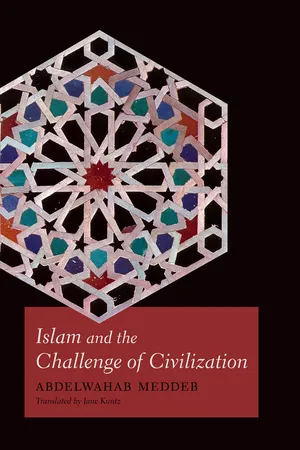
Islam and the Challenge of Civilization
About this book
Trusted by 375,005 students
Access to over 1.5 million titles for a fair monthly price.
Study more efficiently using our study tools.
Information
Publisher
Fordham University PressYear
2013Print ISBN
9780823264360
9780823251230
eBook ISBN
9780823251889
Table of contents
- Cover
- Contents
- Prologue: Religion and Violence
- 1. The Koran as Myth
- 2. The Clash of Interpretations
- 3. On the Arab Decline
- 4. Civilization or Extinction
- 5. Enlightenment between High and Low Voltage
- 6. The Physics and Metaphysics of Nature
- Epilogue: Religion and Cosmopolitics
- Appendixes
- Notes
Frequently asked questions
Yes, you can cancel anytime from the Subscription tab in your account settings on the Perlego website. Your subscription will stay active until the end of your current billing period. Learn how to cancel your subscription
No, books cannot be downloaded as external files, such as PDFs, for use outside of Perlego. However, you can download books within the Perlego app for offline reading on mobile or tablet. Learn how to download books offline
Perlego offers two plans: Essential and Complete
- Essential is ideal for learners and professionals who enjoy exploring a wide range of subjects. Access the Essential Library with 800,000+ trusted titles and best-sellers across business, personal growth, and the humanities. Includes unlimited reading time and Standard Read Aloud voice.
- Complete: Perfect for advanced learners and researchers needing full, unrestricted access. Unlock 1.5M+ books across hundreds of subjects, including academic and specialized titles. The Complete Plan also includes advanced features like Premium Read Aloud and Research Assistant.
We are an online textbook subscription service, where you can get access to an entire online library for less than the price of a single book per month. With over 1.5 million books across 990+ topics, we’ve got you covered! Learn about our mission
Look out for the read-aloud symbol on your next book to see if you can listen to it. The read-aloud tool reads text aloud for you, highlighting the text as it is being read. You can pause it, speed it up and slow it down. Learn more about Read Aloud
Yes! You can use the Perlego app on both iOS and Android devices to read anytime, anywhere — even offline. Perfect for commutes or when you’re on the go.
Please note we cannot support devices running on iOS 13 and Android 7 or earlier. Learn more about using the app
Please note we cannot support devices running on iOS 13 and Android 7 or earlier. Learn more about using the app
Yes, you can access Islam and the Challenge of Civilization by Abdelwahab Meddeb, Jane Kuntz in PDF and/or ePUB format, as well as other popular books in Politics & International Relations & Middle Eastern History. We have over 1.5 million books available in our catalogue for you to explore.