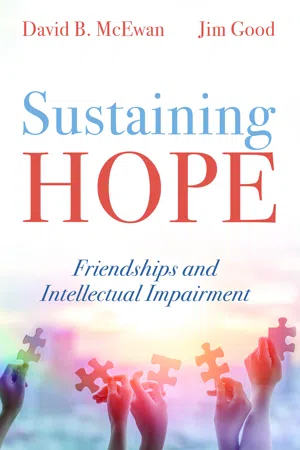
- 176 pages
- English
- ePUB (mobile friendly)
- Available on iOS & Android
eBook - ePub
About this book
In the Gospels we encounter many people who were shunned by their society because they lived with some form of impairment. In stark contrast, Jesus embraces these people and offers compassion without condescension, relationship without ulterior motive, and provides them with practical help. Subsequent history has rarely matched his ministry, particularly for people living with intellectual impairment and their families. Based on personal interviews with a number of families who have children living with intellectual impairment, two major challenges constantly impacted them--a longing for people to treat their child as a person and to form genuine friendships with them. Written from a Wesleyan perspective, this book seeks to address these two issues from a theological and pastoral perspective. It offers practical help for anyone to initiate and develop healthy friendships with people who live with moderate to severe intellectual impairment, their families, and carers.
Information
Topic
Teologia e religioneSubtopic
Ministro del culto cristiano1
The Biblical and Historical Background to the Current Situation
People living with impairment have been stigmatized throughout history. The human rights movement of the twentieth century and the legislation which arose from it, are important for people living with impairment and their families. This is partly because they have provided an opportunity to redress centuries of discrimination. Most Greco-Roman philosophers suggested that human value is “primarily social value and is determined by potentiality.”1 If a person is not able to contribute to society in meaningful ways, they are considered to have no intrinsic value and are without worth. The Greek philosopher Plato said: “The offspring of the inferior, and any of those of the other sort who are born defective, they will properly dispose of in secret so that no one will know what has become of them.”2 A similar viewpoint was held by his student, Aristotle: “Let there be a law that no deformed child shall be reared.”3 The situation in Roman culture was no different. If those living with impairment survived childhood, they were usually mocked and derided. For example, Cicero wrote: “In deformity and bodily disfigurement there is good material for making jokes” and many vase paintings depicted party scenes where “hunchbacks, cripples, and dwarfs perform for the entertainment of onlookers.”4 It was said that the Emperor Augustus had a granddaughter who “retained a dwarf named Cinopas as a pet,” while Plutarch reports on the existence of a “monster market” in Rome.5 Blindness—the most commonly spoken of disability in both Ancient Greece and Rome—was “regularly (although not exclusively) viewed as a punishment.”6 The prevailing Greco-Roman attitude leading up to and including the time of Jesus was one of “fundamental ambivalence toward the deformed and disabled.”7 Soranus of Ephesus reports that a baby worth rearing is one who is “perfect in all its moving parts, members and senses, with every body part properly moving and appropriately sized.”8 This, sadly, is a viewpoint that remains true in some places to this day.
The Biblical Framework
The situation in ancient Israel and in the centuries leading up to the time of Christ was often not much better. The problem was not so much the Hebrew scripture itself but the way it was often interpreted. Saul M. Olyan argues that people living with physical and sensory impairment (such as being lame or blind) were devalued by casting them as “defective,” “cursed” and “profaning of holiness.”9 Such “defective” people (with some exceptions amongst the priestly class10) were to be kept from entering the Temple area while they remained unclean—a lifelong fate for those with a permanent disability. In some cases, they were associated with “curses” such as sterility, disease, blight, drought, military defeat, lack of burial, loss of wealth and land. In other cases, they were linked with ideas such as contempt and divine rejection, weakness and ineffectuality.11 At times in Israel’s history, any form of impairment could be seen as a result of God’s judgement.12 The Qumran text even associates blindness with the “Spirit of Wrong” and equates it with a reviling tongue, abominable acts, wickedness, falsehood and pride. “Thus, blindness is brought into association not only with a substantial selection of negative qualities, but with the antithesis of the deity himself (the ‘Spirit of Wrong’ and ‘the ways of darkness’).”13 The Temple Scroll also excluded any blind or lame person; they “shall not enter into the city of the sanctuary all their days . . . they shall not pollute the city.”14
With these stigmatizing attitudes found in Greco/Roman and early Hebrew perspectives on people living with impairments, it should come as no real surprise that we meet many marginalized people in the stories of the New Testament. In the ministry of Jesus there are regular encounters with people living with impairment who have their needs ignored and who are forced to live in anonymity on the margins of society.15 The devaluation and exclusion of the two blind men of Matthew 20 is indicated by their having to sit on the outskirts of town “by the roadside” begging.16 The crippled woman of Luke 13 is relegated by religious leaders to a position of less value than a healthy animal. We see Jesus censuring these leaders for their willingness to tend to the needs of their own animals on the Sabbath while questioning his healing of her.17 The deeply ingrained devaluation and poor self-worth of the woman who has been bleeding for twelve years (Luke 8:40–48) is shown by her daring to only approach Jesus secretively, unsettled at the thought of having public attention drawn to her. The man thought by many to be not in his right mind (Mark 5:2–15) was forced to live amongst the tombs and often restrained by chains.
The Ministry of Jesus
Brendan Byrne describes how Jesus “draws [our] attention to . . . a correct vision of God and of what God wants for human beings.”18 One of the pivotal points in Byrne’s argument comes from the words of Jesus in Luke 4:18–19 at the very beginning of his public ministry: “The Spirit of the Lord is on me, because he has anointed me to proclaim good news to the poor. He has sent me to proclaim freedom for the prisoners and recovery of sight for the blind, to set the oppressed free, to proclaim the year of the Lord’s favor.”19 This is a quotation from Isaiah 61:1–2, and Jesus applies the words to his own ministry. While Jesus quotes in full Isaiah’s phrase about p...
Table of contents
- Title Page
- Acknowledgments
- Introduction
- Chapter 1: The Biblical and Historical Background to the Current Situation
- Chapter 2: The Rhetoric and the Reality
- Chapter 3: What Does It Mean to Be Human?
- Chapter 4: The Image of God: Broken and Being Healed
- Chapter 5: The Family and Friendships
- Chapter 6: Friends for Life
- Chapter 7: Living in the Hope
- Bibliography
Trusted by 375,005 students
Access to over 1.5 million titles for a fair monthly price.
Study more efficiently using our study tools.
Frequently asked questions
Yes, you can cancel anytime from the Subscription tab in your account settings on the Perlego website. Your subscription will stay active until the end of your current billing period. Learn how to cancel your subscription
No, books cannot be downloaded as external files, such as PDFs, for use outside of Perlego. However, you can download books within the Perlego app for offline reading on mobile or tablet. Learn how to download books offline
We are an online textbook subscription service, where you can get access to an entire online library for less than the price of a single book per month. With over 1.5 million books across 990+ topics, we’ve got you covered! Learn about our mission
Look out for the read-aloud symbol on your next book to see if you can listen to it. The read-aloud tool reads text aloud for you, highlighting the text as it is being read. You can pause it, speed it up and slow it down. Learn more about Read Aloud
Yes! You can use the Perlego app on both iOS and Android devices to read anytime, anywhere — even offline. Perfect for commutes or when you’re on the go.
Please note we cannot support devices running on iOS 13 and Android 7 or earlier. Learn more about using the app
Please note we cannot support devices running on iOS 13 and Android 7 or earlier. Learn more about using the app
Yes, you can access Sustaining Hope by David B. McEwan,Jim Good in PDF and/or ePUB format, as well as other popular books in Teologia e religione & Ministro del culto cristiano. We have over 1.5 million books available in our catalogue for you to explore.