Much of the work in the field of African studies still relies on rigid distinctions of 'tradition' and 'modernity', 'collaboration' and 'resistance', 'indigenous' and 'foreign'. This book moves well beyond these frameworks to probe the complex entanglements of different intellectual traditions in the South African context, by examining two case studies. The case studies constitute the core around which is woven this intriguing story of the development of black theatre in South Africa in the early years of the century. It also highlights the dialogue between African and African-American intellectuals, and the intellectual formation of the early African elite in relation to colonial authority and how each affected the other in complicated ways.
The first case study centres on Mariannhill Mission in KwaZulu-Natal. Here the evangelical and pedagogical drama pioneered by the Rev Bernard Huss, is considered alongside the work of one of the mission's most eminent alumni, the poet and scholar, B.W. Vilakazi. The second moves to Johannesburg and gives a detailed insight into the working of the Bantu Dramatic Society and the drama of H.I.E. Dhlomo in relation to the British Drama League and other white liberal cultural activities.
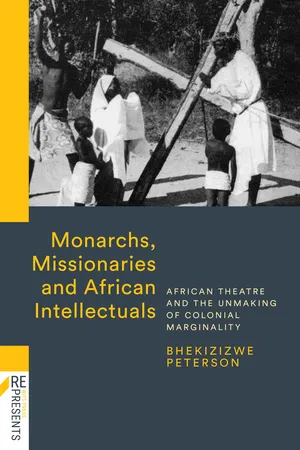
eBook - ePub
Monarchs, Missionaries and African Intellectuals
African Theatre and the Unmaking of Colonial Marginality
- 252 pages
- English
- ePUB (mobile friendly)
- Available on iOS & Android
eBook - ePub
Monarchs, Missionaries and African Intellectuals
African Theatre and the Unmaking of Colonial Marginality
About this book
Information
1
Theatre and Mission Education at Mariannhill
‘All work and no play makes civilisation unattractive to the masses’1
The Reverend Father Bernard Huss is one of the earliest and most influential pioneers in the social and pedagogical uses of theatre in South Africa. Between 1915 and 1927 Huss was the principal of St Francis College, Mariannhill, where he promoted the use of theatre in education and recreational activities with Africans. The students performed plays at St Francis, at the Native Location Hall at Depot Road in Durban, and at teacher training conferences. Huss was a popular speaker and received numerous invitations to address national forums on the ‘native question’. Where possible, Huss would combine speaking engagements with play-making exercises using participants who would perform scripted or improvised dramas. He was also a prolific writer and his ideas achieved a considerable measure of national currency.2
The Mariannhill dramas and their attempts to make or contest hegemony are best appreciated against an understanding of the institutional ideas and processes that underpinned the social enactment of evangelism and the new colonial order. Missionaries seized the vocabularies of narrative and drama, including their textual strategies, and used them to realise evangelical aims. Huss acknowledged the theatricality of the Catholic practice of ‘placing before the minds of her children the lives of saintly men and women’ who ‘illuminate’ Christian teachings and their import for life. Furthermore:
the ritual or religious service abounds in suggestions through all the avenues of the senses, the architecture, decorations, statues, pictures, rites, ceremonies, reverent attitude, sermons, songs, music etc.; these things are suggestive of religious sentiment.3
Consequently, evangelism was in many ways the quintessential melodramatic exercise where personal conduct and social events, even of the most ordinary kind, were emblematic of the battle with African epistemologies and cultures. The beliefs and powers of missions and colonial society had to be staged, not only in plays, but, significantly, in the spatial organisation of the mission, its architectural designs, work rhythms, religious rituals, and even the clothing that African converts wore.4 Mission education approximated a ‘machine of learning’ which, with its detailed daily programme and repetitive exercises, represented the wish to order ‘earthly time for the conquest of salvation’.5 The ideological vision was that evangelical authority could be demonstrated and exercised through the mission’s mediation of space, time and discourse. The degree to which cultural forms could be conscripted by the mission in the theatre of power that typified colonial society depended on the institutional support that they were able to muster. Mariannhill, in this regard, provided Huss with wide-ranging material and institutional support, not least among which were the intellectual traditions that went into the dramatisation of evangelism at Mariannhill which Huss was to tap into and upon which he would extend. The final sections explore Huss’s ideas on theatre as a genre amenable to the advance of evangelism and social control among Africans in schools and urban centres of Natal.
ORA ET LABORA: ‘TO LABOUR IS TO PRAY’6
Huss was born on 27 February 1876 in Oedheimin, Germany and christened Alexander. His father, Alexander Johannes Huss, was a Protestant who went over to Catholicism in 1871 at the wish of his wife, Regina Huss. Huss’s father worked as a carpenter and sculptor. Huss, who was physically frail from a young age and had vision in only one eye, attended the local primary school until the age of ten when he left for the Gymnasium in Landshut, Bavaria, where he excelled as a student. He completed his high school education in 1893 and registered for a degree in Philosophy and Theology in 1894 in Munich. The death of both his parents within two weeks of each other that year saw the nineteen-year-old Huss terminate his studies and join the Trappist Monastery. Huss arrived in South Africa from Bavaria, Germany, on 20 September 1895 and was robed on 1 December 1895 after an eight-week probation. He returned to his theology studies and was ordained as a priest in 1900. His name was changed to Maria Bernardus Huss.7
Mariannhill was set up in the Pinetown area by Father Wendolin Pfanner who arrived in Natal in December 1882, together with thirty-one other monks from the Trappist Order of the monastery of Sept Fons, France, after a brief unsuccessful sojourn at Dunbrody, Port Elizabeth.8 The development of the mission between 1885 and 1909 was phenomenal: by the end of 1885 the Mariannhill monastery had established a church, workshops, roads, buildings for residence, acres of land for agriculture and two schools with boarding facilities for boys and girls. By 1909 Mariannhill mission stations in South Africa consisted of 55 churches and chapels, 25 convents, 41 homes of different kinds, 39 boarding schools and 29 day schools. Mariannhill had the largest number of out-stations – 28 out of 49 Catholic mission stations in the whole country – where 20 000 Africans were baptised, 5 500 deaths were recorded, 946 Christians had been married, and 30 African teachers and 30 catechists had been trained. Huss’s arrival in 1895 coincided with the phenomenal growth of Mariannhill’s congregation, mission stations and schools.9
The monastery’s success was stimulated by the new colonial relations operative in the region after 1879. The year marked the final conquest of the Zulu kingdom of Cetshwayo who was regarded, by missionaries and colonial authorities alike, as ‘an absolute hindrance in the way of civilization’.10 African dynasties continued to be viewed with hostility after conquest since the kings, now demonised as ‘dangerous political revolutionaries’, were feared as possible focal points ‘around which dissaffection might unite’.11 Although Mariannhill ‘only attracted people’ in the wake of the ‘displacement, widespread poverty, and increasing vulnerability of people to government exactions of land, labour, and taxes’,12 many Africans were won over by the association of formal education with Christianity.13
The intellectual ideas operative at Mariannhill were very much in the tradition of the ethnocentric ideologies so prevalent in the last quarter of the nineteenth century, the heyday of the British empire. Christianity and imperialism – conflated as constituting ‘civilisation’ – were projected as normative models and the ideal negations of African ‘primitiveness’, ‘paganism’, ‘savagery’ and ‘degenerate morals’, states of being that were signified in the ‘nakedness’ of Africans, their ‘aversion’ to labour and the absence of industrial progress on the continent.14 Such a symbolic schema expressed ‘a scale of evaluation between European and African cultures’ where ‘essentially unrelated qualities are those which assign all cultural differences to the single category of savage’.15
The first experiments with providing education to African boys at Mariannhill followed a short-lived attempt to share the wisdom of the gospel with four Africans who, it turned out, were more interested in mastering the skills of reading the Book than following the commandments it prescribed.16 Teaching started in earnest in 1884 with Father A.T. Bryant as the director of education,17 assisted by Benjamin Makhaba who was charged with recruiting pupils.18 The daily programme for schoolboys was divided into two and a half hours of schooling and five hours of manual work in the gardens and workshops. The timetable was as follows:
4.15 a.m., rise; 4.30 a.m., Mass, wash and bedmaking; 5.30 a.m., first school; 8 a.m., breakfast; 8.45 a.m., manual work; 11.45 a.m., break; 12 noon, dinner and free time; 1.30 p.m., manual work; 4.30 p.m., school; 5.30 p.m., free time and supper; 7 p.m., school; 7.40 p.m., night prayers and bed.19
Africans were taught the three Rs but the Fathers stressed that for the desired ‘character formation’ to take place, all aspects of their pupils’ daily lives needed transformation:
Preaching alone will not do. It is necessary to teach the Bantu a few other things first: Like a child they must be taught to dress and to eat with a spoon rather than with their fingers. They must be taught to work, and to enter and leave their huts upright, like human beings, instead of crawling in and out like dogs. Finally we must settle them on our monastery grounds ... 20
The Abbot’s statement merely emphasises the interrelatedness that was drawn between the moulding of the African body, consciousness and environment; or as one evangelist put it, ‘cultivating the heathen workers as they cultivated the land’.21 The stress on labour reflected the view that the significance of ‘work’ stretched beyond its role in the political economy: it was also a crucial element of the ‘moral economy’.22 The disparate tropes of space, dress, architecture, body and consciousness were given striking coherence through the use of a ‘network of textualization’.23 The African bodyscape and landscape could then be ‘read’ as ‘vacant’ and ‘uninscribed’ texts.24 The idea that the body, in the impassioned colonial moral canvas, is an indicator25 of ‘an inner essence’26 is apparent in Father Bryant’s taut remark that their ‘minds alas! are as dark as their faces’.27
The first step in the ‘metamorphosis’ of pupils at Mariannhill was literally to scrub their bodies of the muck that was symbolic of their culture. This, according to Schimlek, one of the Fathers at the mission, was a ‘metamorphosis fit for an Ovid to picture in immortal verse’.28 In one of his lectures on ‘Moral Lessons’ Huss quotes an observation that ‘merely to accustom children to ...
Table of contents
- Cover
- Title Page
- Copyright Page
- Dedication
- Contents
- Preface and Acknowledgements
- Note on Zulu Orthography
- Introduction: Staging the (Alien)nation: African Theatre and the Colonial Experience
- 1 ‘All Work and No Play Makes Civilisation Unattractive to the Masses’: Theatre and Mission Education at Mariannhill
- 2 ‘I Will Open My Mouth in Parables’: Accounting for the Crevices in Redemption
- 3 Parallel Time, Parallel Signs, Discordant Interpretations
- 4 B.W. Vilakazi and the Poetics of the Mental War Zone
- 6 The Bantu Dramatic Society According to a Gossip Columnist
- 7 Contesting ‘The Bantu Imagination’: The British Drama League and the New Africans
- 8 H.I.E. Dhlomo: Measuring the Distance between Armageddon and Revolution
- 9 The Black Bulls: Assembling the Broken Gourds
- 10 Hegemony and Identity: What a Difference ‘Play’ Makes
- Notes
- Bibliography
- Index
Trusted by 375,005 students
Access to over 1.5 million titles for a fair monthly price.
Study more efficiently using our study tools.
Frequently asked questions
Yes, you can cancel anytime from the Subscription tab in your account settings on the Perlego website. Your subscription will stay active until the end of your current billing period. Learn how to cancel your subscription
No, books cannot be downloaded as external files, such as PDFs, for use outside of Perlego. However, you can download books within the Perlego app for offline reading on mobile or tablet. Learn how to download books offline
Perlego offers two plans: Essential and Complete
- Essential is ideal for learners and professionals who enjoy exploring a wide range of subjects. Access the Essential Library with 800,000+ trusted titles and best-sellers across business, personal growth, and the humanities. Includes unlimited reading time and Standard Read Aloud voice.
- Complete: Perfect for advanced learners and researchers needing full, unrestricted access. Unlock 1.5M+ books across hundreds of subjects, including academic and specialized titles. The Complete Plan also includes advanced features like Premium Read Aloud and Research Assistant.
We are an online textbook subscription service, where you can get access to an entire online library for less than the price of a single book per month. With over 1.5 million books across 990+ topics, we’ve got you covered! Learn about our mission
Look out for the read-aloud symbol on your next book to see if you can listen to it. The read-aloud tool reads text aloud for you, highlighting the text as it is being read. You can pause it, speed it up and slow it down. Learn more about Read Aloud
Yes! You can use the Perlego app on both iOS and Android devices to read anytime, anywhere — even offline. Perfect for commutes or when you’re on the go.
Please note we cannot support devices running on iOS 13 and Android 7 or earlier. Learn more about using the app
Please note we cannot support devices running on iOS 13 and Android 7 or earlier. Learn more about using the app
Yes, you can access Monarchs, Missionaries and African Intellectuals by Bhekizizwe Peterson in PDF and/or ePUB format, as well as other popular books in Éducation & Théâtre. We have over 1.5 million books available in our catalogue for you to explore.