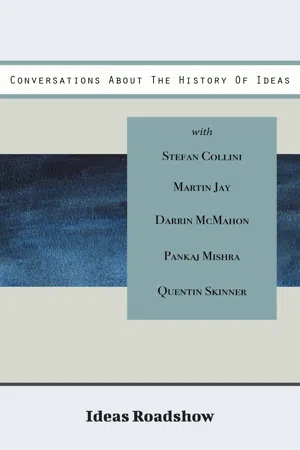
FIVE BOOKS IN ONE! This collection includes the following 5 complete Ideas Roadshow books featuring leading researchers providing fully accessible insights into cutting-edge academic research while revealing the inspirations and personal journeys behind the research. A detailed preface highlights the connections between the different books and all five books are broken into chapters with a detailed introduction and questions for discussion at the end of each chapter: I. The Two Cultures, Revisited - A conversation with Stefan Collini, Professor Emeritus of Intellectual History and English Literature at the University of Cambridge. The 'Two Cultures' debate of the 1960s between C.P. Snow and F.R. Leavis is one of the most misunderstood intellectual disputes of the 20th century. Most people think that the debate only revolved around the notion that our society is characterized by a divide between two cultures: the arts or humanities on one hand, and the sciences on the other. This conversation provides a careful examination and illuminating insights of what the issues really were in this debate.II. Deconstructing Genius - A conversation with Darrin McMahon, the Mary Brinsmead Wheelock Professor of History at Dartmouth College. The word "genius" evokes great figures like Einstein, Leonardo Da Vinci, Mozart and Shakespeare but what quintessential quality unites these individuals? Can we measure it? Can we create it? This thoughtful conversation explores Darrin's research on the evolution of genius from Plato to Einstein in an effort to illuminate what our evolving genius mythology reveals about the rest of us. III. Turning the Mirror: A View From The East - A conversation with Pankaj Mishra, award-winning author. This conversation covers several of Pankaj's books, including From the Ruins of Empire: The Intellectuals Who Remade Asia and An End To Suffering: The Buddha In The World, and his motivations behind them. Pankaj Mishra also describes how the long shadow of Western colonialism has significantly affected, and still significantly affects, those in the East, giving us revealing guideposts to help us develop greater tolerance and cultural understanding.IV. Pants On Fire: On Lying In Politics - A conversation with Martin Jay, the Sidney Hellman Ehrman Professor of History Emeritus at UC Berkeley. A thought-provoking book in dialogue format examining Martin Jay's extensive research on lying in politics from Plato and St. Augustine to Hannah Arendt and Leo Strauss which culminated in his book The Virtues of Mendacity.V. Quest For Freedom - A conversation with Quentin Skinner, Barber Beaumont Professor Emeritus of the Humanities at Queen Mary University of London. This conversation examines how Quentin Skinner came to appreciate the importance of the distinction between the modern view of freedom and the so-called neo-Roman view, together with what it implies for our current and future political understanding.Howard Burton is the founder and host of all Ideas Roadshow Conversations and was the Founding Executive Director of Perimeter Institute for Theoretical Physics. He holds a PhD in theoretical physics and an MA in philosophy.
- English
- ePUB (mobile friendly)
- Available on iOS & Android
eBook - ePub
Conversations About The History of Ideas
About this book
Information
Subtopic
Roman Ancient HistoryIndex
HistoryQuest for Freedom
A conversation with Quentin Skinner
Introduction
Status Symbols
What does it mean to be free?
That hardly seems like a terribly difficult question to answer. I’m free if I’m unconstrained, unimpeded, allowed to act as I see fit. Simple, right?
Well, maybe.
Quentin Skinner, one of the world’s foremost intellectual historians, admits that the concept of freedom had long befuddled him.
“It began with historical work that I was doing when I was writing my first book, The Foundations of Modern Political Thought. I was working on questions about Renaissance moral and political philosophy and came upon some ideas that, quite frankly, puzzled me, because I was assuming that there would be great continuity in thinking about questions of freedom and citizenship, but there wasn’t. I was coming upon a view that suggested that you could not be a free citizen unless you were a politically engaged citizen.”
It’s not difficult to see the problem. For most of us, being politically active simply has nothing to do with our sense of being free.
In his customarily forthright fashion, Quentin shared with me his intellectual meanderings. Could it be that what he was grappling with was simply a rehashed view of Aristotle’s famous dictum that man was a political animal? That, as a naturally political creature, the free man was the exemplar of the species, the one who best realized his potential and thus was somehow maximally political? That freedom in some way represented some sort of acme of human moral potential?
Perhaps. After all, he admits, there was a good deal of modern precedent for such neo-Aristotelian thinking. The renowned 20th-century philosopher Hannah Arendt, in particular, makes an essential equivalence between freedom and politics.
“For her, freedom just is politics. That is to say, the democratic project of people being thoroughly engaged as citizens is an instantiation and a declaration of freedom. So I started to think that that was what I was confronting.”
But still, things didn’t quite fit. He couldn’t help feeling that the proper way to look at things wasn’t so much a description of human potential, but rather a societal prescription for ensuring that you don’t lose what you’ve already got. In other words, as Quentin puts it:
“The more I read, the more I saw that the claim that was being made was a causal claim. In a way, that seemed more intuitive when I thought about it. The claim seemed to be that if you want to remain free as a citizen, then it’s a causal condition of the maintenance of that freedom that you should actively participate in the life of your community.”
This, Quentin recognized, was a very different kettle of fish than the notion of the free person being unencumbered to perform this or that action. While the word—”freedom”—was clearly the same, writers in the Renaissance and Ancient Rome were actually using it in an entirely different way.
“What the writers I was finding in the Renaissance, and then back to Roman—as opposed to Greek—antiquity wanted to say, is that freedom should not be understood as a predicate of actions, essentially, at all. Freedom is the name of a status. That’s what they wanted us to understand. Their emphasis was not on whether I’m free to do this or that. Of course that was important to them. But what was fundamental to them was the question, Do you have the status of being a free person? That’s the question they’re asking.”
So score one for Professor Skinner’s literary detective skills. But why should we care whether or not classical Romans or Renaissance thinkers used terms like “freedom” differently from the way we do now? Isn’t that just all ancient history?
No. Because Quentin believes truly understanding these classical thinkers might significantly inform our judgements as we grapple with some of today’s pressing issues. When governments spy on our emails, for instance, they don’t just violate our privacy (although they surely do that as well), they cause us—ever so slightly—to think differently, to act differently. We begin to consider leaving things out of our correspondence that could conceivably be regarded as incriminating. We begin to write different sorts of messages altogether—perhaps don’t bother to write them at all. In other words, we start censoring ourselves.
To an ancient Roman, such behaviour could be categorized quite simply: we start acting “slavishly”, rather than as free men.
“Nobody is stopping me, no one is interfering directly with me writing the emails I want to write. But again, that’s the way of thinking about freedom superficially. That’s surface stuff.
“What we’re talking about is something much more fundamental, a democratic citizen thinking, Well, I don’t know if I can really say this anymore. And that’s the point: I don’t know. That’s what it is to live like a slave in a certain domain: you don’t know what might happen to you.”
And if “never knowing what might happen to you” is the lot of the slave, how can the free citizen guarantee that this never happens to her—that her free status is protected? By ensuring that she lives in a society with no arbitrary powers beyond her control—by ensuring that the rule of law applies in all circumstances, and that the law itself is a clear expression of the free citizen’s will.
“What this mandates is a particular form of a very active democratic citizenship as a condition of upholding freedom, but not as a condition of upholding freedom as being left alone to do whatever I want. The freedom that is being upheld is freedom from arbitrary power, because if you’re not free from arbitrary power, you don’t have freedom in this absolutely fundamental sense.”
We’ve arrived, then, at the claim that safeguarding our civil liberties and protecting ourselves from the encroachment of arbitrary powers requires an active participation in the democratic process.
Somehow, from ruminating on the precise motivations of celebrated Renaissance thinkers, we’re led to a core belief about the importance of civic action that you could easily imagine hearing at any Black Lives Matter protest.
If that’s not a palpable demonstration of the ongoing relevance of the history of ideas, I’m not sure what is.
The Conversation

I. Paradoxical Origins
Puzzled by Machiavelli
HB: Let me begin by asking you a personal question about liberty and your interest in political liberty. How did that begin for you?
QS: It began with historical work that I was doing when I was writing my first book, The Foundations of Modern Political Thought. I was working on questions about Renaissance moral and political philosophy and came upon some ideas that, quite frankly, puzzled me, because I was assuming that there would be great continuity in thinking about questions of freedom and citizenship, but there wasn’t. I was coming upon a view that suggested that you could not be a free citizen unless you were a politically engaged ci...
Table of contents
- Textual Note
- Preface
- The Two Cultures, Revisited
- Deconstructing Genius
- Turning the Mirror
- Pants on Fire
- Quest for Freedom
Trusted by 375,005 students
Access to over 1.5 million titles for a fair monthly price.
Study more efficiently using our study tools.
Frequently asked questions
Yes, you can cancel anytime from the Subscription tab in your account settings on the Perlego website. Your subscription will stay active until the end of your current billing period. Learn how to cancel your subscription
No, books cannot be downloaded as external files, such as PDFs, for use outside of Perlego. However, you can download books within the Perlego app for offline reading on mobile or tablet. Learn how to download books offline
Perlego offers two plans: Essential and Complete
- Essential is ideal for learners and professionals who enjoy exploring a wide range of subjects. Access the Essential Library with 800,000+ trusted titles and best-sellers across business, personal growth, and the humanities. Includes unlimited reading time and Standard Read Aloud voice.
- Complete: Perfect for advanced learners and researchers needing full, unrestricted access. Unlock 1.5M+ books across hundreds of subjects, including academic and specialized titles. The Complete Plan also includes advanced features like Premium Read Aloud and Research Assistant.
We are an online textbook subscription service, where you can get access to an entire online library for less than the price of a single book per month. With over 1.5 million books across 990+ topics, we’ve got you covered! Learn about our mission
Look out for the read-aloud symbol on your next book to see if you can listen to it. The read-aloud tool reads text aloud for you, highlighting the text as it is being read. You can pause it, speed it up and slow it down. Learn more about Read Aloud
Yes! You can use the Perlego app on both iOS and Android devices to read anytime, anywhere — even offline. Perfect for commutes or when you’re on the go.
Please note we cannot support devices running on iOS 13 and Android 7 or earlier. Learn more about using the app
Please note we cannot support devices running on iOS 13 and Android 7 or earlier. Learn more about using the app
Yes, you can access Conversations About The History of Ideas by Howard Burton in PDF and/or ePUB format, as well as other popular books in History & Roman Ancient History. We have over 1.5 million books available in our catalogue for you to explore.