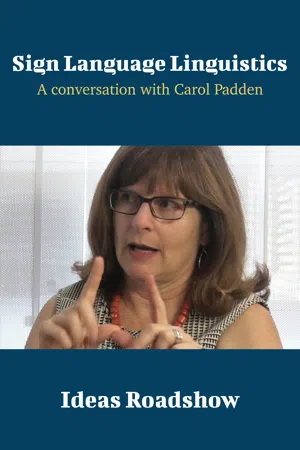
This book is based on an in-depth conversation between Howard Burton and renowned researcher of sign languages Carol Padden, the Sanford I. Berman Chair in Language and Human Communication at UC San Diego. This extensive conversation covers topics such as growing up with ASL, Carol's early work with Bill Stokoe, the linguistic complexity, structure and properties of ASL and other sign languages, the development of new sign languages throughout the world, the role of gesture and embodiment, and much more. This carefully-edited book includes an introduction, Heeding the Signs, and questions for discussion at the end of each chapter: I. Choosing languages - Faulty assumptions and different sidesII. Distance Education - A formative experienceIII. Signing as Language - Bill Stokoe and the development of ASLIV. Diversity and Structure - The many shades of sign languagesV. Distinctiveness - Language, identity, and the question of affordancesVI. Embodiment - Making sense of the world around us through our bodiesVII. A Cultural Window - Change, humour and balanceVIII. Predictions and Proclivities - Speculations on the future, fillers and gender markersIX. Examining Diversity - Brain scans, sign-twisters and gesturing ItaliansX. Making Comparison - Efficiency, community and complexityAbout Ideas Roadshow Conversations Series: Presented in an accessible, conversational format, Ideas Roadshow books not only explore frontline academic research featuring world-leading researchers but also reveal the inspirations and personal journeys behind the research.
- English
- ePUB (mobile friendly)
- Available on iOS & Android
eBook - ePub
Sign Language Linguistics - A Conversation with Carol Padden
About this book
Trusted by 375,005 students
Access to over 1.5 million titles for a fair monthly price.
Study more efficiently using our study tools.
Information
Subtopic
Education Theory & PracticeThe Conversation
I. Choosing Languages
Faulty assumptions and different sides
HB: To begin, perhaps we can talk about how we’re doing this, and some of the difficulties that you were mentioning earlier about the decisions that have to be made when you sit down to do an interview or talk to somebody—the “political issues”, as it were.
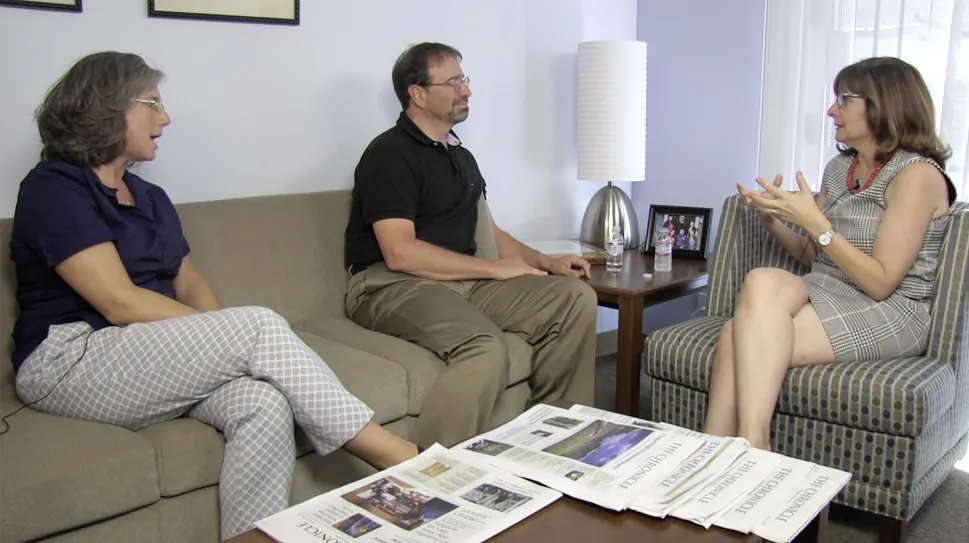
CP: [Speaking] Right. Every time I go into an interview, or if I’m giving a talk, or if I do something spontaneously, I have to decide which language to use. In some situations, if there are a lot of deaf people, I prefer to use American Sign Language.
So, I would just sign [begins signing] like this and allow Mala, my interpreter, to speak for me. This is the most comfortable thing for me. I don’t have to think about how I’m pronouncing a particular word or how I’m going to state certain things because I grew up with American Sign Language, and it’s my first language, my home language. I’m very comfortable with it.
[Speaking] But if I’m in a different situation where, maybe, there aren’t any deaf people there, then I prefer to just speak English without signing, like I did with you when we first met.
However, this means that I’m not available if deaf people are watching the video or watching the event. I have to weigh, Do I use the language I’m most comfortable with? But the voice is not me; it’s somebody else with issues like Well, that’s what other people might be more comfortable with, or might work best in that particular situation. Another issue is that a lot of people have the idea that if you know sign language, then you must use it, because you can’t speak English.
That’s not the case though. So I’d like to switch back and forth so you can hear what I sound like when I’m speaking myself and then hear what I sound like if somebody else is speaking for me.
Mala has worked for me for 12 years, and she knows what words and sentences I like to use, and so forth. So this is the closest thing to me actually speaking, but it has the feeling of a different voice, a different person talking while I’m signing. So I’m just going to switch between these two ways of speaking.
If a topic is perhaps more personal, then I may want to use American Sign Language for that. If we’re talking about technical things—like spoken language and sign language—then maybe I’ll switch to English.
Sometimes there will be a person using American Sign Language and that person doesn’t speak. Sometimes you’re fortunate to have a great interpreter like Mala, but sometimes you don’t have a very good one.
You may think, Does this person really sound like that? You have to remember that the process is one step removed. So I want to illustrate how the same person can sound different, or just slightly a little bit different, depending on what medium she’s speaking in.
I grew up using American Sign Language. Both of my parents are signers, I have an older deaf brother and my parents are deaf, so sign language was completely natural to me. I’ve used it my entire life—so, for me, switching between languages is a natural thing to do. They both feel like they’re me, but they’re different sides of me. You’ll see that when I start signing, I might express myself a little differently than I do when I’m using English.
HB: I’d like to probe you a bit more on this idea of different sides of you. I’ve heard that said by many people who have command of two or more languages. They feel like they are somewhat different people when they speak a different language. But before I do that, and before I go into your personal background, I want to ask a question about what you just said with respect to Mala.
You mentioned how Mala is an excellent interpreter and how you’ve been working with her for 12 years. When you first started working with her, was there this sense of a connection with her that you might not have with other people? Has she changed very much in those 12 years? Did it take 2 or 3 years before you really felt you were on the same wavelength?
CP: Honestly, I can’t remember. I began working with Mala because she’s one of the best interpreters I know. She’s highly qualified and has very good training. I think what happens in the relationship of working with an interpreter, in a job like this, is she understands when I want to sign or use spoken English, when I talk with a person one-on-one or use an interpreter, and so forth. We’ve become accustomed to being in many different situations, so we know what to do and at what time.
But she’s also a linguist by training, so she knows a lot of my vocabulary if I’m signing about something technical. If I have to give a large, keynote talk, I prefer to sign, if I can. I just don’t have to think about it. I feel like I can be more spontaneous.
Whereas if I’m speaking English, I feel like I’m more guarded. It feels like I need to think what the next word will be—maybe not subconsciously, but I feel more protective if I’m doing it in English. I feel like I’m a little bit looser, a little bit more spontaneous, if I’m signing.
But Mala just knows—she’s heard all of my jokes, for example, ten times over. She knows the joke, so she can time it exactly, almost all the time. It’s really about that comfort—when you walk into a situation where people really don’t know anything about signers, or don’t know anything about me, then having the confidence of working with an interpreter I know very well is one less thing to worry about.
HB: What happens when you want to come up with a new joke?
CP: Maybe you should ask Mala.
Mala: I freak out a little bit.
CP: Mala likes to be thoroughly prepared. If I have notes, she wants to read them in advance. But sometimes, in situations like this, we don’t have notes, so we’re flying a little blind here.
HB (To Mala): So you are out of your comfort zone now?
Mala: A little bit.
Questions for Discussion:
- If you see someone signing do you naturally assume that she can’t speak?
- What do you think makes “a great interpreter”? To what extent does it involve more than knowing how the person likes to express herself? Do you think that there’s an objective difference between the act of interpreting from a sign language to a spoken language and interpreting from one spoken language to another?
- Do you feel somewhat like a different person when you are speaking another language?
II. Distance Education
A formative experience
HB: You mentioned having deaf parents and a deaf older brother. My understanding is that you didn’t go into an English-speaking environment until grade 3 or thereabouts. I’d like you to tell me not only how that experience was for you and the impact that it had on you, but I’d also like to get some general understanding of the circumstances. Why did your parents do that at that particular time? What were their motivations, and were they pleased by the result?
CP: My parents are both academics. They’re retired now, but they were both on the faculty at Gallaudet University in Washington D.C. They both graduated from there and then they both became professors. My father was an athlete, so he became a professor of physical education, and my mother was a professor of English literature. As a result, I grew up in a home talking about ideas, talking about teaching, talking about university. Now that I’m working in one, it feels like an extension of my childhood.
But my parents’ life was very different from mine. They both went to boarding schools for deaf children, which was the norm at the time. My dad graduated from Gallaudet in 1945, my mom in 1947. They both went to schools where they lived year-round and only came home on holidays. They grew up in a segregated environment. Deaf people went to special schools and hearing people went to what were called publi...
Table of contents
- A Note on the Text
- Introduction
- The Conversation
- Continuing the Conversation
Frequently asked questions
Yes, you can cancel anytime from the Subscription tab in your account settings on the Perlego website. Your subscription will stay active until the end of your current billing period. Learn how to cancel your subscription
No, books cannot be downloaded as external files, such as PDFs, for use outside of Perlego. However, you can download books within the Perlego app for offline reading on mobile or tablet. Learn how to download books offline
Perlego offers two plans: Essential and Complete
- Essential is ideal for learners and professionals who enjoy exploring a wide range of subjects. Access the Essential Library with 800,000+ trusted titles and best-sellers across business, personal growth, and the humanities. Includes unlimited reading time and Standard Read Aloud voice.
- Complete: Perfect for advanced learners and researchers needing full, unrestricted access. Unlock 1.5M+ books across hundreds of subjects, including academic and specialized titles. The Complete Plan also includes advanced features like Premium Read Aloud and Research Assistant.
We are an online textbook subscription service, where you can get access to an entire online library for less than the price of a single book per month. With over 1.5 million books across 990+ topics, we’ve got you covered! Learn about our mission
Look out for the read-aloud symbol on your next book to see if you can listen to it. The read-aloud tool reads text aloud for you, highlighting the text as it is being read. You can pause it, speed it up and slow it down. Learn more about Read Aloud
Yes! You can use the Perlego app on both iOS and Android devices to read anytime, anywhere — even offline. Perfect for commutes or when you’re on the go.
Please note we cannot support devices running on iOS 13 and Android 7 or earlier. Learn more about using the app
Please note we cannot support devices running on iOS 13 and Android 7 or earlier. Learn more about using the app
Yes, you can access Sign Language Linguistics - A Conversation with Carol Padden by Howard Burton in PDF and/or ePUB format, as well as other popular books in Languages & Linguistics & Education Theory & Practice. We have over 1.5 million books available in our catalogue for you to explore.