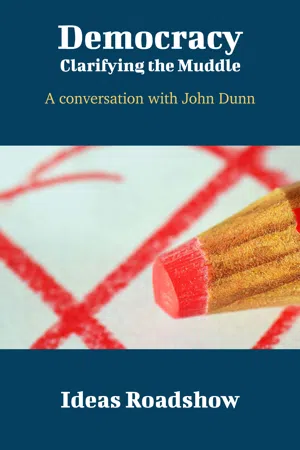
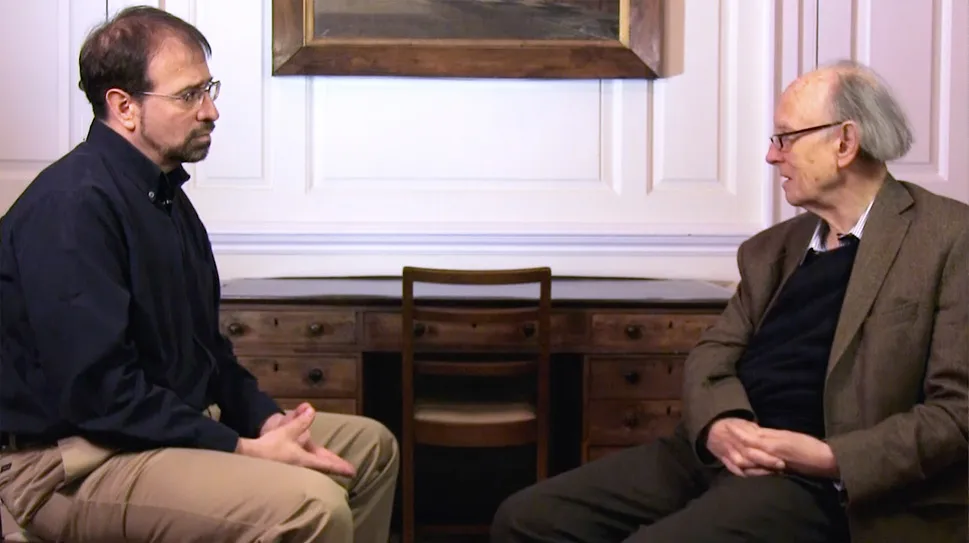
This book is based on an in-depth filmed conversation between Howard Burton and renowned political theorist John Dunn, University of Cambridge. Through an engaging dialogue format, John Dunn candidly shares his deep insights on the historical development and current significance and future of democracy in different parts of the world and the relevance of political science departments in achieving democracy and other worthwhile goals. This carefully-edited book includes an introduction, Democratic Daze, and questions for discussion at the end of each chapter: I. Illusions and Confusions - Unmasking American stereotypesII. Historical Examinations - The power of etymologyIII. Thinking Deeper - Minimizing political badsIV. Trust and Belief - Thinking criticallyV. China - Challenging Western ideals?VI. India - The world's largest democracyVII. Power to the People - Overthrowing autocracy and what happens nextVIII. Towards Progress - Why we should care about all of thisIX. Professional Indulgence - Critically examining "political science"About Ideas Roadshow Conversations Series: This book is part of an expanding series of 100+ Ideas Roadshow conversations, each one presenting a wealth of candid insights from a leading expert in a focused yet informal setting to give non-specialists a uniquely accessible window into frontline research and scholarship that wouldn't otherwise be encountered through standard lectures and textbooks. For other books in this series visit our website: https://ideasroadshow.com/.
- English
- ePUB (mobile friendly)
- Available on iOS & Android
eBook - ePub
Democracy: Clarifying the Muddle - A Conversation with John Dunn
About this book
Information
Subtopic
WeltgeschichteThe Conversation
I. Illusions and Confusions
Unmasking American stereotypes
HB: You’ve been talking and writing about democracy for some time; and in your book, Breaking Democracy’s Spell, you discuss such notions as “the spell of democracy” and “the veil of democracy”. What are you talking about here, exactly, and why is this an important thing to be concerned with?
JD: Well, it’s an important thing to be concerned with because democracy as a word and an idea has a unique political force in the world. And an awful lot of people’s political responses are in the end organized in one way or another in response to its presence.
I got interested in it pretty accidentally—it wasn’t because I had some special insight—but I’ve spent a lot of time thinking about it and trying to understand what’s been happening in it. And I think I’ve understood something very important about it that isn’t generally understood: namely, how it’s come about that it’s so prominent and that it has the sort of effect it does have on people’s political comprehension.
People can only understand politics through ideas: they can’t understand it just by looking or smelling. And the ideas through which they try to understand it mostly don’t help very much. In fact, very many of these ideas actively impede understanding politics—and, in fact, are meant to impede understanding of it.
HB: But if I’m an American sitting here listening to this, I might say, “Well, I know what democracy is, and I know democracy is an important thing. It’s what my republic is based on.”
I might even think that it was a motivating force in the generation of my republic, but at any rate I’m likely convinced that it’s the right way to do politics and the model through which we should enlighten the rest of the world. That’s a fairly common view, I think, that your average American would have: that we should export democracy to the rest of the world, that we should encourage other people to be democratic.
And my reaction to you might be some combination of bemusement and hostility: “What’s your problem, exactly, Professor Dunn? Are you an anti-democrat, somehow? You don’t believe in democracy? What is all this talk about ‘breaking the spell of democracy’, trying to change my views? Why should I pay attention to all of that?”
JD: Well, you should pay attention to it because your views are wrong.
That’s the best reason for paying attention to someone, if your views are what’s in question. I don’t think that I can show you exactly what the right views for you are, because that depends a lot on you, and what you’re actually concerned with, and very complicated judgments about the world that you shouldn’t take on trust from me or anyone else.
But what is definitely true is that the way Americans think about democracy is very, very grievously mistaken, and it’s mistaken in a number of different ways.
First of all, it isn’t true, historically, the story you’ve just recited to me. It isn’t true that the American Republic was founded on the idea of democracy. The American founders were extremely sceptical of democracy, and they thought it referred to a very bad form of government. And they very actively and militantly argued against allowing anything that would appropriately be described with that word to operate in the United States.
There are one or two momentary exceptions—the most striking of which was something that Alexander Hamilton once said. Alexander Hamilton is normally regarded by American historians as the most spectacularly antidemocratic political agent and political thinker in the history of the United States and someone who built the United States as a state that had all the wrong purposes for it to be a democracy, because a democracy in that sense is a soft responsive structure that cares for everyone equally, and it’s liable to be paralyzed because of its cares and not to be very effective at doing anything.
Alexander Hamilton started off in the opposite direction, really. He began with the question of how to make the United States into a strong enough state to actually protect itself and thrive in a world in which it will very often be living with what are, essentially, competitors and enemies. And the United States that emerged—a United States which for a time was very clearly the most powerful state in the world and is still the most powerful state in the world by a sort of receding margin for a variety of reasons—the United States that came about was the sort of state, very broadly speaking, that Hamilton had in mind, and not at all the sort of state that some of the other founders had in mind.
But Hamilton did, at one point, call the United States that he was attempting to generate “a representative democracy”. He didn’t call it that in the context of arguments about what it should be like. He just used the phrase. And a lot of what is said by the most intellectually powerful and politically influential founders about democracy is straightforwardly dispraised.
HB: And if you look at something like the Electoral College, for example, which comes into prominence every so often when there is the spectre of a presidential candidate winning the Electoral College vote without winning the popular vote, that should trigger an acknowledgement of the fact that the founders framed a system that was not manifestly democratic.
JD: Well, it was intended to prevent certain bad things from happening which democracy as a political form was believed to make particularly likely, or even completely inevitable. So you can see it’s a muddled way to think about the relationship between what those people were trying to do and democracy to say that the United States Republic was built as a democracy and to be a democracy. It just wasn’t.
What, I think, is very important about American political beliefs about this word is that those beliefs are based on the idea that there is one correct way to understand democracy—which is the way Americans understand democracy and the way in which their own political institutions are structured—and that these specific political institutions are, in principle, the correct ones for everyone.
Now that’s certainly not what the idea of democracy means in any coherent understanding of its historical trajectory or of what the idea itself could possibly mean.
The idea couldn’t possibly mean, The Americans have a way of doing something which is the way for everyone to do it, irrespective of how everyone else thinks and feels and believes.
The fundamental concept of democracy means that, in any place where it applies, what will be true is that the people of that place decide what they want and can be guaranteed that that will be what happens.
That’s a very demanding idea. It doesn’t plausibly get realized anywhere ever; but it’s less obviously false in some settings at some times than it is in others at other times.
Take an important recent example. If you look at Gaza, the Gaza bit of...
Table of contents
- A Note on the Text
- Introduction
- The Conversation
- Continuing the Conversation
Trusted by 375,005 students
Access to over 1.5 million titles for a fair monthly price.
Study more efficiently using our study tools.
Frequently asked questions
Yes, you can cancel anytime from the Subscription tab in your account settings on the Perlego website. Your subscription will stay active until the end of your current billing period. Learn how to cancel your subscription
No, books cannot be downloaded as external files, such as PDFs, for use outside of Perlego. However, you can download books within the Perlego app for offline reading on mobile or tablet. Learn how to download books offline
Perlego offers two plans: Essential and Complete
- Essential is ideal for learners and professionals who enjoy exploring a wide range of subjects. Access the Essential Library with 800,000+ trusted titles and best-sellers across business, personal growth, and the humanities. Includes unlimited reading time and Standard Read Aloud voice.
- Complete: Perfect for advanced learners and researchers needing full, unrestricted access. Unlock 1.5M+ books across hundreds of subjects, including academic and specialized titles. The Complete Plan also includes advanced features like Premium Read Aloud and Research Assistant.
We are an online textbook subscription service, where you can get access to an entire online library for less than the price of a single book per month. With over 1.5 million books across 990+ topics, we’ve got you covered! Learn about our mission
Look out for the read-aloud symbol on your next book to see if you can listen to it. The read-aloud tool reads text aloud for you, highlighting the text as it is being read. You can pause it, speed it up and slow it down. Learn more about Read Aloud
Yes! You can use the Perlego app on both iOS and Android devices to read anytime, anywhere — even offline. Perfect for commutes or when you’re on the go.
Please note we cannot support devices running on iOS 13 and Android 7 or earlier. Learn more about using the app
Please note we cannot support devices running on iOS 13 and Android 7 or earlier. Learn more about using the app
Yes, you can access Democracy: Clarifying the Muddle - A Conversation with John Dunn by Howard Burton in PDF and/or ePUB format, as well as other popular books in Politik & Internationale Beziehungen & Weltgeschichte. We have over 1.5 million books available in our catalogue for you to explore.